In today’s newsletter: The government has approved drilling in the Jackdaw gas field despite fierce opposition and evidence against it
Good morning. After weeks of speculation, the secretary of state for energy and net zero, Miatta Fahnbulleh, approved drilling in the Jackdaw gasfield this morning. In a statement, published a few minutes before today’s First Edition, Fahnbulleh stressed that the government remains “resolute” in achieving net zero by 2050. It has also announced a new wealth fund that will invest tax revenues from North Sea oil and gas into low-carbon projects.
Even so,Fahnbulleh’s decision will be a monumental disappointment for climate campaigners (and I’d bet many readers of First Edition, too). So this morning’s newsletter is about two things: why the government approved Jackdaw, despite all of the arguments marshalled against it, and, in an attempt to strike a more hopeful note, what it can do to reduce the UK’s reliance on fossil fuels. That’s after the headlines.
UK news | During the Covid-19 pandemic, and government failures caused the virus to spread “like wildfire” among vulnerable and elderly people, a public inquiry has found.
Europe news | Italy’s government is sending 500 soldiers to Milan and vowed a “firm response from the state” after protests against the cost of living descended into clashes with police, vandalism and looting.
Ukraine | The US has resumed sharing intelligence with Kyiv about Russian missile strikes, Volodymyr Zelenskyy said after a meeting with the US envoy Steve Witkoff in Norway.
Media | Television channels BBC Three and BBC Scotland are to close and the Radio 4 Extra radio station will be scrapped, as part of the corporation’s drive to cut £500m in costs.
UK news | RAF Typhoon fighters are to be used in efforts to protect Saudi Arabia from attack by Yemen’s Houthis, as western allies increase their intervention in the escalating conflict.
Action needed to avoid disastrous overshoot of climate targets, according to organisation’s environment body
The world needs to cut carbon emissions by nearly a fifth in the next four years, and by close to half within a decade, to avoid overshooting climate targets by a disastrous margin.
Although the “window has closed” on holding temperature rises to 1.5C, in line with scientific advice, limiting the “overshoot” of that target is still possible, according to the UN Environment Programme (Unep).
The U.S. is the only major economy where planet-warming pollution dramatically increased last year. The United Nations warns the planet is on track for catastrophic warming.
A decades-long mystery beneath the North Sea has finally been solved. Scientists have confirmed that the Silverpit Crater, buried 700 meters below the seabed, was created when a 160-meter-wide asteroid struck Earth roughly 43 to 46 million years ago. The violent collision blasted a towering curtain of rock and water 1.5 kilometers into the air and triggered a tsunami more than 100 meters high.
New independent modelling by Fraunhofer ISI shows that implementation of the Clean Corporate Vehicles Regulation could deliver up to €48bn in value creation and 344,000 jobs by 2030. CCVR and IAA explained The CCVR sets binding minimum targets for zero- and low-emission vehicles (ZLEVs) among large companies’ new car registrations: ... [continued]
Today, we are excited to announce that Waymo is laying the groundwork for our fully autonomous ride-hailing service in Spain, beginning with the Region of Madrid. With over 20 million trips completed and hundreds of thousands of commercial rides served each week, we are excited to be a part of ... [continued]
Setting targets on companies to go electric and limiting financial support only for company cars that are electric and Made-in-EU would see economic gains of €20 bn and boost investments by €18 bn EU-wide electrification targets for large fleets, combined with limiting national fiscal benefits only to electric Made-in-Europe company ... [continued]
From the air, Wainwright, Alaska, looks like a perfectly stable band of homes and roads between the Chukchi Sea and a vast, flat tundra. But just below the surface, the frozen ground that this town was built on contains large bodies of ice. Along the eroding coastal bluffs, that hidden ... [continued]
By Melissa Flaherty, Director of Sustainable EV Battery Ecosystem, GM When it comes to EV batteries, most of us start with the same questions: How far can I go on a charge? How long will my battery last? Those are fair questions. But here’s something that might surprise you: powering ... [continued]
Jackdaw, a natural gas field off the coast of Scotland, would be the first new gas extraction project in the North Sea since a government moratorium in 2024.
This report is a collaborative effort based on the input and analysis of the following individuals: Research team Jocelyn Kiley, Director, Political ResearchSteven Shepard, Associate Director, Political ResearchHannah Hartig, Senior ResearcherBaxter Oliphant, Senior ResearcherGabe Borelli, Research AssociateAndrew Daniller, Research AssociateAndy Cerda, Research Analyst Shanay Gracia, Research AnalystTed Van Green, Research Analyst Communications and editorial Nida […]
The American Trends Panel survey methodology Overview Data in this report comes from Wave 200 of the American Trends Panel (ATP), Pew Research Center’s nationally representative panel of randomly selected U.S. adults. The survey was conducted from Sept. 28 to Oct. 4, 2026. A total of 5,062 panelists responded out of 5,835 who were sampled, […]
This past weekend was the latest in an ongoing series of (massive) “No Kings” protests held around the country (and in some cases around the globe). The latest one was part of a “get out the (early) vote” campaign to make sure people are voting in the upcoming midterm elections. And, in the middle of it, suddenly it was reported that the No Kings Instagram account was suspended for about an hour, with admin access locked out for a few more hours. Many supporters of the protests immediately suspected foul play, highlighting that Mark Zuckerberg has gone in hard in supporting Trump over the past couple of years. So, the implication was that Zuck must be fiddling the dials to help the guy he supports in the White House. For a variety of reasons, this is unlikely to be true.
I’ll explain some of those reasons towards the end of this article just to be thorough, but the point of this article is to highlight the argument that Will Robinson and Tim Chambers recently made in response to this, which is that it doesn’t even matter if it was done on purpose or not. Even if you believe that Zuckerberg and Trump were laughing their heads off and jointly pressing the button to silence the No Kings account, the real problem was that this was possible in the first place.
Our response should be the same either way.
Robinson and Chambers focus on the very practical lessons for anyone engaged in digital organizing, which is how to prepare for the possibility that a centralized provider takes down your account. And their advice is good and practical (read the whole thing!): make sure you have communication channels that a third party can’t easily switch off, set up accounts on open platforms, and have a playbook on how to respond (mostly getting out the word) if your account gets shut down.
But it’s also a reminder of the larger point that I have been harping on for some time about the importance of decentralization and user control over their online experiences. Centralized systems create a natural gravity that leads to control over your speech. My friend Danny O’Brien (who also helped inspire Techdirt’s very existence) wrote a few years ago about how decentralization is not an end in and of itself, but rather part of the means to guarantee we have “cognitive liberty.”
When we hand over the control of our speech to a third party, with no ability to exit (with all of our content and connections intact) we have given up a fundamental element of our liberty. O’Brien describes it here:
Right now, if you wrote a note to yourself and put it on your personal computer’s hard drive, you could say whatever you want, draw whatever you want. If it’s in the cloud, you don’t have that guarantee: even if you kept it in your own Google Drive or DropBox, it could be found wanting, and deleted. I don’t know about you, but my notes are my memory, most of the time. My search engine searches are as much me talking to myself about my worries and interests, in a way that I would rarely disclose even to my closest companion.
[….]
Our own consciousness cannot be rented from others, or temporarily conceded to us, with built-in police or backdoors or hidden ad men. We need to seize the means of computation, and that means ejecting all of these interlopers, and relocating it back into the personal domain we control: whether that’s physically, or by using tools like encryption and zero-knowledge proofs to preserve our control when our data and processing power sits on others’ hardware.
That’s the pyramid of digital rights for me: a firm foundation of decentralized, user-controlled technology, giving us broader cognitive liberty, internal privacy, freedom of self-expression, and freedom of self-determination. On top of that solid ground, we can build a society that’s free and fair. And then we can have the ability and freedom to self-reflect, to talk, and to plot our better shared future together, free at last in our digital environment.
Achieving that kind of freedom for “cognitive liberty” requires us to recognize the threats of centralized systems. And Meta shutting down the “No Kings” Insta account is one such example no matter if it was on purpose or an accident. This was the very thinking behind my original Protocols, Not Platforms paper in the first place. If you hand control of your digital spaces to someone else, they get to decide whether those spaces exist at all.
And they might be bad at it, whether through incompetence or malice.
And sometimes that means your account gets shut down — whether for good reasons or bad. Many people seem to not want to grapple with this issue. They say “the people are there,” and that is true, but only because the “people” have agreed to give Mark Zuckerberg and whoever else that power.
Unfortunately, most of the “solutions” to this problem that people are suggesting are some form of “force Mark Zuckerberg to be better and not shut off the account we like.” But that’s no way to build a better world. It is, also, the exact same response that MAGA folks had when Donald Trump was banned from social media in the wake of the January 6th insurrection. Their response was to try to force platforms to host the content of people MAGA supported. That cannot be a workable solution, because as political fortunes shift, forcing platforms to host the worst people’s accounts is unworkable for basically everyone.
But there is a better solution: build tools that are open, decentralized, and user controlled. And then actually use them instead of just giving more power to Mark Zuckerberg to shut down a protest organization’s account in the middle of one of its big protests.
Is it bad that Meta pulled down that account? Sure. Do you fix it by demanding Zuck “be better”? No. That just gives him even more power, while reducing some of our own power. Whoever has the power over the systems — whether it’s a billionaire CEO or a government official — has the ability to cut you off (or to force others into your feed).
Even if it gets people you support back on the platform you want them on, you’re just setting yourself up to be angry the next time someone you don’t trust is in power. The answer is to make sure they don’t have that power in the first place.
When I discussed this on Bluesky, some people claimed that it was fine for Congress to “investigate” what happened with the No Kings account to find out if Zuckerberg was told by government officials to remove the account. Connecticut Senator Chris Murphy announced he intends to have Congress investigate Meta over this.
But the right way to look into that is for Congress to use its oversight powers over the executive branch to find out whether any administration officials contacted Meta about the account. This is also where something like the JAWBONE Act would be handy. But any approach that has elected officials (or any government officials) pressuring companies to moderate the way they prefer is only going to blow back on you the next time people you don’t like are in power. As far as I can tell, there is no one who supported Jim Jordan’s investigation into Meta & Twitter’s moderation practices in taking down Trump’s account who are equally excited about Murphy now investigating this.
And that should be a warning. When you choose if you agree with the policy based on which “team” is pushing for it, that’s not a principled take.
But we don’t have to live in that world where we pingpong between this or that government official and which billionaires they can bully (even when you agree with the bullying). This is why supporting decentralized tools like atproto or ActivityPub is more than a matter of taste. Those systems make this kind of takedown far harder and far less damaging, giving you the same kind of reach while you retain the “cognitive liberty” and the ability to truly own your own account.
As for this particular case, as far as I can tell, there’s very little likelihood that this was done deliberately. First, these kinds of mistakes happen all the time. Most people who haven’t worked in trust & safety at a large platform cannot fathom the sheer scale of what’s happening on any given day. Hundreds of millions of pieces of content show up every single day. If less than 1% are incorrectly moderated, that’s still a huge absolute number.
And, yes, people are pointing to other stories of bad Meta moderation in the past week to find some sort of pattern, but the key pattern is Meta will always be bad at this. It was bad at it before — back when MAGA folks insisted Zuck was “censoring conservatives” — and it’s bad at it now. Because getting this right at that scale is not something that is humanly possible.
And an account like No Kings probably saw a massive upswing in attention the day of its protest — the first No Kings protest in a little while — which is the sort of thing that often trips the automated sensors. Meta’s explanation is unsatisfying to many, who are quite sure there’s a conspiracy afoot, but it fits with the pattern. The company initially claimed increased activity by the account, and then later clarified that the real trigger had been a surprising jump in “reading” other posts from that account, which matched the pattern of “automated bot traffic rather than an ordinary human browsing our system.”
That’s not surprising. Even as the No Kings organizers say they hadn’t posted that much, it’s not about the posting. Meta’s explanation for the jump was that they detected “a Claude tool” (which, yeah, is odd phrasing):
“Specifically, our network security systems detected the use of a Claude tool reading profiles, posts, and hashtags, the rate of which sharply increased (~4x volume) in intense bursts on October 17. “
That seems entirely reasonable. Someone with access to that account (and it may be multiple people) may have been using Claude to try to monitor posts and mentions, or looking for protest photos and videos from around the country to share and repost.
Or, it could just be that Meta’s automated systems suck.
Indeed, another complaint that people made is that “it shouldn’t have taken them that long to reinstate the account.” And, yes. That’s true. But the underlying assumption behind this is that the one hour response time to reinstate and the four-ish hours to return access is somehow out of the ordinary. Chances are it’s actually quicker than normal. And we have no idea how many other mistakes Meta’s crap automated systems were making at the same time, many of which probably also needed to be reviewed. Just because you only were aware of one in the one area you were paying attention to does not mean it is not happening to thousands of others as well.
On Bluesky, someone argued that Meta “should know” to keep an eye on “big political accounts” like this, which is nice in theory, but as I explained, Meta actually did that for years, in a program they called XCheck, which flagged high-profile accounts (i.e., “big political accounts”) for secondary human review before any action was taken against them — exactly what this commenter suggested. But.. when Frances Haugen leaked that to the WSJ, it was presented as Facebook having “a secret elite that is exempt” from its rules.
There’s even a movie in the theaters right now, by Aaron Sorkin, with this as one of the subplots.
Damned if you do, damned if you don’t.
But the biggest reason I don’t think this was deliberate is because… why would anyone think it would help in any way? Of all the accounts the Trump admin might want to ban, does anyone actually think they would suggest this one account on Instagram of a protest that was already happening across the country, with people involved who would immediately notice the account was taken down and use other means to get the word out?
If the Trump admin were actually telling Zuck to take down accounts, you’d expect it to be happening a lot more frequently, to much more meaningful accounts, in ways that wouldn’t so immediately draw way more attention to the original account. The story just doesn’t hang together in any sensible way.
Still, some will argue, perhaps it wasn’t the White House reaching out. Perhaps it was just Zuck or a Zuck minion thinking “gosh I hate all these protestors, and now that we’re all in for Trump, let’s show these libs a thing or two….” While possible this seems incredibly hamfisted and unlikely, and generally not at all how these systems work.
Either way, if you think I’m hopelessly naive, and that this was obviously government intervention, or even just Zuck deciding on his own to show the protestors who’s the boss… the outcome doesn’t change. And what we do it about it doesn’t change. The intent barely matters here at all.
In either scenario the problem is that Zuck has too much power, and the answer should be to make sure Zuck has less power by moving to systems no single billionaire, no single politician, no single entity anywhere can control. Yes, that will involve some form of collective action. But it starts with you. If you are continuing to rely on such platforms yourself, then don’t whine about how Zuck might not have your best interests in mind.
We already know that.
Any plan that involves demanding billionaires become better people to make your life easier is destined to fail. Instead, we now have the power to build our own tools on our own systems that we control — and we can make them billionaire resistant, which makes them enshittification resistant. And then we don’t even have to worry about Zuck or Trump or Musk or anyone putting their fingers on the scale in a way that goes against our own interests.
But it only happens if people agree to stop giving those billionaires the power over us.
Whether Zuck or Trump or anyone had anything to do with deliberately taking down the No Kings account should be the least of our concerns. The fact that anyone is relying on a system where there is a central provider who can do that — by accident or not — is the underlying problem. Because the fact that a single provider can do it, means that eventually someone will try to pressure them to do it, even if that didn’t happen in this case. Or it will go down by accident at exactly the wrong moment. Either way, you avoid that by moving to systems where no single provider gets to make that call.
No kings is a great slogan, but it should apply to the people who control our communications infrastructure as well.
The reversal comes after environmental and Indigenous rights groups pushed the bank to acknowledge environmental concerns. More watchdogging of development banks is on the horizon, they say.
By Georgina Gustin
The world’s development banks continue to finance expansions of large climate-polluting livestock operations, but environmental advocates are notching a victory after they say the World Bank’s private lending arm has withdrawn funding for a controversial feed mill in Brazil.
Many cities around the world are sinking because too much water is extracted from the groundwater reservoirs beneath them. This sinking makes these coastal cities more exposed to rising seas as the climate warms. But as our new research shows, this process can work in reverse; when groundwater is replenished, ... [continued]
For much of the climate-policy era, national self-interest and climate action could plausibly point in different directions. A country could let others spend more on emissions reductions while continuing to use familiar coal, oil and gas infrastructure at home. When the low-carbon alternatives were expensive, limited or immature, that could ... [continued]
A new study reveals that improved hurricane forecast graphics may help people identify threatened areas without making them more likely to recognize the danger or take protective action. Researchers also found that a widespread misunderstanding of the hurricane cone persists, highlighting a potentially dangerous gap between accurate forecasts and public preparedness.
Legendary anchor and foreign correspondent Christiane Amanpour announced Monday that she would leave CNN next year after more than four decades at the cable network. “After thinking carefully for several […]
For this issue, we’re revisiting an important topic we originally covered two years ago; in the interim, this crisis has only gotten worse.
The cost of US home insurance has risen nearly 50% nationwide over the last five years as the frequency and severity of extreme weather have increased, driving up costs to repair, rebuild, and replace damaged homes. It’s not just that premiums are skyrocketing, as companies pull out of high risk areas (or simply go broke), it’s becoming harder to find insurance.
Given that someone has to foot the bill, with insurers worldwide paying out more than $140 billion in claims relating to natural catastrophes in 2024 — many homeowners are seeing higher premiums in areas that haven’t been hit by major disasters. A paper published earlier this year found that climate change is already costing U.S. households between $400 and $900 a year, with insurance being one of the most direct ways a warming planet hits your wallet. With affordability being on top of mind of voters, report on how much this insurance crisis is costing homeowners and investigate whether they know of the root cause of their rising premiums.
– David Dickson, CCNow
Reporting Tips
This edition’s tips come to you from Chase Cain, an award-winning meteorologist and former climate reporter for NBC. Chase is now an independent meteorologist and journalist telling stories on his YouTube show “Chase What Matters,” which focuses on the intersection of the weather, climate, and nature.
Last month, Chase and other US-based independent journalists collaborated on a pop-up reporting project about housing and climate change called ‘Betting the House’. (CCNow advised and supported the project.)
The insurance crisis doesn’t just affect homeowners. Tens of millions of Americans rent. What happens to the people when they’re forced out of their homes by rising insurance costs? They rent. Or move somewhere less risky. We’re not building housing fast enough to meet demand, and rents are already on the rise. The cost to rent will only increase as climate-amplified disasters and risk force more Americans to move.
Entire communities are now uninsurable due to climate change. “Forced coverage” — also called “force-placed” or “lendor-placed” insurance — is when a homeowner can’t get insurance because the risk is too high, so their mortgage company forces coverage. That insurance is often more expensive than the monthly mortgage payment, and for most people, that means they can no longer afford their home — sometimes overnight. That financial Catch-22 forces homeowners to either sell quickly or wait for foreclosure. That’s already happening in many states.
Your tax dollars might be insuring the riskiest places to live. Maybe you’ve heard about when state-funded insurance companies — called “insurers or last resort” — step-in when private insurers won’t cover certain zip codes (or entire states). The state plans vary widely, and they’re not all popular. This is absolutely a topic worth investigating through FOIA requests and homeowners’ experiences.
Insurance companies have insurance too. You’ve probably heard of State Farm, Allstate, or Farmers Insurance. But have you heard of Swiss Re, Munich Re, or Lloyd’s? They’re the companies that insure your insurance company. In my experience, reinsurers are rich with data, research, and a willingness to talk. Because they don’t answer directly to homeowners, I’ve found they’re far more willing to discuss the drivers, problems with, and potential solutions to our insurance crisis.
We all have an emotional attachment to home. If a stranger told you to move-out of your home of 20 years, how would you feel? What if an insurance company made it so you couldn’t afford to stay, how would you feel? Watching our communities change, fade, or vanish because of the consequences of climate change bears an emotional toll. Explore this angle with the help of psychologists or mental health experts. That was also the foundation of my recent story about the challenges facing New Orleans that was part of a “pop-up” collaboration supported by CCNow.
Stories We Like
Grist examines how an overlooked race for California’s insurance commissioner could shape how the state adapts for future climate disasters.
In Florida, some homeowners are risking it all — going into hurricane season uninsured as some homeowner’s insurance has increased by over 1,000% over the past several decades, the Miami Herald reports.
High Country News covers how scientists are working to better understand how climate change is increasing hail risks — the main factor driving up insurance premiums across much of the US.
Even if you haven’t suffered direct damage, you’re likely paying for increasingly extreme weather. Yale Climate Connections explores this nationwide issue and possible solutions to avoid a looming insurance crisis.
Explore the racial inequality in the rising costs of insurance. Homeowners in predominantly Black and Hispanic zip codes are charged significantly more for the same home insurance coverage than homeowners living in predominantly white zip codes, according to a new report from the Consumer Federation of America.
Check out the database of US Billion-Dollar Weather and Climate Disasters, once gathered by NOAA, now hosted on Climate Central’s website.
Dave Jones, director, Climate Risk Initiative at UC Berkeley School of Law’s Center for Law, Energy & the Environment (CLEE), and former insurance commissioner for California
Carolyn Kousky, founder and executive director, Insurance for Good
Jesse Keenan, associate professor, Tulane University
In both terms, Trump has rolled back or blocked attempts to reduce highly warming methane emissions from the oil and gas industry.
By Dylan Baddour
In the Permian Basin of West Texas, methane gas billows from oil wells. It blasts out of pressure valves on pipelines, wafts from sprawling gas processing plants and rises up in plumes when companies air out systems during routine maintenance in the nation’s largest oilfield.
The deal struck by Donald Trump with his Russian counterpart, Vladimir Putin, on October 9 to allow Russia to sell millions of tonnes of diesel is a major departure from US policy and runs counter to Ukrainian and European interests. It also directly contradicts a law signed by the US ... [continued]
In the third quarter of 2026 (3Q26), 23% of new light-duty vehicles sold in the United States were hybrid electric, battery electric, or plug-in hybrid electric vehicles, down slightly from 24% in 3Q25. Between 3Q25 and 3Q26, hybrid electric vehicles continued to gain market share, reaching 16% of light-duty vehicle ... [continued]
Chemistry is politically agnostic. It can give us wondrous new products, like nylon and Dacron, but it can give us destructive products like napalm and Agent Orange. Here are two stories in the news that came clattering into the teletype machines in the third sub-basement at CleanTechnica world headquarters today. ... [continued]
Spring Hill, Tennessee is blazing a new trail in battery technology, as Ultium Cells LLC — a joint venture between General Motors and LG Energy Solution — just announced plans to produce lithium manganese rich (LMR) prismatic battery cells at its plant just outside Nashville. This is expected to make ... [continued]
By Shilpan Amin, Global Chief Procurement and Supply Chain Officer, GM Long before electric vehicles became a familiar sight on American roads, General Motors engineers were developing technologies that help make today’s EVs possible. One example sits at the heart of a modern electric motor: the permanent magnet. In the ... [continued]
FracTracker and Public Citizen identified 35 permitting actions taken by regulators in Texas in the weeks after Gov. Greg Abbott ordered a moratorium.
By Dylan Baddour
Regulators in Texas did not stop processing permits for data center projects when Gov. Greg Abbott ordered a pause last month, according to an analysis of public records released Monday by the oil and gas watchdog group FracTracker.
Concerns about siting, water and electricity demand have led to calls for more oversight of data center construction in the Cowboy State, but not alignment on how to achieve it.
By Jake Bolster
CODY, Wyo.—On a warm October evening at a bar in downtown Cody, Wyomingites gathered to ponder the future of what some hope will be the Cowboy State’s next booming industry: data centers.
The Reynolds Journalism Institute’s Student Innovation Fellowships are designed to be mutually beneficial. Missouri School of Journalism students spend each summer gaining real-world experience in news organizations across the country, while the organizations themselves get help on innovative projects that engage audiences, incorporate new technologies, address gaps in coverage and more.
Scientists monitoring the deep ocean near the disaster site found that animal populations declined by as much as 80 percent, with little evidence of recovery.
By Bob Berwyn
Across hundreds of miles of the northern Gulf of Mexico, a deep-water ecosystem collapsed after the massive 2011 Deepwater Horizon oil and gas spill, and recovery is uncertain, new research concludes.
Florida governor has consistently opposed any legislation to curb planet-heating emissions, calling it a ‘radical climate agenda’
A life-sized statue of Ron DeSantis, the Florida governor, was unveiled and promptly began melting in front of an audience in Tallahassee in a symbolic protest at his rejection of action on the climate crisis.
The silvery statue, revealed to an audience of onlookers last week, melted away to show a skull under DeSantis’s face. The structure was cast from solid gallium, a metal that melts at 85.6F (29.8C), which is below summertime high temperatures frequently reached in Tallahassee, Florida’s capital.
Soon as we skirted that ridge, the skies opened. Then it got colder. A lot colder.
Riding wide
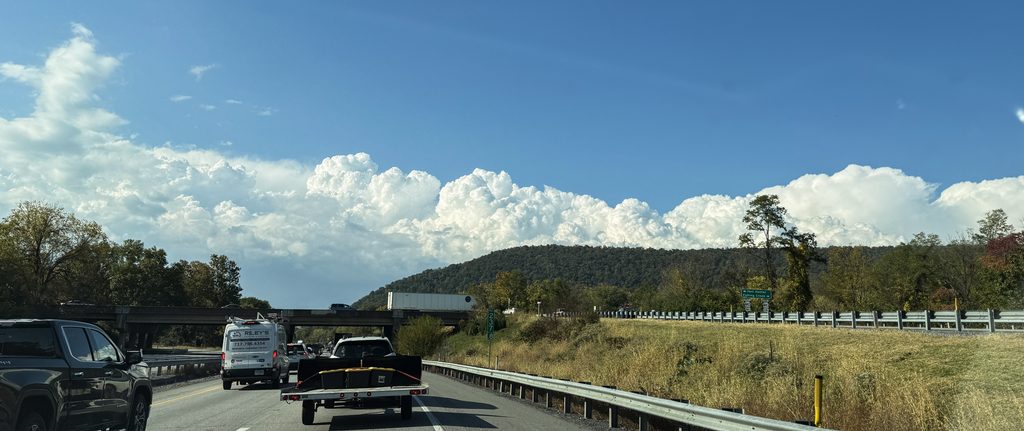
On the road for a while. Above is a storm coming over Elk Country in north-central Pennsylvania. After that, Elk Country, Ohio, and back to Indiana, by RAV4.


 This edition’s tips come to you from