A new report documents widespread contamination of waterways across the country by “forever chemicals,” which have been linked to cancer and other health problems.
By Amy Green
A new report suggests dozens of “forever chemicals” linked with cancer and other human health problems are prevalent in Florida waterways, reflecting widespread contamination of the toxic chemicals in streams, rivers and lakes across the country.
Climate change is contributing to declines in the state’s fisheries and opposition to oil and gas development, two top issues in the election.
By Nicholas Kusnetz
If you listen to the candidates running for the U.S. Senate seat in Alaska, some of the biggest issues in the race revolve around the state’s fisheries, its oil and gas development and soaring prices for fuel and other staples.
People succumbed to heat at highest rates in Malta, Italy and Hungary, with health issues, loneliness and poverty exacerbating toll
Heat killed a record 50,000 people in European cities this summer, new research suggests, with scientists blaming climate breakdown for two in every three of the deaths.
Morgues and funeral homes filled with bodies from June to August as the heat added by planet-baking pollution cut short an extra 32,000 lives in urban areas, the researchers found. Hot days pushed vulnerable bodies into overdrive and warm nights prevented them from recovering.
Series A led by VXI Capital, with backing from the people who built modern solar, including founding Enphase CEO Paul Nahi, former SunPower CEO Tom Werner and former New York energy czar Richard Kauffman Nine years in the making, Optivolt’s energy intelligence turns passive solar hardware into adaptive power systems ... [continued]
The Battery Show North America 2026 in Detroit, Michigan wasn’t about the next breakthrough. It was about who can deliver. Each fall you can learn a lot about the battery industry by walking through the halls of Huntington Place in Detroit. This year’s Battery Show North America, held October 12th ... [continued]
Hyundai Motor partners with Laksana to deliver 11 COUNTY EV buses to GGGI for the first electric bus public transportation pilot project in Bali, Indonesia Field quality assurance program to monitor vehicle quality and driving performance for project success Hyundai Motor aims to expand electrified vehicle business across Indonesia and ... [continued]
In its seventh year, the annual research collaboration continues to examine the convergence of biodesign and biomimicry, advanced art and design practices, and the future of mobility across the globe In the 2026–27 Regeneration Studio, faculty and students explore the theme of “Motion Rewild” via two courses and complementary programming ... [continued]
New analysis shows how solar and storage are lowering electricity costs in red and blue states as affordability takes center stage heading into the midterm elections. WASHINGTON D.C. — As energy affordability emerges as a defining issue heading into the midterm elections, new analysis from the Solar Energy Industries Association ... [continued]
Scientists urge governments to expand targeted health measures to better protect vulnerable populations.
By Bob Berwyn
Heat-related deaths in Europe’s urban areas exceeded 50,000 in the summer of 2026, as repeated waves of record-breaking temperatures swept across the continent from late May through August.
The $20 million from the Loss and Damage Fund would be a first—and it’s still months away at best.
By Nicholas Kusnetz
A United Nations fund to help developing nations pay the costs imposed by climate change voted Thursday to allocate money for Nepal as the country recovers from devastating flooding in August.
The largest news publishing trade association in the United States is calling on Meta CEO Mark Zuckerberg to suspend the implementation of the company’s new commercial terms of service, set to go into effect on October 30.
In an open letter to Zuckerberg published Thursday, News/Media Alliance’s president and CEO Danielle Coffey wrote that Meta should “withdraw these terms and should hold discussions around future changes with NMA and publishers.”
The terms, first reported by Nieman Lab on October 15, would allow for the mass scraping of websites “associated with” business accounts on Facebook, Instagram, WhatsApp, and Threads. There is currently no option to opt out. On October 16, Meta removed the word “train” from its terms and limited the use of future scraped content to “advertising and business products.” But legal experts told Nieman Lab the revised terms would still permit mass scraping.
“News publishers will be forced into providing their valuable journalism to support the development of products that may be used to compete with them for readers and advertisers, under duress and without compensation,” Coffey said in her letter. “It is wholly unreasonable for the mere use of a Meta business account to require publishers to grant unrestricted access to their websites (and even content posted by their users), for the benefit of Meta to develop its business products.”
NMA represents more than 2,000 news publishers in the United States. The discussions, Coffey said, should focus on four core issues:
Meanwhile, publishers’ and media advocates’ concerns about the new terms of service are mounting in Europe.
On Thursday morning, the Movement for an Open Web (MOW) — a U.K. nonprofit organization that advocates for an accessible internet — filed formal complaints with the U.K. Competition and Markets Authority and the European Commission’s Directorate General for Competition, calling the terms “unfair,” and “exploitative” and saying they “threaten to cause immediate and irreparable harm to businesses.”
“The terms go live in a few days’ time, and once they’re in force the damage will be done — you can’t unscrape that content,” said Tim Cowen, a MOW cofounder.
MOW’s complaints follow comments from CMA executive director for digital markets Will Hayter, who said during a parliamentary committee session on Tuesday that he had sent a letter to Meta and scheduled a meeting with company representatives to learn more about the terms. In Germany, the German Association of Free Press and the Federal Association of Digital Publishers also sent a joint letter to the European Commission, calling on the institution to block the new terms from going into effect until it conducted a complete review.
On Wednesday, four European press associations — the European Magazine Media Association, the European Newspaper Publishers’ Association, the European Press Council, and News Media Europe — sent a joint letter to the European Commission and its heads of technology and competition. The letter, viewed by Nieman Lab, claims that Meta’s new terms violate the European Union’s Digital Markets Act, a law passed in 2020 to curb the dominance of big tech companies and create fairer competition across the region.
The joint letter calls on the Commission to block the terms from “taking effect in their current wording — or in any wording producing identical or similar effects — to safeguard publishers’ rights.”
“Publishers, whose content has long been subject to sweeping unfair and unlawful exploitation by dominant gatekeepers, including for AI-related purposes, thus face an unacceptable choice: abandon a key distribution channel or consent to the exploitation of their professional content without negotiation, licensing and remuneration,” the letter reads. “These conditions could also undermine publishers’ rights in ongoing or future AI-related legal proceedings.”
The Association of Information Media (AMI) in Spain, which represents more than 100 news outlets in the country, echoed its support of the letter in a statement on Thursday.
“Technological innovation and the development of artificial intelligence cannot come at the expense of content creators’ rights or the economic viability of professional journalism,” the AMI statement reads in part. “Defending publishers’ rights does not mean hindering innovation, but rather ensuring that it develops while respecting the law, competition, and media pluralism.”
“Very interesting that The Ringer’s writers write on Substack and not…The Ringer.” “What’s the point of the website then?” “Hold up. You’re telling me The Ringer would rather make money on writing than not make money on writing?”
These were some of the responses after The Ringer’s Zach Lowe announced his new newsletter. The Lowe Post, which covers the NBA, joins The Ringer’s Sean Fennessey, Tom Pelissero, and Bryan Curtis on Substack. (The Lowe Post is $10 a month, and has already become one of Substack’s bestselling sports newsletters. Fennessey’s newsletter is $5 a month; Pelissero’s is $8 a month, and Curtis’s is free.)
Though podcasting has been his main gig for a while now, Zach Lowe is one of the best sports writers in the country — witty, warm-hearted, and a true lover of basketball and the Mets. In his inaugural newsletter, he wrote about how he feels his sports analysis loses a step when he’s only talking, not writing.
On the one hand, of course Lowe should have a newsletter. But his Substack, and those of his colleagues, are not independent side hustles. Each has Spotify and The Ringer branding.
The Ringer declined to comment on its Substack strategy and would not tell me whether the writers receive a share of subscription revenue. (The lack of comment has garnered its own press coverage.) Though The Ringer has referred to the new newsletters as being in “partnership” with Substack, there’s no separate financial relationship between the two companies, Substack confirmed.
If you find this a little strange, you’re not wrong. The Substack-Ringer whatever-this-is is a confusing move that is raising a lot of very 2026 questions. Here are some things I’m wondering.
Why is The Ringer giving up on its own website?
While Grantland — the beloved sports writing site created by Ringer founder Bill Simmons in 2011 and shuttered by ESPN in 2015 — was known for its long-form journalism, The Ringer is all-in on podcasts. Simmons jokes on nearly every episode of his own show that his “fingers stopped working” years ago and that his days writing columns are behind him.
Today, most of the links on The Ringer’s homepage will bring you somewhere else. The homepage’s function is closer to a landing page or linktree than a news website. Many links redirect to Spotify, where listeners can watch or listen to Ringer podcasts. Now, with the newsletter launches, several links whisk you off The Ringer and over to Substack.
Burned by Facebook and forever-shifting algorithmic winds, many publishers have focused on building on their own channels in recent years. The theory is that direct-to-reader news products like newsletters, apps, and events will help publishers control audience connections and insulate them from inevitable platform pivots.
But though Substack was once synonymous with independent writers, its perks are luring more and more established publications onto the platform. Some, like The Ringer, are sharing Substack-exclusive content. Others, like New York magazine and The Wall Street Journal, are redistributing work that existselsewhere on the internet.
One major pull? Substack has morphed into a full-on social media platform, albeit one where publishers can directly monetize and capture email addresses for themselves.
In the past six months, the app has generated nearly 800,000 paid subscriptions, according to Substack, and more than half of those subscriptions came directly from its Twitter-like Notes feed. Network effects account for more than half of all subscriptions on the platform and about 30% of paid subscriptions, a spokesperson said.
Substack offers publishers another major perk: little friction when signing up or converting to a paid subscription. I subscribed to The Lowe Post with a single click. I didn’t have to fill out my credit card info or even my email address — since I’m a paying subscriber to other Substacks, it was a seamless transaction.
Media journalist Simon Owens has been tracking the rise of traditional media outlets on Substack (on Substack, naturally).
“I’d compare The Ringer’s strategy to publishers producing native content for YouTube,” Owens said. “The company recognizes that Substack has its own audience ecosystem, and it may be easier to convert users into subscribers directly on the platform than to convince them to visit The Ringer’s website.”
“What’s more, these payments are facilitated through The Ringer’s own Stripe account, so in the worst case scenario it could easily move its subscribers over to its website if it decides to abandon Substack,” he added. “So I think there’s little downside.”
Is this a bad omen for the open web?
“Open web” is an ill-defined concept. Sometimes people use it to mean the public portion of the internet that’s indexable by search engines. Others mean, basically, websites — anything you can reach on a web browser at a URL. Whatever the semantics, people have been shoveling dirt on “the open web” for years. (This New York Times obituary noting the rise of paywalls, apps, and tiers of access was published back in 2010.) But the deathnotices have picked up with the rise of AI.
Google Search referrals to publisher websites are down 40.2% year over year, according to Chartbeat. And AI chatbots are not sending users to news sites. Referrals from ChatGPT, Perplexity, Claude, and the like were just 0.01% of traffic to publishers and declining, Chartbeat found.
Even before it was acquired by Spotify, The Ringer’s primary business was podcasts, so it’s never been as reliant on search as text-first publishers. The Ringer can afford to deprioritize its website more than most. But all kinds of publishers are having to respond to a real shift in the way people consume news and content.
What does this mean for other publishers?
Kendall Baker, senior writer and head of newsletters for Yahoo Sports, knows a thing or two about email newsletters. He says The Ringer’s move exemplifies a news consumption trend that’s only picking up speed.
“Most people’s general way of finding information or consuming information online is that they’re opening their phone and going straight to a social media app and starting to scroll,” Baker said.
Another app that most U.S. adults open up every day? Their email.
“If I want an engaged audience on a daily basis, relying on them coming to find me versus going to them would be silly — and it’s becoming more and more silly,” he said. “I think that’s partially what’s driving this. Newsletters are an obvious solution there.”
The Ringer’s move is also a bet on the strength of individual personalities. Substack doesn’t (yet) offer bundles, so a reader who wants all of The Ringer’s paid Substack content will have to fork over something like $23/month — more than a subscription to New York magazine or Apple News and a little less than a full New York Times bundle. Even with the strong parasocial relationships The Ringer enjoys — enoughtofuelmany, manysubreddits — the pricing was a commoncomplaint online.
Many publishers will not want to cannibalize pricier subscriptions by selling access to a single popular writer. Offering a whole-site subscription also lets readers discover (and hopefully fall in love with!) more of your content.
“It seems in the Substack era, you’re writing for people who really like you,” Simmons said on a recent podcast about sportswriting. “And you’re getting that audience but then, how do you pull other people in? That’s going to be the big question over the next five to 10 years.”
“Obviously we have a lot of writing on The Ringer dot com that we’re very proud of,” Simmons added, pointing to a NFL Take-O-Meter piece by The Ringer’s Austin Gayle. “But will it ever be like 2011 again? I don’t know.”
“You mean, when we launched Grantland?” The Ringer’s Bryan Curtis asked.
“No, just that era. How many writers were coming up — the energy behind it, and all the different styles,” Simmons said. “I wonder if we’ll ever have that many writers again trying that many different things.”
On Wednesday, JD Vance did the one thing JD Vance knows how to do with full commitment: lie through his teeth about something he fully knows is bullshit. In this case, claiming that Donald Trump “hates the idea of people enriching themselves fraudulently over access to the government.”
JD Vance: "There is no person who hates the idea of people enriching themselves fraudulent over access to the government than Donald J Trump"
Remember, this is the same Donald Trump who dismantled the FBI and DOJ teams that handled public corruption because they had been involved in investigating himself. That alone appears to already be letting politicians off the hook in bribery cases. It’s the same Donald Trump who personally profited by over $2 billion in his first year in office. There are widespread reports of insider trading based on knowledge from his position as president. There are the sketchy settlement deals he gets to do with himself to take taxpayer money. The corruption is so blatant it would be hard to believe if we weren’t watching it happen.
Perhaps JD Vance means that Trump is fine with Trump enriching himself via public office… but “hates the idea” of others taking money that should be going directly to Trump himself.
And there’s now a story that can be used to test Vance’s claims. It involves Trump’s former personal lawyer, Alina Habba, who he tried and failed to appoint as a US Attorney (she held the position temporarily until a court said she was illegally appointed) and who was accused in a lawsuit of conning a former Trump golf club worker into signing an illegal NDA by posing as a neutral ally rather than someone looking out for Trump. A bombshell NY Times report reveals that the family of Julio Herrera Velutini, a billionaire desperate for a pardon, gave Habba a $50 million contract, and the pardon soon followed. Not surprisingly, Habba insists the two things are unrelated, but come on.
We’ve talked in the past about the idea of “soft corruption,” where even the mere appearance of potential corruption massively diminishes trust in government. Here, it’s difficult to see how the “soft” modifier even applies.
The article points out that he hired a different former Trump lawyer, Chris Kise, as well as donated $3.5 million to a Trump PAC directly, but it wasn’t enough to secure a pardon (he did get a very light plea deal — dropping federal bribery, conspiracy, and wire fraud charges in exchange for pleading guilty to a campaign finance violation — from the Trump DOJ, but he wanted a full pardon). So then the family turned to Habba, who was still occupying the US Attorney’s office in New Jersey (despite a court having ruled she was doing so illegally) when she signed the deal:
Then the Herrera family hired Alina Habba, who had been one of Mr. Trump’s personal lawyers and at the time was an adviser at the Justice Department. They offered her $10 million a year for four years along with a range of bonuses. In total, including bonuses, she was guaranteed more than $50 million over four years, according to interviews and documents obtained by The New York Times.
Under the agreement, Ms. Habba would become general counsel at Concord Partners, a company that Ms. Herreraset up in late October 2025in Florida. The company has no public profile and its business remains unclear even to some people associated with the Herrera business empire. Ms. Habba finalized her deal days after the company was registered, while she was still serving as U.S. attorney in New Jersey.
Even if you want to argue that the contract itself is legitimate, the fact that she took it while serving as the US Attorney should ring all sorts of alarm bells.
So should this:
She formally began her work for Concord Partners on Jan. 1. Weeks later, Mr. Trump granted Mr. Herrera a full and unconditional pardon.
By then, Ms. Habba was a senior adviser to Attorney General Pam Bondi, overseeing U.S. attorneys. She had an office at the Justice Department and a protective detail from the U.S. Marshals, a holdover from her time serving as the U.S. attorney in New Jersey.
The sequence of events raises questions about how Mr. Herrera secured the pardon and who might have helped him. People familiar with Ms. Habba’s contract said they believed that she was brought in to help with Mr. Herrera’s push for a pardon and expressed surprise at the scale of the compensation.
When a sitting US Attorney lands a $50 million contract from the family of a man seeking a pardon, and the pardon shows up weeks after she starts that new made up job (while still working for the DOJ in an advisory role!), that’s about as blatant as corruption gets.
Part of the problem with not cracking down on corruption is that it invites ever more blatant corruption, while destroying whatever trust the public has left in government. When the public sees that people are going into public service to effectively get massively lucrative deals from criminals, it makes the entire government suspect.
There has always been some corruption in the US government, but it was limited, and those involved at least tried to hide it. Those days are over, and the Trump/MAGA movement seems to be looting everything it can get its hands on while it can. But sure, JD, tell us again how much Trump “hates the idea of people enriching themselves over access to the government.”
At a splashy GM Forward event in New York City on October 21, General Motors laid out its plans to remain relevant in the auto manufacturing business. (Never mind that the industry enjoys a walled garden status in the US, which has chosen to erect trade barriers that exclude sales ... [continued]
AI inverts the traditional journalism hierarchy: Instead of reporters gathering information, editors deciding how to present it, and newsrooms releasing the same final story to everyone, AI agents deliver what readers ask for, refining or expanding on information as requested.
It’s “an interactive process in a way the current news system isn’t,” write the authors of “The Three-Layer Cake: Public-Interest Information in an AI-Intermediated Age,” released Wednesday by the Tow-Knight Center for Journalism Futures at the Craig Newmark Graduate School of Journalism at CUNY. (The cake’s three layers are “the products that identify what people want to know, the systems that synthesize answers, and the organizations that produce the underlying reporting.”)
This new age may be better for some readers. The authors write:
There are people the old system never reached, or never reached well. A parent who hears of school budget cuts may want to know if their child’s elementary school art class will survive. No newsroom would assign that story. It matters to a handful of families whose children attend a single school, and the exact answer is uncertain. A well-designed AI system could pull together what is known from reporting and context and offer a nuanced response — fulfilling an information need that previously did not have enough economic power to be met directly.
Similarly, minority communities whose concerns didn’t rise to the level of interest of a city newspaper might have rarely seen their perspectives reflected in coverage in the past. Coverage in the mainstream media of the AIDS epidemic in the early 1980s was often focused on the risk to the heterosexual population rather than on the gay community it ravaged. An AI system that can access information from and about underserved communities could rectify that.
Publishers opting out could make the information environment worse. If news organizations seek to prevent AI from using their content, they may contribute to a poorer “information commons,” the authors argue. It “works as a strategy for individual organizations, but cedes the broader mission of providing information to the vast majority of the public to others who may not have the public’s interests at heart.”
Scoops and exclusives are a “luxury” — and they’re losing value fast.
Even a pivot to investigative reporting, as important a public good as that is, is not necessarily a solution. Much of investigative journalism is summarizable once it is published, even if the original story breaks important news and is a delight to read. As Francesco Marconi noted, a multi-month investigation could cost a newsroom $200,000 in resources, then drop in economic value to close to zero within minutes of publication. Both investigations and scoops can have huge social value and help build a brand, but economically, they provide little lasting value to their newsrooms — and even less so in an AI-intermediated landscape.
“Commoditized news” isn’t saving anyone. Publishers have to make “hard choices” about what they’ll cover, the authors write:
In an AI-intermediated world, commoditized news carries little value, especially if it’s already available in some other form. That’s not to say that day-to-day coverage of municipal government, a core task of many local newsrooms, should go away; only that its coverage needs to be differentiated from what could be found elsewhere or summarized from a meeting transcript, for it to hold value. Differentiation might involve adding context to the coverage through original reporting, or asking questions that wouldn’t otherwise be asked at a press conference.
The deeper and more specialized a newsroom’s area of coverage and expertise is, the less likely it is to be duplicated by other organizations — and that provides both pricing power and closer links to the communities that value such information.
The report is here. Read excerpts from a talk that coauthor Chua gave to Nieman Fellows here.
In a landmark piece of climate journalism, Reuters has just published a groundbreaking investigation arguing that the term “heat waves” no longer adequately captures what is happening on the planet. A better term is “heat storms,” wrote Maurice Tamman, a veteran investigative journalist who was the lead reporter on “The Age of Heat Storms” project.
“[S]upersized heatwaves used to be rare,” Tamman wrote. “No longer. Now they swarm the planet.” In a video accompanying the report, he explained that, “whereas heatwaves were once small and relatively self-contained, now we live in a world where these heatwaves are massive.”
Drawing on interviews with dozens of scientists and researchers, Reuters defined a “heat storm” as an episode of “abnormally high temperatures” that lasts for at least five consecutive days and covers more than 1% of Earth’s surface, an area roughly the size of half of Canada. Whereas the planet averaged about five heat storms in the 1960s, the largest of which covered 6% of the planet and lasted for 46 days, the average today is 102 heat storms per year, the largest of which affected 85% of Earth’s surface “and virtually every single human being living in 2023 and 2024.”
Heat storms, Tamman added in the video, are not only larger and stronger than heatwaves, they “are also different in another way: They are cascading, where there is an endless series of storms, one after the other.” Indeed, for the last 18 years straight, “at least one heat storm has been roiling the planet, and often more than one,” according to a fresh analysis of global temperature data that Reuters conducted with the scientists.
Tamman, who won a Pulitzer Prize in 2025 for an exposé of the global fentanyl trade and has covered climate change for years, was drawn to this project after having long been “frustrated by a disconnect between scientists and the public,” he wrote. It can be useful for scientists and policymakers to talk about the need to limit global warming to 2 degrees Celsius above pre-industrial levels, he acknowledged, but “what is an ordinary person to make of that? Not much.” Extreme heat, on the other hand, is something that ordinary people viscerally understand — and that nearly everyone on Earth has now experienced. In recent months, global warming and the heat that follows has become even more visceral, bringing ever more extreme events like last summer’s Nepal glacier collapse and the deaths of more than 35,000 people across Europe.
Like the best climate reporting, the Reuters investigation both humanized and localized the story. One installment told the story of Justice Trumpler, a 17-year-old high school football captain in Texas who invites college recruiters to watch him play, only to succumb to non-stop vomiting in the 100 degrees Fahrenheit heat and end up in the hospital. Another installment described how hundreds of the iconic pink dolphins that inhabit the Amazon river were literally cooked to death by extreme heat. In the Philippines, a math teacher saw a student face-down on his desk, crying; when the teacher coaxed him to sit up, the boy’s face and chest were covered in blood from a spontaneous nosebleed, a common malady in extreme heat.
All this and more is happening, bear in mind, after average global temperatures have risen by “only” 1.4 degrees C. And because emissions continue to increase, temperatures are projected to rise to at least 1.7 C by roughly 2050, the UN Environment Programme said in its annual “Emissions Gap” report, released yesterday. A key reason emissions keep increasing, The New York Times reported, is that the US under President Donald Trump has reversed the country’s previous efforts to limit fossil fuel production. To limit the amount of “overshoot” of the Paris Agreement goal of 1.5 degrees C of temperature rise, UNEP said, “a massive global scale-up” in emissions reductions will be needed, a goal certain to be discussed at the COP31 UN climate summit taking place in Turkey from November 9 to 20.
To help both the public and policymakers grasp how harshly even today’s 1.4 degrees C of global warming is transforming life on Earth, the Reuters project suggested that heat storms be given names, just as hurricanes routinely are. “Naming events,” the report said, “is ‘a powerful way for people to understand that something is happening,’ Anthony Leiserowitz, director of the Yale Program on Climate Change Communication, told Reuters. Yet ‘we don’t currently do that with heatwaves,’ he said, even though heat has been estimated to kill almost half a million people a year.”
In online discussions, some meteorologists have bristled at the term “heat storm.” David Dickson, Covering Climate Now’s resident meteorologist, noted that “storm” is a term “with a very distinct meteorological definition that is the opposite of what happens during extreme heat (storms occur with low pressure, heat with high pressure).” However, Dickson added, “I can’t think of a better name, and think it does the job in communicating impacts quite well — and we already have other things described as storms that aren’t, i.e. solar storms.”
For nearly a decade, thousands of climate scientists have been deliberately using the term “emergency” to describe how fast and dangerously global warming is intensifying. Activists picked up the “emergency” framing as well, but the Reuters findings underscore that that framing has always been fundamentally a matter of science, not politics.
From Us
RSVP: Why COP31 Could Surprise Us. Join us TODAY, Thursday, October 22, at 12pm US Eastern Time, for a press briefing with superstar panelists Kumi Naidoo, President of the Fossil Fuel Treaty initiative; Johan Rockström, Director of the Potsdam Institute for Climate Impacts Research; Ana Toni, COP30’s CEO and Executive Director; and Stientje van Veldhoven, The Netherlands’ Minister of Climate and Green Growth.
RSVP: Prep Yourself to Cover COP31 — From Turkey and Remotely. Next week, join a CCNow-hosted session designed to get you ready to cover the upcoming UN climate summit. We’re hosting the session at four different times to fit your schedule:
APPLY: The Climate Newsroom.Join the fall cohort of CCNow’s free, three-session training program for US-based journalists. Apply by Friday, October 30; classes start Tuesday, November 3. 2026 Elections Guide. Access the latest polls and studies connecting climate to local and national races, recordings of conversations with experts on energy affordability and voter concerns, and a collection of stories we like about how climate factors into local, state, and congressional races.
Plus, sign up for CCNow’s pop-up elections newsletter, Climate on the Ballot, for inspiration to help you integrate climate change into your midterms coverage.The second edition looks at climate-first voter turnout.
Noteworthy Stories
Overshoot scenarios. For the first time, the annual UN Emissions Gap report, released Wednesday, states that overshooting 1.5 degrees Celsius of temperature increase is “imminent and unavoidable” and that the goal now is to limit the overshoot by phasing out fossil fuels. By Andrew Freedman for CNN…
Crucial election. Deforestation has dropped to its lowest level ever recorded in the Amazon this year, according to Brazil’s government. But that progress could be reversed if Flavio Bolsonaro, a climate denier, wins next week’s election. Critics worry his vague pledge to end illegal deforestation means he will make it legal. By Sergio Peçanha and Ana Ionova for The New York Times…
Meanwhile, ClimaInfo reports that IBAMA, the federal environmental agency, has issued R$2 million in arson fines for numerous wildfires surrounding the metropolitan capital of Manaus. Officials say they were set to attack the Lula government in a “political war.”
School daze. Student protestors in France say that climate change made their classrooms unbearably hot during the summer’s extreme heatwaves creating unhealthy conditions that brought on heat exhaustion, headaches, and nosebleeds. By Mathilde Augustin for Inside Climate News…
US elections. Voters in red and blue states want politicians to talk more about climate change, but candidates are quiet on the issue. Why? By Oliver Milman for The Guardian…
Lack of action. The UN Conference on Biological Diversity (COP17) kicked off this week in Armenia “with daunting challenges.” Despite the fact that 196 countries signed on to the Kunming-Montreal Global Biodiversity Framework four years ago, very little progress has been made on the agreement’s 23 targets. By María Mónica Monsalve S. for El País…
Quote of the Week
“Climate science must continue to advance even if it’s not politically favored. Communities are still at risk of climate impacts, whether or not the government aligns with what those risks are.”
– Professor Costa Samaras, lead author of a new climate paper published Tuesday that originally had been cancelled by the Trump administration, told The Washington Post
The Solutions Journalism Network/MIT Climate Journalism Fellowship is accepting applications for an eight-month program supporting 10 US-based freelance and staff journalists to report on climate solutions in local and regional outlets; apply by October 26.
Internews’ Earth Journalism Network (EJN) is accepting applications for an in-person fellowship program that will support selected fellows to attend and report from the Biodiversity Beyond National Jurisdiction COP1 scheduled for January 11–22, 2027, in New York City; apply by October 27.
Informed Earth is accepting applications from reporters and editors for its new climate journalism training program; apply by November 1.
The National Institute for Computer-Assisted Reporting is accepting applications for the Philip Meyer Journalism Award, which rewards outstanding work using social science research methods; apply by November 18.
The New York Times is accepting applications for the Times Fellowship, its yearlong opportunity for early career journalists; apply by November 20.
Investigative Reporters & Editors is accepting applications for its Data Journalism Bootcamp scheduled for January 11–15, 2027 in Columbia, Mo.; apply by December 6.
CCNow Journalism Awards
Over the coming months, in each edition of this newsletter, we’ll be spotlighting one category from the 2026 Covering Climate Now Journalism Awards. See all the winning work and help us celebrate the winners here.
This week, we’re highlighting winners from the Extreme Weather & Its Impacts category. Stories in this category made clear the connection between weather disasters and human-caused climate change. Strong explanations of how climate factors into extreme weather — hurricanes, floods, wildfires, extreme heat and cold, and more — as well as human-centered stories of disasters and their aftermath told with a climate lens, can help inform the public about the bigger picture.
Floods of Trouble
By Alex Harris & Susan Merriam Miami Herald
The Storm
By Jonah Goodman with Maurice Haas, Sebastian Broschinski, Francisco Martinez Ruiz & Céline Stettler Tages-Anzeiger’s Das Magazin (Switzerland)
Where Land Disappears
By Usraat Fahmidah with Rifat Anik Asian Dispatch (India)
Check out the citations for these winners and find links to their stories here.
Students across Kalimantan and Sumatra took to the streets to demand government accountability for the wildfires and toxic haze blanketing the region. While Indonesia regularly battles wildfires in the dry season, these blazes are the most intense in more than a decade and exacerbated by slash-and-burn practices to clear land for agriculture, including palm oil, of which Indonesia is the world’s largest producer.
England outside London carried about 1.85 billion local-bus passenger journeys in 2024/25, compared with roughly 1.98 billion before COVID-19. Passenger journeys had recovered to 93.3% of their 2019/20 level, while bus service mileage had recovered to 86.0%. Put those two figures together and passenger journeys per service mile were about ... [continued]
Solar power has helped keep wholesale electricity rates down in Texas and California over the past five years, regardless of partisan politics and heat waves, too.
Exclusive: Climate impacts and debt pressures are escalating across the developing world, a new paper from World Vision finds, threatening the long-term development of children more with every year that passes
If climate change continues apace, 96 percent of shallow coral reef ecosystems may collapse within 50 years, including in Australia’s Great Barrier reef.
Federal Communications Commission Chair Brendan Carr warned broadcasters Wednesday that airing what he calls “Fake Polls and Suppression Polls” could violate their regulatory obligations, putting the FCC in the middle […]
The tech giant is funding one of the nation’s largest “virtual power plants,” which would pay homes and businesses to adjust their energy use when grids are strained.
Nobel Prize winning economist, Paul Krugman, wrote an important article this morning. In it, he decried Elon Musk and his decision to take down Ukraine’s access to Starlink, which allows the country to protect itself from Russian attacks through drone technology. “Did Elon Musk decide by personal fiat to cut ... [continued]
Protesters at World Bank and IMF meetings, along with new research, are railing against a globalized system that fails to produce enough food and has massive climate impacts.
By Georgina Gustin
Rising food prices. Supply chain disruptions. Wars. More extreme weather.
How do the practitioners charged with fighting disinformation understand the problem they are meant to solve? We surveyed 106 French practitioners across military, government, regulatory, civil-society, and media organizations. These practitioners converge on an upstream, supply-side diagnosis (platforms and amplification structures, rather than public demand, drive the spread of disinformation) but describe a field blocked by weak coordination, scarce resources, and fear of censorship accusations. Their relationship to science adds to these constraints: while most practitioners trust peer-reviewed research, few engage with it directly. Nearly all expect disinformation to become a greater threat, and only 13% believe institutions will be able to contain it.
How do counter-disinformation practitioners perceive the threat of disinformation, its trajectory, and those responsible for it?
In the practitioners’ view, why do people believe disinformation, and what makes it spread?
What operational, legal, and ethical constraints hinder practitioners’ actions?
How do practitioners access and use scientific research, and how do their views compare with scientists’?
Essay Summary
Practitioners broadly share an upstream, supply-side diagnosis of disinformation, identifying platforms, algorithms, and organized actors as more important drivers of the problem than citizens’ demand for false content.
This shared diagnosis does not translate into effective action: practitioners report that governments call the fight against disinformation a priority but withhold the coordination, resources, clear mandates, and shared indicators an effective response requires.
Practitioners rank the fear of being accused of censorship among their top obstacles, yet most say they rarely or never face ethical dilemmas: what inhibits them is not moral conflict but the accusation they anticipate.
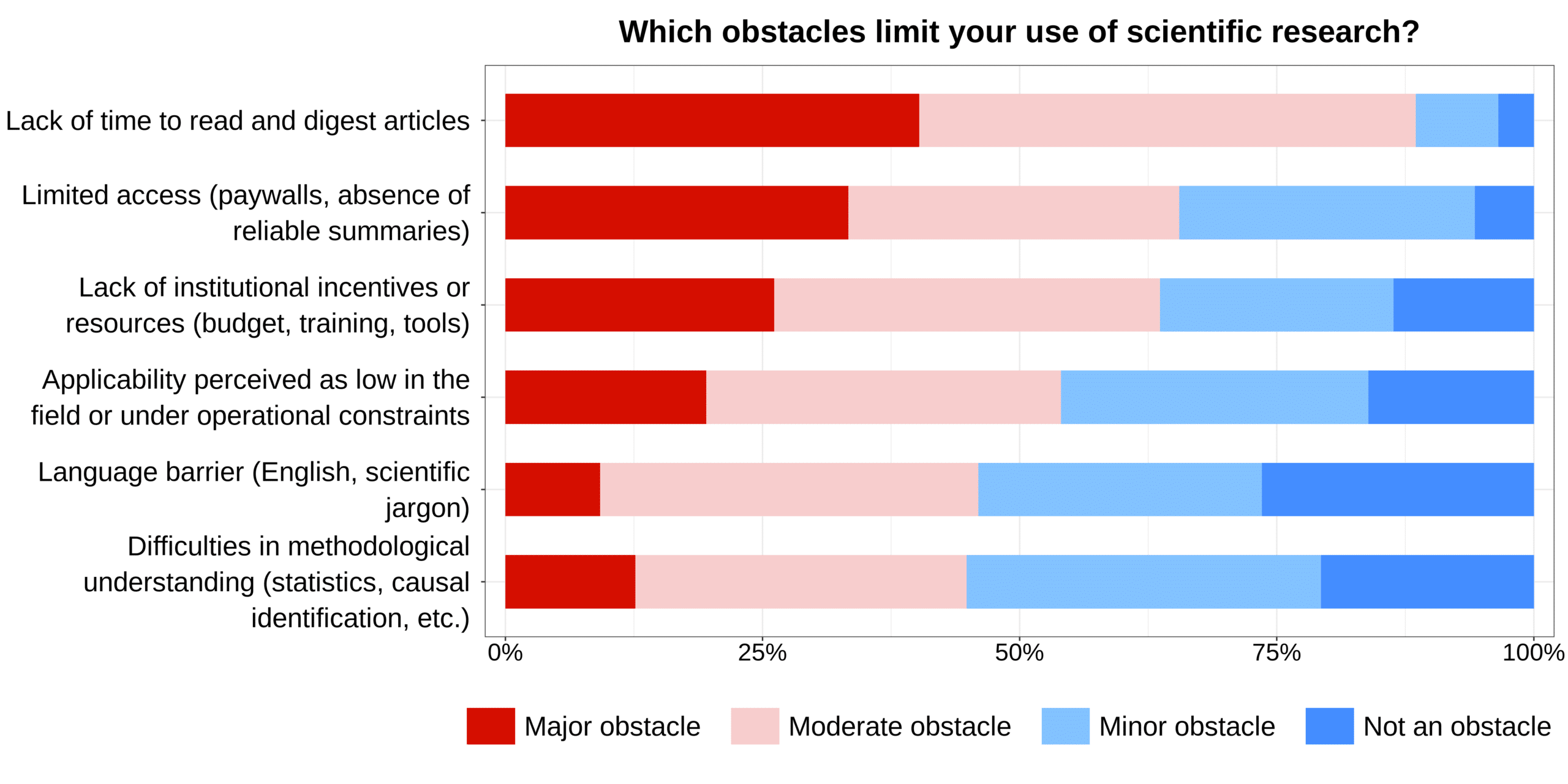
Scientific research is trusted but rarely read firsthand. Most practitioners rely on press coverage and gray literature, leaving practice largely dependent on secondhand interpretations of the evidence base. The barriers they report are mainly organizational (lack of time, paywalled access, weak institutional incentives), and most read about disinformation in French while the literature is largely in English.
Set against academics surveyed in 2022 (Altay, Berriche, Heuer, et al., 2023), practitioners agree on well-established drivers of belief in disinformation, such as confirmation bias and repetition, but judge its electoral impact larger and give less weight to institutional distrust. This comparison is descriptive, as the two surveys differ in instruments and timing.
Nearly all practitioners expect disinformation to become a greater threat, and only 13% believe institutions will be able to contain it.
Practitioners need research translated into their working language, shared measures of exposure and effects rather than activity counts, clearer coordination, and transparent safeguards that make legitimate intervention defensible.
Implications
The people who shape and carry out democracies’ responses to disinformation are not scientists. They are civil servants, military officers, and regulators. Yet these practitioners remain largely unstudied. Recent surveys have mapped what scientists and experts think about misinformation (Altay, Berriche, Heuer, et al., 2023; Altay et al., 2025; Kruger et al., 2024), but not the practitioners who act on that knowledge.
We surveyed 106 French practitioners engaged in counter-disinformation work: senior figures such as members of the offices of the President and Prime Minister, officials in the ministries of Foreign Affairs and Health, military and intelligence officers, executives of independent regulators (such as the audiovisual regulator ARCOM and the telecommunications regulator ARCEP), and journalists specialized in fighting disinformation (see Appendix A for sampling and inclusion criteria). This study documents how counter-disinformation practitioners in a national setting understand the threat and identifies where institutional responses risk falling short of the evidence they claim to rely on.
This article uses “disinformation” as French practitioners and institutions do: as an umbrella term, broader and more heterogeneous than researchers’ usage (Wardle & Derakhshan, 2017), routinely extended to misinformation, malinformation, and information manipulation at large (Darcy, 2026a, pp. 7–10; Appendix H). Even within the French field, the term’s meaning follows each institution’s mandate: security institutions (the armed forces, the Foreign Affairs Ministry, and VIGINUM, the government service against foreign digital interference) work with the narrower lens of foreign information manipulation and interference (FIMI), while journalists and educators confront the broader spectrum. We therefore imposed no definition on respondents.
By “counter-disinformation practitioners” we mean people who, by virtue of their position, hold responsibility for preventing, monitoring, analyzing, regulating, or responding to disinformation in this broad sense (see Methods). What unites them is functional rather than conceptual—a mandate within the response system, exercised under institutional or organizational constraints, not a shared profession, toolkit, or definition of the problem. Whether their understandings converge is therefore an empirical question, and the findings show that there is convergence on the diagnosis but divergence on obstacles and research use.
Research and practice form two communities, with distinct incentives, vocabularies, and timelines (Caplan, 1979; Weiss, 1979). In neighboring fields such as advertising and crisis communication, practitioners act on implicit theories that develop largely independently of academic findings (Claeys & Opgenhaffen, 2016; Kover, 1995; Nyilasy & Reid, 2009). Because knowledge translation must be tailored to the receiving community’s beliefs and constraints (Oliver et al., 2014; Ward et al., 2009), documenting what practitioners believe, read, and face is a prerequisite for any research-to-practice effort.
Most of the practitioners we surveyed were trained in the social sciences and communication studies and report little formal research training, a sample profile oriented toward institutional analysis and operational response rather than research production or consumption (see Methods and Appendix A). This background plausibly leads them to frame the problem in terms of cases, discourse, and institutions more than quantitative data.
Practitioners share an upstream, supply-side understanding of the disinformation problem: they trace the problem to the production and amplification of false content and give little weight to the public’s demand for such content (see Finding 2 below). Nine in ten rate social media platform owners as a major threat to the information environment, while ordinary citizens come last by a wide margin. The same supply-side logic shapes how they explain the spread of disinformation: large majorities attribute that spread to platform algorithms and to mass distribution by producers and platforms, whereas the idea that the public actively seeks out such content divides them.
In a descriptive comparison with about 150 academic scientists surveyed by Altay, Berriche, Heuer, et al. (2023), practitioners agree on well-established drivers of belief in disinformation but differ on contested questions. They rate the electoral impact of misinformation far higher and give less weight to institutional distrust, which scientists treat as central to vulnerability (see Finding 6 and Appendix C). This points to a selective diagnosis. By overweighting supply-side factors and individual credulity while underweighting the social and institutional conditions that make misleading claims persuasive, the field risks designing interventions that miss the deeper drivers of the problem.
This common diagnosis is not matched by a shared capacity to act. Practitioners report facing numerous concrete obstacles (Finding 3). The leading obstacle, which three in four respondents rate as serious, is a gap between rhetoric and action, and the complaint comes from inside the state. Officials, officers, and regulators report that counter-disinformation is proclaimed a priority without the resources, coordination, and indicators it requires. Most of these obstacles are structural. Institutions are asked to respond to a politically sensitive threat under fragmented authority, ambiguous mandates, and uncertain legitimacy, conditions under which even a shared diagnosis fails to produce action.
A further obstacle concerns knowledge itself. The research that could broaden this selective diagnosis rarely reaches practitioners directly (Finding 4). The issue is engagement, not trust in science. Seven in ten respondents trust peer-reviewed research to guide their decisions, yet only about a third keep up with it, relying instead on the press and gray literature. Language sustains the pattern, since nearly all read about disinformation primarily in French, a language in which far less of the literature is available.
The main barriers to scientific engagement are organizational. Lack of time, limited access to publications, and weak institutional incentives all rank above low perceived applicability, the language barrier, and methodological difficulty, though self-reports may understate the last two (Finding 4). Perceived applicability and the language barrier both vary sharply by role (Appendix D). Research is trusted in principle but consumed through intermediaries, which could create gaps between what practitioners believe the evidence shows and what it actually supports.
Whether this selective, supply-side diagnosis reflects incomplete uptake of the evidence or limits in the evidence itself can be partly answered item by item. The first reading, incomplete uptake, holds on the two divergences noted above, where current evidence does not support the practitioner position. On elections, the best available evidence finds little sign that misinformation decides outcomes (Allcott & Gentzkow, 2017; Budak et al., 2024; Eady et al., 2023). On trust, comparative research treats institutional trust as central to vulnerability (Ejaz et al., 2025; Humprecht et al., 2020), and low institutional trust is widely recognized as making people more receptive to misinformation, even by researchers who disagree about misinformation’s societal effects (Altay & Mercier, 2026; Tay et al., 2026). This makes practitioners’ low ranking of institutional distrust all the more notable. The second reading, limits in the evidence, is also plausible: a literature that is largely Anglophone, platform-centric, and focused on average population effects may say less about the targeted foreign operations many respondents confront. Exploratory analyses do not settle the question: respondents who engage most with research find it neither more nor less applicable than those who rarely do (all |ρ| ≤ .18; Appendix I).
A third reading ties the other two together and may help explain the supply-side diagnosis (Finding 2), though our data cannot test it. Institutions tend to diagnose the problem in terms of what they can measure. Disinformation’s effects are hard to measure, and prevention that works leaves no trace, since success means the expected harm never happens. So, institutions count what they can see instead—the attempts they detect, mostly online. That focus on the digital, upstream side steers action toward the reactive policies whose results they can show. Acting at this level makes the technology-centered diagnosis look right, so it confirms itself. This dynamic is well documented in public administration. When measurable objectives stand in for hard-to-measure goals, indicators come to define the activity they monitor (Bevan & Hood, 2006; Campbell, 1979), and counter-disinformation is unusually exposed: its ultimate goal (an information environment citizens can trust) is among the hardest outcomes to measure, while its operational objectives (campaigns detected, content removed) are easier to count. Even impact metrics sit upstream of the harms that justify the policy, since institutions reach for engagement counts and declared beliefs, yet likes are not beliefs, and beliefs are not actions (Altay, Berriche, & Acerbi, 2023; Budak et al., 2024). Research faces the same constraint, since its evidence concentrates where data are accessible. The supply-side convergence of practitioners and scientists may therefore partly reflect shared observability limits rather than independent assessments.
None of this is inevitable, and each reading points to its own remedy. Incomplete uptake calls for translating what already exists more than for new studies: rapid briefs, short syntheses, and permanent brokerage roles that connect existing research to training, doctrine, and operational decisions in practitioners’ working language. Limits in the evidence call for the reverse flow, carrying practitioners’ operational questions back into research agendas. The measurement loop calls for measuring the outcomes that matter rather than the activity that is easiest to count.
Respondents do not experience these challenges uniformly. Educational background is the most consistent source of variation, especially in perceived obstacles to action (Appendix D). Research engagement and censorship fear also vary by role, with fear of censorship accusations highest among normative, regulatory, and public-protection roles and lowest among cybersecurity practitioners. Mandates and objectives diverge, too. Practitioners face different threats, use different tools, and define success differently.
Our findings have implications for institutions, researchers, and the infrastructure between them. We focus on how the response system could work better (its coordination, its evidence base, and the links between them) rather than on which interventions work, a question that existing reviews and guides already cover (Appendix J).
For institutions, coordination should accommodate the diversity across roles rather than flatten it. A single framework that assumes all practitioners see the problem alike would serve some roles and be distrusted by others. A limited set of common indicators (exposure, incident response, coordination quality, effects), embedded in clear mandates and auditable safeguards, would be a way out of this measurement loop.
For researchers, this diversity of mandates means there is no single standard for “fighting disinformation.” Success for an educator (accurate beliefs) may mean nothing for a regulator (compliance) or an officer (attribution). The evidence base is just as fragmented. Psychology and communication study corrections, literacy, and inoculation (Ecker et al., 2022); security, intelligence, and computer science study attribution and deterrence; some problems, like evaluating institutional responses, fall to no field at all.
The infrastructure between them could translate research into different products for different professions (a legal memo, a threat report, a classroom resource) rather than one brief for all. One speculative arrangement would combine measurement and knowledge translation in a standing observatory of the information environment, building the indicators current instruments miss and deploying the knowledge translation mechanisms the evidence-use literature has tested; its precedents, mechanisms, and design risks are in Appendix J.
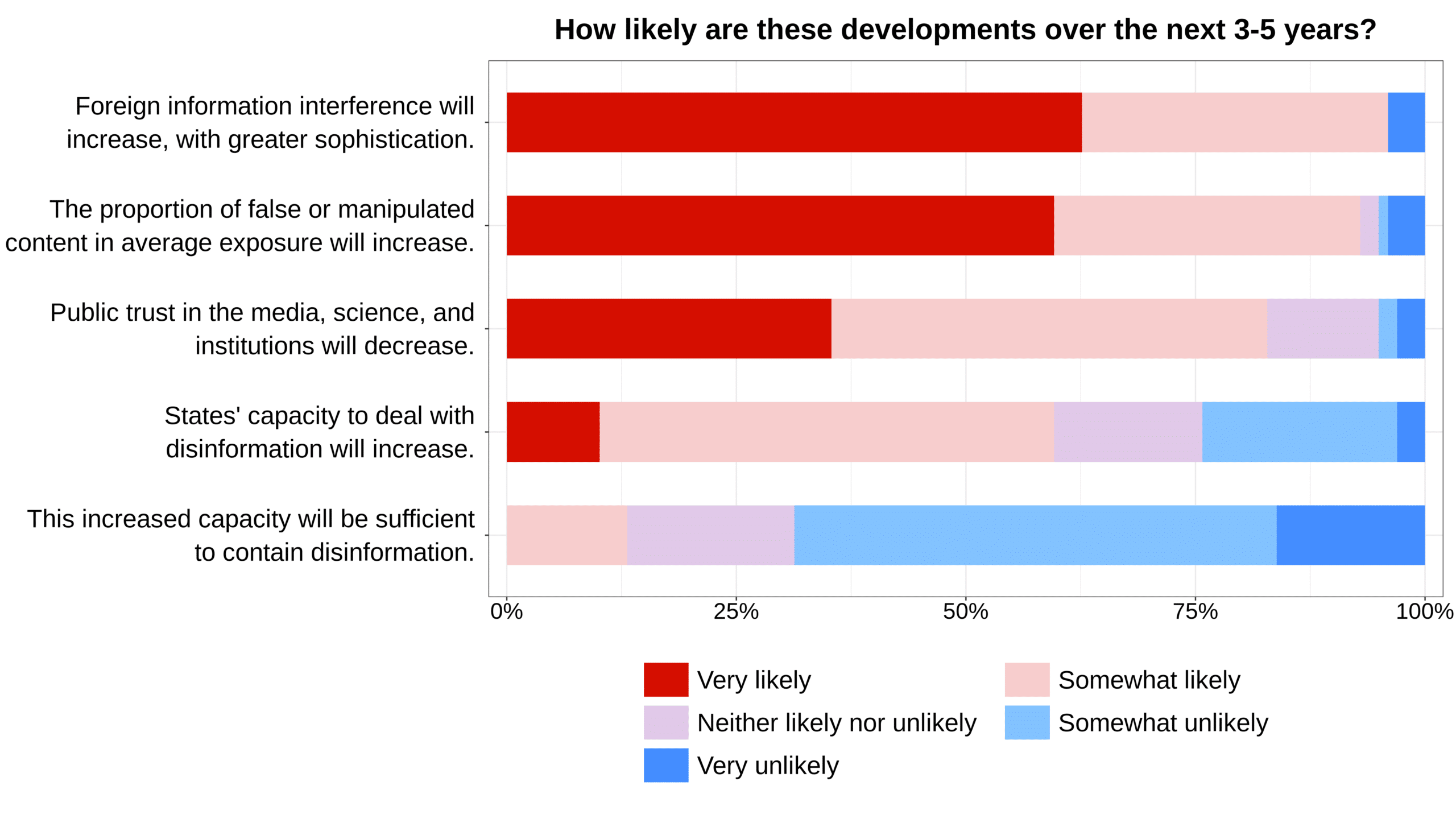
This is pressing because practitioners expect deterioration (Finding 5). Nearly all foresee more foreign interference and more false content in users’ feeds over the next three to five years, and most expect declining trust in media, science, and institutions. Yet, only one in eight believes the response will be sufficient, and practitioners see no trajectory that closes the gap under current arrangements.
These findings have limitations. The sample is non-random, France-centered, state-weighted, and thin in some sectors; a dedicated comparison found no public–private differences on the substantive questions, though low precision means this is not evidence of equivalence (Appendix D). Recruitment ran partly through defense and security networks, possibly tilting the sample toward foreign-threat and supply-side framings. All measures are self-reports of what practitioners believe, read, and face, not what they do, and with no imposed definition, answers may reflect heterogeneous understandings of “disinformation,” which we treat as part of the object of study but which limit comparability. Subgroup analyses are exploratory, resting on uneven group sizes and variable response rates (Appendix A). The scientist comparison is likewise descriptive rather than confirmatory, because it sets side by side two surveys with different designs (different instruments, response scales, languages, populations, and fielding periods), so item-level contrasts should be read as indicative only (Appendix C). Respondents mandated to counter disinformation may overstate its prevalence or severity. Yet, because they select detection instruments, draft regulations, and decide when to intervene, their perceptions are consequential.
The French setting, however, is not only a limitation. As a European Union (EU) and North Atlantic Treaty Organization (NATO) member, France is covered by the Digital Services Act (DSA), into which the Code of Practice on Disinformation was integrated in 2025, and has built one of Europe’s most institutionalized counter-disinformation apparatuses (e.g., VIGINUM and a national strategy adopted in 2026), making it both a leading case and, increasingly, a reference point for partners (Darcy, 2026a, pp. 101–106; Appendix H). At the same time, it concentrates features common to many democracies—fragmented responsibility, strong security salience, and uneven access to an overwhelmingly Anglophone literature—so its lessons are unlikely to be France’s alone. Replication across national settings would clarify which patterns are specific to France and which reflect structural features of democratic counter-disinformation more broadly.
Findings
Finding 1: Practitioners treat disinformation as a first-order societal threat, on par with democratic decline and climate change, and attribute broad macro-political effects to it.
Nearly all respondents (96%) rate disinformation as an important or very important societal problem. Most place it at roughly the same level as democratic decline (69%), climate change (62%), and armed conflict (57%), rather than clearly above them (Figure G1). Practitioners also attribute broad consequences to disinformation: large majorities view foreign campaigns as a major threat to democracy (90%) and believe disinformation sustains Russian support for the war in Ukraine (87%), fuels vaccine hesitancy (81%), enables voter manipulation (80%), and erodes trust in the state (78%; Figure G2). Although existing research has found limited and context-dependent evidence for misinformation effects on voting behavior (Allcott & Gentzkow, 2017; Budak et al., 2024; Eady et al., 2023), 83% agree that a disinformation campaign can decisively change an election result. Agreement is somewhat lower on the specific case of Trump’s 2016 election (71%), which suggests that practitioners see disinformation as a greater threat in the abstract than in a concrete case. This threat assessment is anchored in direct experience: a majority of respondents (57%) report that their institution has already been directly targeted by disinformation, while 21% do not know, suggesting that even organizations engaged in counter-disinformation cannot always tell whether they have been targeted (Figure A1).
Finding 2: Practitioners share an upstream, supply-side diagnosis: they locate responsibility in platforms and amplification structures, explain belief through cognitive and algorithmic mechanisms, and give less weight to institutional distrust than scientists do.
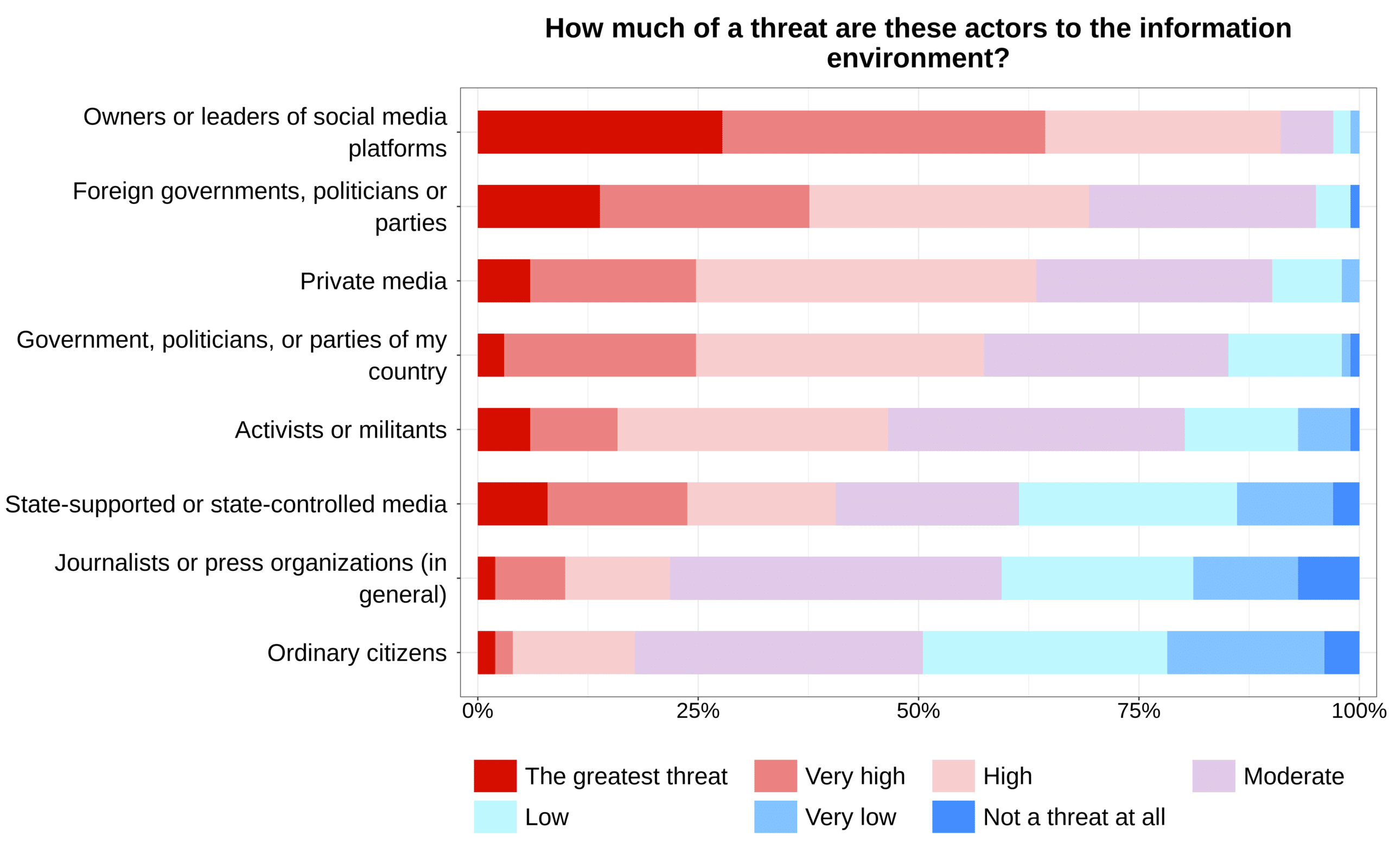
Threat attribution is concentrated on actors who shape the information environment. Nine in ten practitioners rate social media platform owners as a major threat, and nearly three in ten name them the single greatest threat (Figure 1). Foreign governments rank next (69%), followed by private media (63%) and domestic politicians (57%). Ordinary citizens are rarely treated as major drivers (18%). As in the International Panel on the Information Environment’s survey of 412 researchers (IPIE, 2024), which used the same actor list and scale, platform owners rank first and ordinary citizens and journalists last. Practitioners, however, are more alarmed about platform owners (91% vs. 64%) and private media, and they rank foreign actors above domestic politicians (69% vs. 57%), whereas researchers did the reverse (50% vs. 56%).
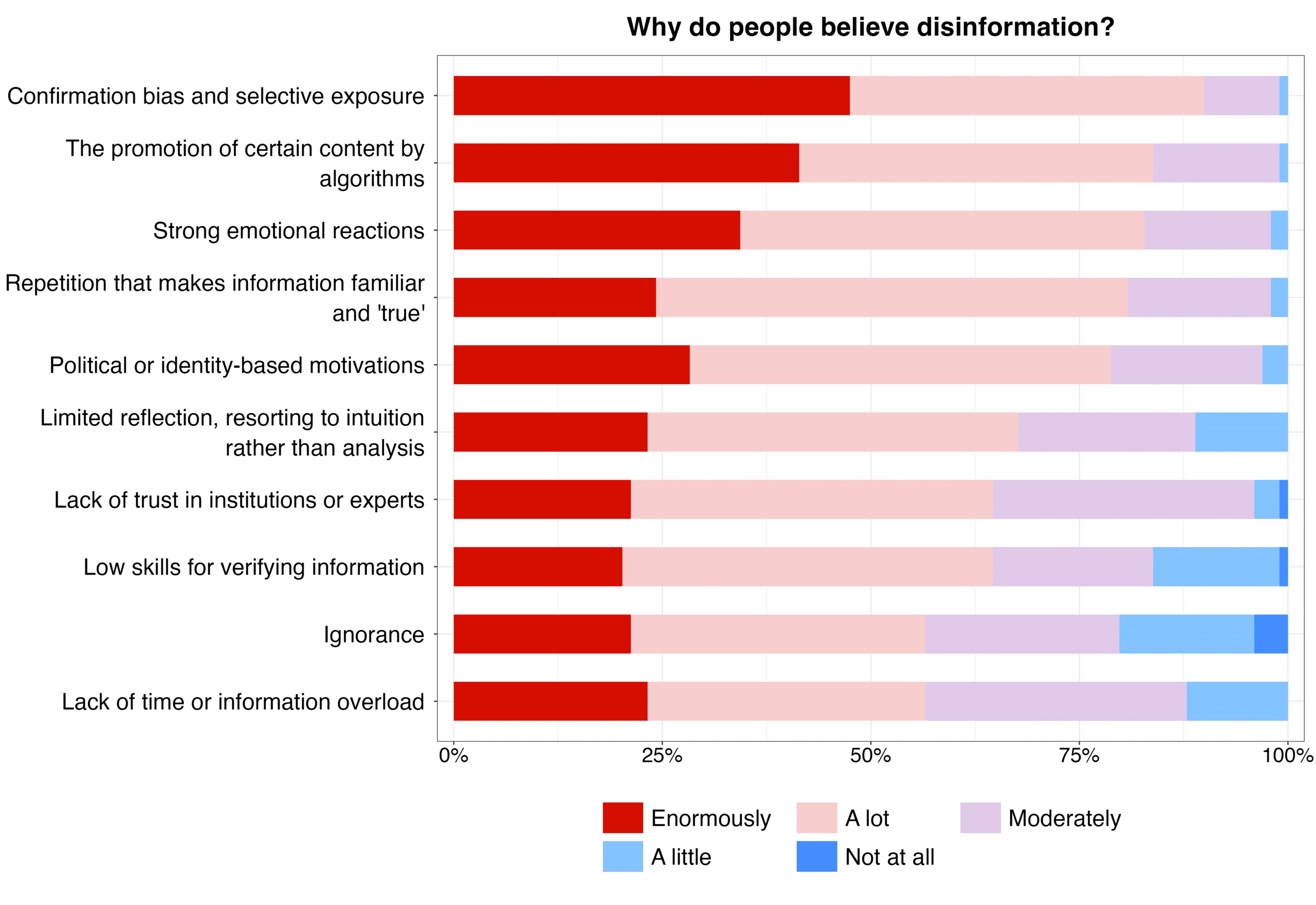
Beliefs about how disinformation spreads follow the same logic. Large majorities agree that platform algorithms strongly influence political opinions (85%) and that producers and platforms distribute misleading content on a massive scale (76%; Figure G3). The idea that the public actively seeks out such content divides the sample nearly in half (39% agree, 43% disagree). On belief drivers, the most prominent explanations are confirmation bias and selective exposure (90%) and algorithmic promotion (84%), followed by emotional reactions, repetition, and identity-based motivations (Figure 2).1 Both were closed lists with a limited set of options, so neither covers every possible explanation.
A notable result is the relatively modest place of institutional distrust, which the academic literature often treats as a central condition of vulnerability (Ejaz et al., 2025; Humprecht et al., 2020). In short, practitioners frame disinformation as a supply-side problem, driven by infrastructure and amplification acting on cognitive vulnerabilities, and give less weight to audience demand.
Figure 1.Perceived threats to the information environment by actor type (%, N = 101).Figure 2.Beliefs about why people believe disinformation (%, N = 99).
Finding 3: The top obstacles to fighting disinformation are a rhetoric-action gap, reactive policies, and platform power, compounded by anticipatory fear of censorship accusations.
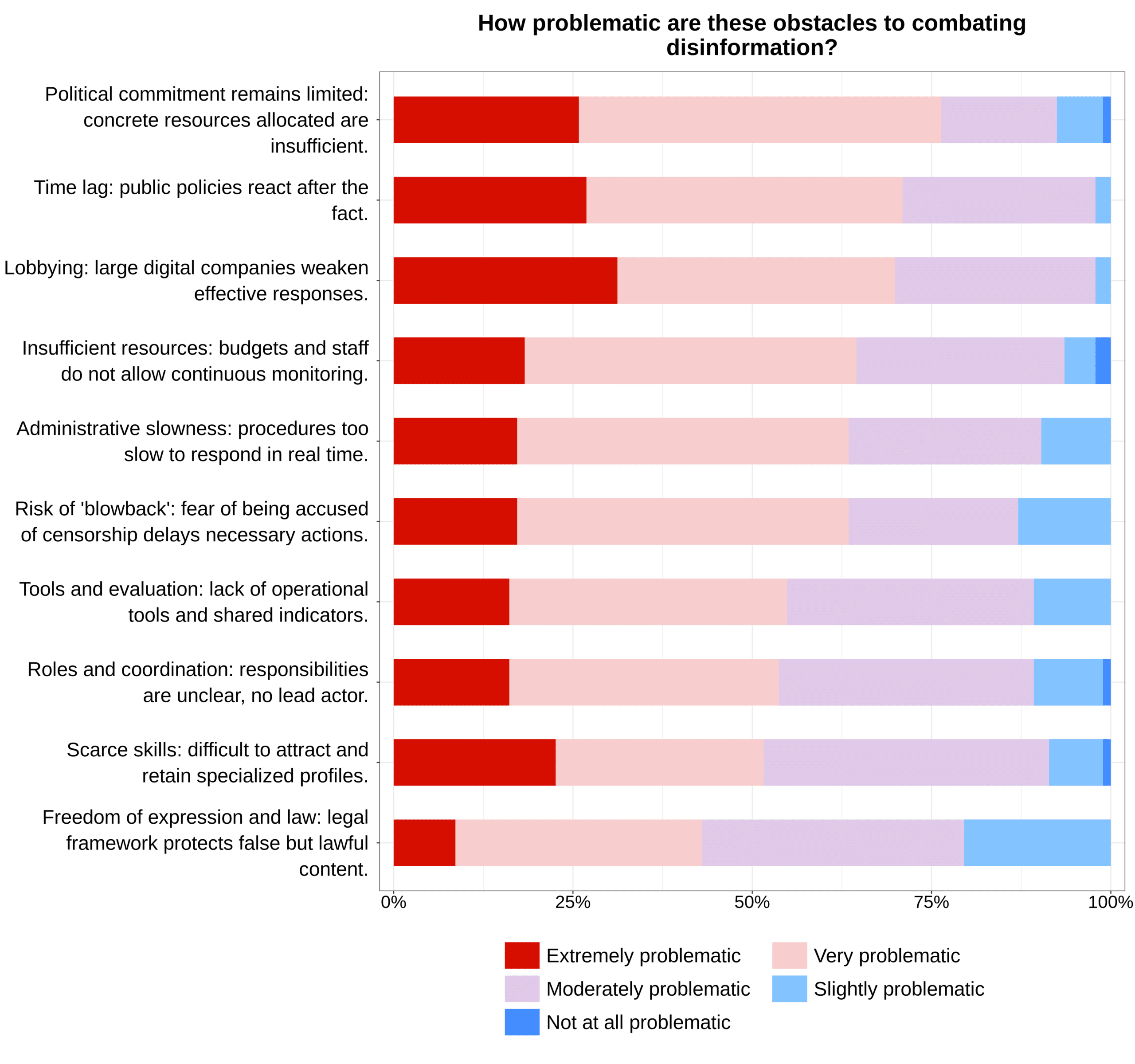
The most important obstacle, rated very or extremely important by three in four practitioners (76%), is that counter-disinformation is proclaimed a political priority while concrete action remains insufficient (Figure 3). The next most cited obstacles are reactive policies that lag behind new tactics (71%) and the influence strategies of large digital companies (70%). Structural constraints compound the picture, each cited by a majority of respondents (52–65%): insufficient budgets and staff, administrative slowness, the lack of operational tools and shared indicators, unclear roles and coordination with no lead actor, and difficulty attracting and retaining specialists. Fear of censorship accusations also ranks high (63%), yet only one in five practitioners (21%) reports encountering actual ethical dilemmas often in daily work, while more than six in ten (62%) encounter them rarely or never. The constraint appears largely anticipatory. What inhibits practitioners is mainly the prospect of being accused of overreach.
Figure 3. Obstacles to combating disinformation (%, N = 93).
Finding 4: Practitioners trust scientific research but rarely engage with it directly.
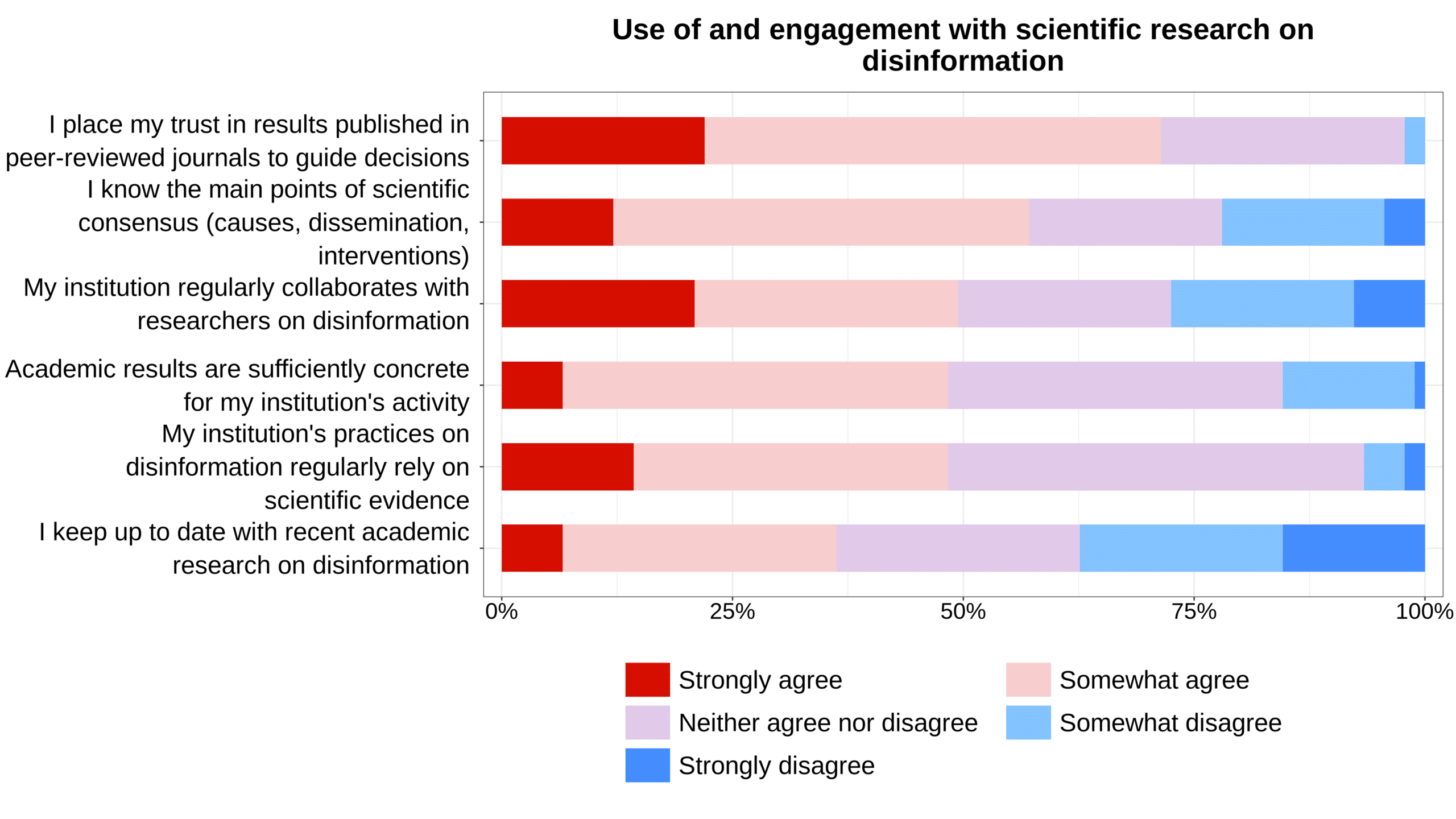
Nearly three in four practitioners (71%) say they trust peer-reviewed research to guide their decisions, but only about a third (36%) report keeping up with recent academic work (Figure 4). Nearly all (88%) read about disinformation primarily in French, a language in which far less of the scientific literature is available. The most frequent sources are the press and gray literature, with scientific articles secondary (Appendix G, Figure G4). The barriers are organizational: lack of time, limited access to publications, and weak institutional incentives all rank above methodological difficulty or skepticism (Figure 5).
Because these items ask respondents to judge their own competence, they may be affected by social desirability: admitting difficulty with methods or scientific English is more face-threatening than citing lack of time or access. The ranking should therefore be read with caution, and the 45% reporting methodological difficulty as a likely lower bound. The French setting may reinforce this under-reporting. French administrative elites are selected and legitimized through extensive, formalized general knowledge rather than specialized expertise (Mangset, 2017), and only 4% of our respondents have a research background (they hold or are preparing a doctorate, or work in higher education or research), so many may not recognize what they miss when reading a study. Two features temper this concern, however: answers were anonymous, and respondents readily gave other potentially face-threatening answers, admitting low engagement with research and reliance on French-language sources.
Figure 4. Engagement with scientific research (%, N = 91).Figure 5. Obstacles to using scientific research (%, N = 87–88).
Finding 5: Practitioners expect the threat to worsen and do not believe institutional capacity will keep pace.
Nearly all respondents anticipate increases in foreign interference (96%) and in false or manipulated content in ordinary users’ feeds (93%) over the next three to five years (Figure 6). Large majorities also expect declining trust in media, science, and institutions (83%). On the response side, six in ten (60%) think state capacity will increase, but only one in eight (13%) believes future capacity will be sufficient, while more than two in three (69%) judge that outcome unlikely.
Figure 6. Expected developments over the next 3–5 years (%, N = 99).
Finding 6: Respondents converge on the diagnosis but diverge on obstacles and research use, with educational background the most consistent source of variation, and their views sometimes differ from scientists’.
Variation within the sample was assessed with linear mixed-effects models across three grouping variables (organizational type, educational background, and practitioner role; 60 omnibus tests, Appendix D). One effect survived multiple-testing correction: perceived obstacles to action varied by educational background (raw p < .001, adjusted p = .007, η²p = .23). Respondents trained in computer and data sciences (n = 11) rated obstacles as less severe overall (block mean 3.19 vs. 3.71–3.95 in the other fields; lower on nine of the ten items), while the ranking of obstacles did not differ detectably (group × item interaction, p = .587). Ranked by the variance of subgroup means, variation was strongest for obstacles to action and barriers to using scientific research, and weakest for perceived impact and expected future developments. The subgroup patterns are exploratory, given the study’s precision limits (Appendix B). A dedicated comparison of public-sector and private respondents found no detectable difference in the substantive diagnosis (Appendix D).
We also compared respondents’ answers with those of about 150 academic scientists surveyed by Altay, Berriche, Heuer, et al. (2023), on six closely matched items (see Appendix C). Because the two surveys differed in instruments, response scales, language, populations, and timing (fielded in 2022 and in 2025–2026, on either side of the 2024 U.S. election), the comparison is descriptive. The two groups give similar ratings to well-established mechanisms (confirmation bias, repetition) and diverge sharply on the role of disinformation in the 2016 U.S. election, which practitioners rate far higher (d = 0.89), and on lack of trust in institutions, which scientists rate higher (d = −0.46). Convergence thus concentrates on well-established psychological mechanisms. On contested items, practitioners favor explanations centered on individual credulity and campaign power, while scientists give more weight to the structural conditions that make audiences receptive, such as eroded institutional trust. The full item-by-item comparison and its caveats are in Appendix C.
Methods
The target population comprised practitioners holding official responsibility for preventing, monitoring, analyzing, regulating, or responding to misleading, manipulated, or hostile informational content. Academic researchers were excluded by design; their beliefs have been documented elsewhere (Altay, Berriche, Heuer, et al., 2023). No sampling frame exists for “disinformation practitioners” in France, so we maximized coverage through organizational charts, conferences, interagency initiatives, practitioner networks, and snowball referrals. The sample should not be interpreted as a random draw. Consistent with the institutional usage described above, the questionnaire did not impose a definition of disinformation; items used the term as it circulates among French practitioners.
Recruitment proceeded in two waves (September 2025–February 2026). Wave 1 contacted practitioners directly within state institutions and major non-governmental organizations (n = 85, 80%); Wave 2 disseminated an anonymous Qualtrics link through practitioner association channels (n = 21, 20%; see Appendix E for wave composition). Of 123 consented responses, 106 met inclusion criteria (see Appendix A for full details).
The resulting sample is skewed toward state institutions: one third of respondents work in military or intelligence services, 29% in regulatory or normative bodies, and 21% in senior government or political offices, while private-sector and media actors are comparatively limited (7% from private for-profit organizations, 6% from private non-profits, and 4% from journalism or media; Appendix A, Figure A1). Educational backgrounds are mostly (61%) in the social sciences and communication or media studies, with smaller shares from computer and data sciences, the humanities, and the natural sciences (Figure A1). Only 4% are doctoral students, doctorate holders, academics, or researchers, and only 16% report formal training drawing on research on disinformation. This profile describes a sample oriented toward institutional analysis, communication, and operational response rather than toward research production, and should be kept in mind when interpreting the findings.
The questionnaire (92 items, in French) was closed-ended, apart from optional “Other (please specify)” fields in some blocks and one open question on ethical dilemmas. Respondents rated each statement in a predefined list separately on a labeled scale. Several blocks reuse, in French translation, items from existing expert surveys whose results serve as benchmarks for comparison. The threat block (Figure 1) reproduces the actor list and seven-point scale of the 2024 IPIE expert survey (IPIE, 2024). The belief drivers (Figure 2) take up the list of Altay, Berriche, Heuer, et al. (2023) to allow comparison with scientists; to shorten the survey, their identity, partisanship, and motivated-reasoning items were merged into one. Items on the 2016 U.S. election, opposing views online, fact-checking, and algorithms are adapted from the same survey (Appendix C). The research obstacles (Figure 5), which have no equivalent in these surveys, cover the barriers to evidence use most often reported for policymakers (time, access, skills, relevance, and institutional resources; Oliver et al., 2014), plus language. Full wording in French and English is in the codebook provided with the replication materials.
To maximize available information given heterogeneous missingness patterns, analyses rely on pairwise deletion, using all available data for each analysis rather than excluding participants with any missing value (Enders, 2010; Little & Rubin, 2019). Full methodology is detailed in Appendix A. Throughout the findings, percentages aggregate the highest response categories; item-level means and standard deviations on the original response scales are reported in Appendix F.
1 As worded in the survey, confirmation bias and selective exposure is a way of handling information (“one avoids contrary information and prefers information favorable to oneself”) that can serve any prior belief. Political or identity-based motivation is a reason for wanting a conclusion (“one believes what reinforces one’s side or one’s identity”), which may or may not work through that mechanism. Altay, Berriche, Heuer, et al. (2023) also keep them separate, and here the two ratings correlate only moderately (Spearman ρ = .47, n = 99).
Scientists discovered a rock in Papua New Guinea that plunged more than 90 kilometers beneath Earth's surface, revealing a bizarre temperature pattern that challenges established theories of Earth's interior. The unexpected shift from unusually hot to relatively cold conditions could transform our understanding of tectonic plate movements, earthquakes, and volcanoes.
I haven’t covered a Tesla earnings release and call in a while, but I thought I’d give a quick summary since this quarter was pretty interesting. Last quarter I wrote this after the delivery release, but I didn’t write up the earnings call. Observations From The Shareholder Deck: Gross margin ... [continued]
Deepway Star semi trailer from China joins the growing number of trucking brands on Australian roads. Information was shared over LinkedIn, Facebook, and through phone interview. Mark Blackburn, Managing Director of VCF Transport Services, is not only proud of the newest acquisition to their logistics fleet, but also keen to ... [continued]
Adam McKay is the fellow who brought us the satirical Don’t Look Up! movie five years ago. We did an article about it at the time, which got over 100 comments. That may be more than the number of people who paid to see it in theaters. Undaunted, McKay is ... [continued]
Gas utilities have a structural problem in an electrifying economy. Customers can stop using gas one building at a time, while most of the physical network remains in service until enough neighboring customers have left for a section of pipe to be shut down. That distinction matters more as heat ... [continued]
A quick update on a story we mentioned earlier this month. Much of the attention in the whole Bricks & Minifigs saga has focused on Reckless Ben and his attempts to expose sketchy behavior by the company, but the fight has also put a lot more scrutiny on Bricks & Minifigs Corporate (BAM), including the creation of a very useful site called The BAM Map, which has been chronicling basically everything terrible that BAM has been up to since all of this went down.
But at the end of the last month, BAM filed a lawsuit against the “John Does” behind The BAM Map and took steps to have them identified, claiming that franchisees and other insiders had violated confidentiality agreements by leaking internal documents that ended up on the site. As we noted at the time, there are protections for anonymity under the First Amendment, and we hoped that the recipients of the subpoena that a magistrate judge approved — in this case GoDaddy and Vercel — would at least inform the operators of the site, and allow them to go to court to try to make sure their rights were protected.
Soon afterwards, lawyer and well-known legal YouTuber Leonard French moved to appear (via local counsel Eric Allen) on behalf of the site’s operator. French then took steps to make sure that the operator of the site could proceed anonymously, followed quickly by a motion to quash the subpoenas, in part by claiming the operator of the site is a non-party to the lawsuit as just the publisher of the site, not a franchisee. That matters because BAM’s whole theory is that contract-bound insiders leaked the documents, and its own complaint describes the site operator as a third party who received them, not as a defendant. As the motion lays it out:
The grounds are these. The Ex Parte Order authorizes discovery to identify the defendants so that BAM may serve them. BAM’s Complaint pleads that the defendants are franchisees and other insiders bound by confidentiality agreements, and it identifies the website operator as a third party that received information, not as a defendant. BAM also pleads that it already has evidence, in its own systems, identifying a suspected source. Unmasking an anonymous publisher on a matter of public concern, and through the publisher its sources, requires First Amendment balancing that BAM’s ex parte motion never presented. And the subpoenas reach beyond identity to the contents of stored communications, which the Stored Communications Act bars.
Finally, French filed a motion to stay the discovery on behalf of the operator of the site, asking the court to halt production while it considers the motion to quash, so that the operator, whom BAM seems desperate to unmask, isn’t outed in the meantime. As French points out, outing the operator of the site could irrevocably harm that individual, since anonymous speech is supposed to be protected:
The harm is irreversible. The Emergency Motion seeks to prevent the unwarranted disclosure of the Publisher’s identity and, through account and upload records, the identity of the website’s sources. If production occurs before the Emergency Motion is decided, the Emergency Motion will be moot in substance. Anonymity, once lost, cannot be restored by a later ruling
As the filing notes, if it later turns out that there actually are grounds to unmask the operator of the site, that can be done at a later time with no real harm to BAM.
Not surprisingly, BAM pushed back on all this, claiming it really, really, really badly needs those records.
Those measures would leave the records BAM needs solely in the hands of third parties while the disclosures that prompted this action continue and delay production of documents and information held by third-party website hosts who do not retain records indefinitely. As such, BAM respectfully requests that the Court deny the Motion to Stay as proposed
All that paperwork seems to have made the court aware of the anonymity interests at stake, and the magistrate has granted an “interim” stay of production so that nothing is revealed before these issues are more fully resolved. The court orders that GoDaddy and Vercel should not produce the info in the subpoena, that BAM can’t serve any additional subpoenas, and if they somehow have received some information in response to the subpoenas, they will sequester that info, not look at it, and not disclose anything that’s in it.
That removes the immediate risk that one of The BAM Map’s hosting companies hands over the operator’s identity before a court has even weighed the First Amendment questions. BAM’s response to the motion to quash is due October 23, with a reply due October 30. Crisis averted… for now. Also, it’s good to see French representing the site operator here, so we know whoever it is is in good legal hands.