All posts by media-man

Be a Voice That Inspires at the 2017 PBS Annual Meeting


The theme of the 2017 PBS Annual Meeting is “Voices That Inspire” and we’d like to hear from some of our most inspirational voices – you! Whether you will be attending this year’s Annual Meeting or not, PBS would like to showcase your voice during the General Audience Programming Sessions. We want to know:

· How you are using national programming at a local level;
· What impact you are seeing from your efforts; and
· How national programming is resonating with and inspiring your station and your viewers

PBS is seeking videos of up to one minute in length from our station colleagues addressing any or all of the points above. The videos do not need to be high-tech – they can be shot on your phone if that works best for you – but be as creative with your video as you’d like. For example, you could show us an event you hosted, share a viewer response, or create a musical homage to your favorite PBS series (complete with costumes!). We will use the videos you submit to create a spot or spots to be shown during the Annual Meeting to demonstrate how national programming is inspiring at a local level.

We’d like to be able to share these spots with stations for off-air use (not on-air or online) following the Annual Meeting, so please keep that in mind as you create and submit your videos.

Click here for upload instructions.  All videos are due by March 31, and we will follow up with all submitters by May 5 with more information.

Are you registered for the Annual Meeting?

Please contact Gina Hardter or Cynthia Hynes with any questions.

Africa’s Great Civilizations : COVE Programming Update


Due to President Trump’s Address to Congress on Tuesday, February 28 @ 9PM ET, Africa’s Great Civilizations will have an adjusted COVE release scheduled.  The President’s Address will preempt broadcast programming that night, delaying episodes 2 & 3 by one night for primarily for east coast viewers. However, streaming in COVE will take place as follows:


Episode
Broadcast Feed
COVE Release

Ep. 1 - Origins
2/27/17
2/27/17 at 9pm ET
Ep. 2 - The Cross and The Crescent
2/27/17
2/27/17 at 10pm ET
Ep. 3 - Empires of Gold
3/1/17
2/28/17 at 9pm ET
Ep. 4 - Cities
3/1/17
2/28/17 at 10pm ET
Ep. 5 - The Atlantic Age
3/2/17
3/1/17 at 9pm ET
Ep. 6 - Commerce and the Clash of Civilizations
3/2/17
3/1/17 at 10pm ET


MisinfoCon starts today

Happy Friday, hacks and hackers! We hope to see you this weekend at MisinfoCon or next week at NICAR. If not, you can follow along at #MisinfoCon and #NICAR17. ICYMI yesterday: From saving democracy...

Visit Hacks/Hackers to read the full post and join our community.

Going All In with PBS TechCon 2017


Every April, amidst glow and glimmer of the City of Lights, there is a special gathering unlike any other in public media. A special group of professionals—time-tested and supremely-dedicated—come together for a learning event beyond compare in our industry.

For those who have attended in the past, it has become a permanent fixture in their calendars. And each year, the individuals planning the experience try to outdo themselves, adding more engagement and wisdom at every turn. You’ve heard the tales, and read the stories! (herehere, and here)

If you haven’t already guessed (or read the headline of this article), PBS TechCon is the event, and the 2017 conference is right around the corner.

REGISTER FOR PBS TECHCON 2017 TODAY!

This year, PBS TechCon is expected to offer even more learning, networking, and growth opportunities for attendees. The amount of sessions being offered for each discipline—T&O, Digital, Traffic—has increased, with sessions focused on digital fundraising and production being added to the mix.

Here is a look at what you can expect at this year’s PBS TechCon:
  • 80+ tactical and strategic breakout sessions focused on broadcast infrastructure, content & engagement, fundraising, future tech, media management, digital products, traffic, and more. (Check out the session agenda - http://bit.ly/2mcu2AN)
  • Over 10 peer-to-peer networking opportunities across two and a half days
  • Four general sessions with PBS leadership and industry experts
  • Two exhibit areas featuring industry-related vendors and core PBS services for stations
  • An integrated Digital Immersion track focused on building an effective multiplatform strategy
Add in multiple off-agenda evening events, and each day is filled, from start to finish, with a chance to grow as a professional and engage with system colleagues.

WINNING COMBINATION OF SESSIONS
From the very first concurrents on Wednesday afternoon to last breakouts on Friday, each session provides a chance to hone existing skills and absorb new knowledge. The sessions are a mix of PBS and system-crafted topics designed to present success stories and learning from across our industry. You will not want to miss a minute. Peppered throughout the conference are sessions dealing with interconnection, public safety, organizational structure, and too many other topics to list.

Next week, we will go more in-depth with a look at session highlights from the Digital track. Be sure to check back in.

A FULL HOUSE OF NETWORKING
Beyond the sessions, there will be an exhibit hall filled with industry-related vendors, and another area dedicated to PBS services for stations. At the PBS Digital booth you can receive demos, meet PBS Digital staff, and members of the Digital Media Advisory Council. In addition you can learn more about the Source 2.0, get hands-on technical support for PBS Digital products and services, or set up time to meet with colleagues while you charge your devices.

One of the goals of PBS TechCon is to foster collaboration and connections, so take advantage of the spaces and times set aside for networking.

TRIFECTA OF OPPORTUNITIES
This year, there are three different scholarships available for those seeking assistance to attend TechCon.
  • The Tracy Carter Traffic Scholarship (February 28th deadline) awards two station traffic staffers with registration for TechCon. 
  • The YoProWo Scholarships (March 10th deadline) offers two young professionals, relatively new to PBS stations, a chance to attend, covering registration, hotel, and airfare. 
  • The Digital Immersion Project (February 28th deadline) will be rewarding 25 PBS member station staff who work on digital initiatives with a professional development opportunity that includes a TechCon scholarship for registration, hotel, and airfare.
Early Bird registration ends March 17, so there is still time to apply and receive notice before each scholarship deadline.

If you haven’t thought about attending TechCon, it is definitely worth considering. Public media is quickly becoming a cross-skill industry, and adding new proficiencies will help you and your station adapt to the constant changes. If you’re looking for some talking points to help justify your trip, visit this link: http://www.pbstechconference.org/agenda/justify-your-trip/

Here are some additional info to plan your trip:
We hope you can join us at PBS TechCon 2017. We are excited to meet you and hear about what your station is doing. See you in Vegas!

See you at NICAR

Hello, hacks and hackers! We made it through Valentine’s Day (at least, those of us who live in countries that celebrate it) and we’re now less than a month from the popular NICAR...

Visit Hacks/Hackers to read the full post and join our community.

Dont Miss DevDay at PBS Annual Meeting!

Amanda J. Hoehn | Assistant Director | PBS Development Service

CLICK HERE TO VIEW THE LATEST DEVDAY AGENDA - All workshops now posted!

The PBS development community is invited to gather at the Annual Meeting in San Diego for a new learning and networking experience! 

By first attending the Annual Meeting, development professionals will access the full range of upcoming programming, general sessions, and educational strategies PBS offers and gain important skills at the development breakout sessions.

After the Annual Meeting wraps, we’ll kick off our development-specific gathering on Wednesday evening with a Development Late Night Networking Event. The networking and social event for development professionals, this high energy gathering is a place to reconnect with colleagues from across the system.

Then, at Thursday's DevDay, we’ll present a series of interactive, hands-on training workshops focused on the most relevant fundraising and development activities. These workshops will center around four tracks: Corporate Support, Digital, Philanthropy, and Sustainers. During these workshops, participants will step out of the “conference bubble,” apply what they’ve seen and heard earlier that week at the Annual Meeting, and create new fundraising strategies and plans to use back at their stations. We’ll also recognize the 2017 Development Award winners at DevDay!

DETAILS:
Where: All DevDay events will be held at the Annual Meeting conference hotel, the Marriott Marquis San Diego Marina.
Registration: Registration is open! You can register for both Annual Meeting and DevDay at the same time.
Lodging: After you register, you will receive a link to reserve your hotel stay at the Marriott Marquis San Diego Marina.
Fee: DevDay is included with an Annual Meeting registration. If you are attending only the Development Late Night Networking Event and DevDay, the fee for PBS Member Stations is $125; for nonmembers the fee is $250.
Sign up to receive Development Services’ newsletter and get important DevDay announcements.


See you in San Diego!

What makes a great photo editing intern (Apply now for Summer 2017!)

NPR Interns at workPhoto by Rachael Ketterer

This is not your standard photo internship!

This internship is an opportunity to learn more about the world of photo editing. Our goal isn’t to make you into a photo editor; we view this internship as a chance for you to understand what it is like to be an editor and improve your visual literacy, which can help you become a better photographer.

The internship runs from May 22, 2017 to August 11, 2017. Applications are due Sunday, March 5, 2017 at 11:59pm eastern.

What you will be doing

  • Editing: You’ll be working closely with the Visuals Team’s photo editors (Ariel and Emily) on fast-paced deadlines – we’re talking anywhere from 15 minutes to publication, to short-term projects that are a week out. You’ll dig into news coverage and photo research, learning how to communicate about what makes a good image across a range of news topics, including international, national, technology, arts and more.

  • Photography: Depending on the news cycle, there may be opportunities to photograph DC-area assignments. This can mean you’d have one or two shoots in a week, or maybe just a couple shoots in a month. You’ll work closely with a radio or web reporter while out in the field, and a photo editor will go through your work and provide feedback for each assignment. There will also be a chance to work on portraiture and still lifes in our studio.

  • We also encourage each intern to create a self-directed project to work on throughout the semester. It can be an Instagram series, video, photo essay, text story or anything in-between. You can work independently or with another intern or reporter.

You will be part of NPR’s intern program, which includes 40-50 interns each semester, across different departments. There will be coordinated training and intern-focused programming throughout the semester, which includes meeting NPR radio hosts, career development and other opportunities. As an intern, you will be treated as a member of the team. Many NPR employees are former interns and they’re always willing to help current interns.

Eligibility

Any student (undergraduate or graduate), or person who has graduated no more than 12 months prior to the start of the internship period to which he/she is applying is eligible. Interns must be authorized to work in the United States.

Who should apply

We’re looking for candidates that have a strong photojournalism background. An interest in editing, or experience with video/photo editing is a nice plus. It’s also helpful if you’ve completed at least one photojournalism-focused internship prior to applying (let us know if you have!), though it’s not necessary. A portfolio, however, is required.

We also want folks who can tell us what they would like to accomplish during their time at NPR. What do you want to learn? What do you want to try? We try to shape each internship around our intern, so we rely on you to tell us what goals you have for your time with us!

So how do I apply?

Does this sound like you? Read about our expectations and selection process and then apply now!

Into code, design, and data? Check out our design/development internship.

Be our design/code/??? intern for summer 2017!

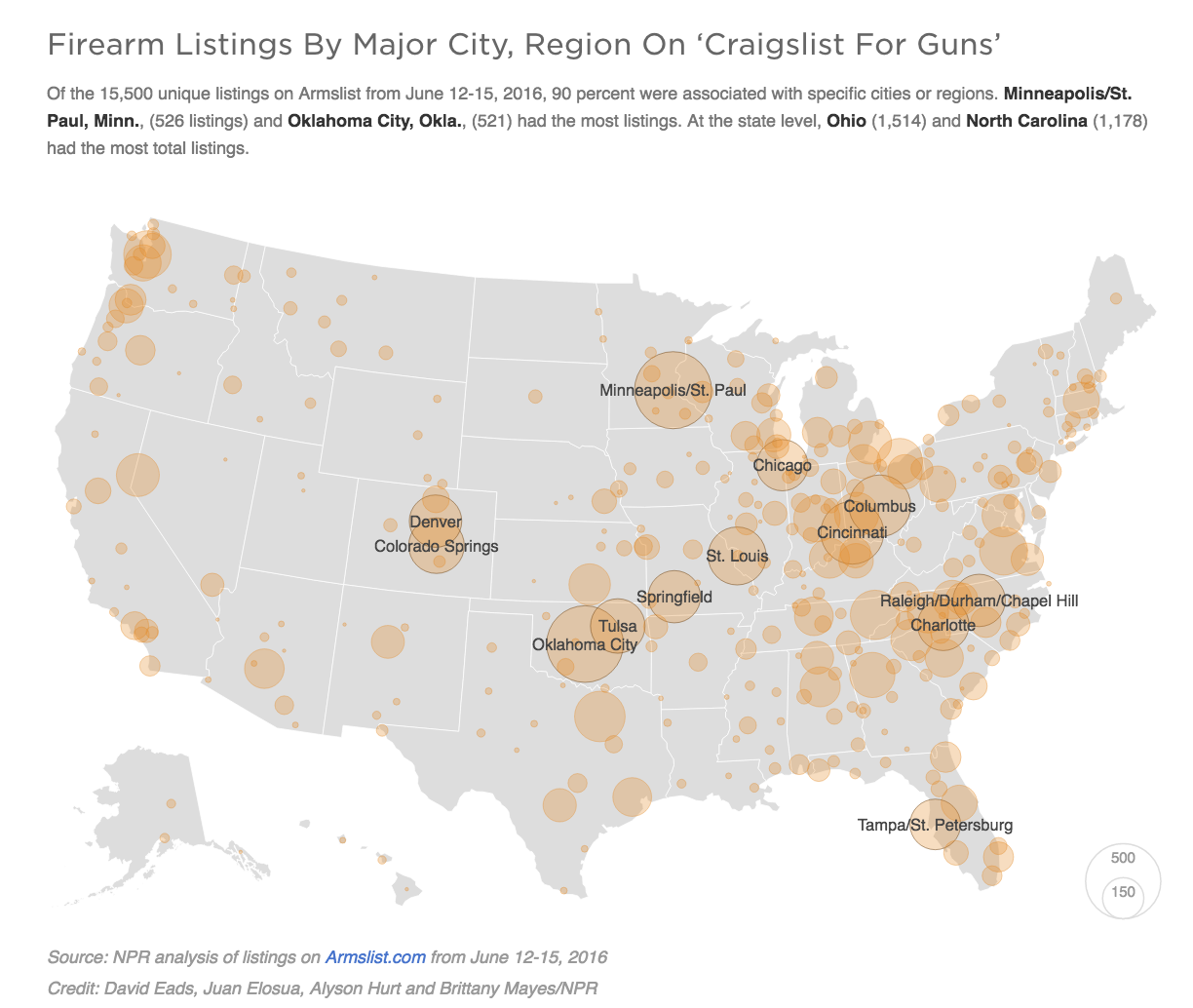
Semi-Automatic Weapons Without A Background Check Can Be Just A Click AwayMap by Visuals Team intern Brittany Mayes

Are you data-curious, internet savvy, and interested in journalism? Do you draw, design, or write code? We are looking for you.

We’ve had journalists who are learning to code, programmers who are learning about journalism, designers who love data graphics, designers who love UX, reporters who love data, and illustrators who make beautiful things.

Does this sound like you? Please join our team! It isn’t always easy, but it is very rewarding. You’ll learn a ton and you’ll have a lot of fun.

The internship runs from May 22, 2017 to August 11, 2017. Applications are due Sunday, March 5, 2017 at 11:59pm eastern.

Here’s how to apply

Read about our expectations and selection process and then apply now!

Into pictures? Check out our photo editing internship.

Notes from TechCon16

by Pam Parker | Director of Communications and Social Impact | CPT12

If you’re like me, you spend a  lot of time in front of your computer screen busily creating lists and ticking off the items. Sure I seek input from outside my day-to-day work life on how to connect better with our audience; how to compel our viewers to support the work we do. But most of the time I’m working in isolation from the larger, connected community of colleagues we call PBS.

TechCon is an opportunity to burst that isolated bubble. It’s a chance to reconnect with a group of really smart, creative people who have experimented in the digital and tech space.
So with that preamble, here are my three reasons to attend TechCon.

1. You’re not alone! While at your office you’re certainly interacting with the really smart people at your station but at TechCon, you’re connecting with people from all over the country who are experimenting, creating, and tackling issues that are common to all of us. You’ll learn a ton about what’s happening at PBS in Washington and what’s working around the country. For those of us who cannot attend the Annual Meeting, the sneak peek of the programming pipeline is incredible.

2. You’ll meet people who are in your shoes…and who have walked through the same challenges. You’ll take away ideas but perhaps more important, you’ll take away contacts (and friendships) that will serve you in the future. The community I’ve been able to build by being face-to-face with station colleagues has given me important relationships to turn to for information and concepts.


3. You’ll be able to look at your challenges from a 10,000-foot view. Seeing the big picture always helps me make sense of the individual tasks and goals I need to achieve. Zooming out to that macro level helps to put things in perspective and gives me the long view to plan beyond the immediate horizon. Plus the keynote speaker is always an expansive thinker who helps to make sense of trends.


Take advantage of the opportunity to get out of your every day work life and go beyond your own great ideas to learn more great ideas among a lot of inspired, clever, and talented people. You’re guaranteed to walk away with more than you thought possible and you’ll certainly meet people to whom you can turn in the future.

This year TechCon is back at Caesars Palace.  Have you registered yet? Want more information? Check out this year's agenda!

Consider applying for the Digital Immersion Project; find details here!

Introducing: Radiotopia Ad Music from JD Samson

JD SamsonRadiotopia turns three this month, and to celebrate we launched a fancy new website! We also commissioned our first-ever original ad music from DJ, producer and musician JD Samson, who leads the band MEN and is one-third of the electronic-punk-feminist performance project, Le Tigre. Besides writing some fantastic music for us, JD kindly answered a few questions about working on the project.

Hi JD Samson! What appealed to you about working with Radiotopia to create original ad music?

I love Radiotopia’s programming, and felt really excited to be seen as an articulation of their aesthetic. Creating this kind of accompaniment was extremely meditative and exploratory for me, which is something I like to challenge myself with often.

How did the process compare with your usual song-writing approach?

The process was really interesting to me because there were so many aspects of the music that needed to make sense for ALL the producers. Some people wanted happier tunes, some people sad, so I had to really make sure the music was atmospheric, but not a “song”. I had to ensure the tone was kind of dull. Not too extreme in either direction, and make sure there weren’t a lot of melodies crowding the space. It was fun for me to break down my compositions after I made them and often heard the comment “make it more boring.” I honestly loved this direction because it forced me to see aspects of my production that were unnecessary in this case.

What are some of your favorite podcasts?

As a music composer/producer, I love Song Exploder, I could listen to it all day long. Also, I love 2 Dope Queens, Sagitarian Matters by my friend Nicole Georges, and Criminal. There are many more but these are some of my faves.

Is there anything on your horizon we can share with Radiotopia fans?

I’m in the middle of creating a documentary series, writing a book, teaching at NYU, and possibly making my own podcast! I’ve been focusing a bit more on some other aspects of my life, that began before the music industry fell on me…. but of course continuing to make music and create performances that establish new relationships to songs and songwriting, and how to make activist work after the dawn of the internet.
Keep your ears open for upcoming Radiotopia episodes with JD’s music, or hear her work in the “Meet the Radiotopians” clip at the top of our new homepage. You can learn more about JD on her website, and keep up with her @jdsamson.

The post Introducing: Radiotopia Ad Music from JD Samson appeared first on PRX.

Webinars: Road to TechCon


Join PBS Digital for two encore performances of the most popular sessions from TechCon16.


On Thursday, February 16th Dan Haggerty will take us through his Joy of Analytics session, sharing out insights from the PBS audience and showing you step-by-step how to conduct the same analysis with your data. You’ll learn techniques like “How are my links on PBS.org performing?” and “What are my most popular shows in the Video Portal?" to “What's driving donations on my site?” and “What videos are my Passport members watching?” Don't miss it! Go here to register.


Then join us Thursday, February 23rd with Matt Schoch's Technology, Data & Editorial: A Digital Match Made in Heaven. Matt will cover the ways digital technology and development, data and analytics and editorial functions can work together to make digital projects more successful. To register head here.


Are you registered for TechCon?

Make sure you check out the evolving TechCon agenda and continue to check back as we get closer to conference time for more updates.


Black History Month 2017

Join Black Culture Connection (BCC) for 2017 Black History Month celebrations!

This year, the BCC is turning its lens onto audiences with the return of #MyBlackHistory a social media campaign that asks audiences to share how Black History & Culture influences their lives and directly from their point of view.

Every week, the BCC will release a series of GIFs and time-lapse videos with quotes from prominent voices in Black history and present. In turn, we'll ask audiences to help identity their favorite and inspiring quotes, and share them using the hashtag #MyBlackHistory.

Many of these quotes are tied to the men & women featured in the films streaming this BHM. With this in mind, we hope your social teams will help us unearth inspirational quotes, moments, sayings from the people featured in your priority films. We¹d love to highlight them in #MyBlackHistory and have you use the hashtag to do the same.

Please reach out to nreley@pbs.org to sign up for weekly social updates.

Additional BHM Assets:
E-banner/ Video: Please see The Source.
Press release: Black History Month 2017

Discover more BCC content below.

Browse BCC Bentomatics:
Black History Month 2017
#MyBlackHistory Social Media Campaign
10 Top Black History Documentaries
10 Black Authors Everyone Should Read
10 Little Known Black History Facts
10 Different Ways to look at Iconic Black Pioneers

To gain access to any of the available Black History Month Bentomatics for your station site, submit your request via the Digital Support Portal.

Happy Black History Month!

Nicole Eley-Carr | Sr. Manager, Content Strategy and Partnerships | Digital

PRX Podcast Garage: Five Things with Jody Avirgan

Five Things is an ongoing live series at the PRX Podcast Garage hosted by Julie Shapiro (EP, Radiotopia). The series invites some of today’s most talented and successful producers, artists, writers and thinkers to share five things —audio, visuals, books, objects or something else entirely — that have shaped their creative practice over time, and inform how they approach work today. In short: interesting people share cool stuff they love.

For the second installment of Five Things, we welcomed Jody Avirganhost of the FiveThirtyEight politics podcast, producer of the upcoming Thirty for Thirty documentary podcast from ESPN, ultimate frisbee enthusiast and champion of sesame sticks and dried mango. Watch a video of the conversation and recap Jody’s Five Things below.

#1: Video for Dress Sexy at My Funeral, by Smog

“This is my favorite YouTube video of all time. It happens to include one of my favorite songs of all time, but more than anything it’s a random captured moment of peace that gives a window into a stranger’s life. If you read the comments you learn a tragic coda. I’ve never really brought myself to look into the life of Calab, but I’m grateful for this moment.”

#2: “On Leadership”, a book by legendary basketball player and coach, John Wooden

Five Things“This book sometimes slips into corporate-CEO speak, but there’s a lot of wisdom here. I’ve learned more from sports than almost anything. Two ideas in particular stick with me. One is the idea of “competitive greatness,” which is basically another name for “grace under pressure.” I think that your capacity to learn and perform under pressure is far more important than talent or skillset. The other thing I love about Wooden is his focus on process over outcomes. Winning/success is almost a byproduct, and afterthought, of doing all the steps along the way with attention and enthusiasm.”

#3: Lord God Bird, by Long Haul Productions and Sufjan Stevens

“A Five Thingsbeautiful radio piece that listens as much as it talks. I love how it just goes to a place and sits. It’s un-narrated, which I don’t think people do enough, and it’s full of great moments. It’s also incredibly indulgent! Take an indie rock singer, have them write a song about a bird, make it over 10 minutes? Why not! But there’s a valuable lesson here, if someone’s going to let you get away with a piece like this, go for it.”

#4: “The punctum”, from Roland Barthes’ Camera Lucida

Five Things“The basic idea here is that some art is full of all the perfect elements of content, composition, execution… but still somehow lack that thing that “shoots out of it like an arrow.” Thinking about this taught me to be strategic about trying to create these moments in my work. When you have something that you think can be a punctum, make sure you’re getting out of the way and letting it do its thing.”

#5:  Picture on the Wall, by Phyllis Dillon

Just one of my favorite songs from what I think is the best moment in musical history: 1960s Jamaica. I love that many of the early reggae songs were soul covers, which is a reminder that every artist, even the ones we think of as sui generis, starts out as a deep fan. Fandom is a perfectly good place to start – it’s kind of the only place to start. So, copy the stuff you love.”

Honorable Mention

The Charles Mingus CAT-alog for Toilet Training Your Cat

One More Thing
Five Things

Prompted by Julie, Jody also shared responses to a call out on the What’s the Point podcast for listeners to track, visualize and illustrate a week’s worth of podcast listening via postcard.

Next Up for Five Things

March 22nd: Jenna Weiss-Berman (podcast producer, co-founder of Pineapple Street Media, former director of audio for BuzzFeed).

About Jody Avirgan
Jody is the host of the FiveThirtyEight politics podcast. His next venture is a series of sports-related audio docs under the “30 for 30” umbrella, coming spring 2017. Before ESPN, he was at WNYC’s Brian Lehrer Show, did reporting for the WNYC newsroom, and went on air and asked you for money during the pledge drive. He’s worked with On The Media, Radiolab, 99% Invisible, Marketplace, Studio 360 and many more. On the side, he hosts the comedy and storytelling show Ask Roulette, where strangers ask each other questions live on stage. He lives in Sunset Park, Brooklyn. Find him online at @jodyavirgan and www.jodyavirgan.com.

About Julie Shapiro
Julie Shapiro is the executive producer of Radiotopia. From 2014–15, she was the executive producer of the Australian Broadcasting Corporation’s Creative Audio Unit. In 2000 she co-founded the Third Coast International Audio Festival, where as artistic director, she prioritized innovative audio and a cross-pollinating international listening culture. Shapiro has taught radio to university students, presented at conferences all over the globe, and produced stories for the airwaves and podcasts in the US and beyond. You can find her on twitter @jatomic.

The post PRX Podcast Garage: Five Things with Jody Avirgan appeared first on PRX.

Announcing MisinfoCon

Welcome to another Friday, hacks and hackers! We’ve got a bigger announcement than usual this week: .@HacksHackers, @firstdraftnews and @niemanfdn present Misinfocon: A summit on misinformation...

Visit Hacks/Hackers to read the full post and join our community.

YoPro Goes to TechCon!


For the past three years YoProWo [n: Yo-Pro-Woah], the in-person young professional development event, has been held prior to Annual Meeting. YoProWo events are geared towards helping young professionals network and grow their working knowledge of the public media system, and industry wide trends through engaging and collaborative discussions.This year along with the YoProWo event at the PBS Annual Meeting in San Diego,YoPro is expanding its presence to PBS TechCon in Las Vegas.


For nearly 40 years PBS TechCon has been a place where technology professionals can gather and meet to learn more about technological advances, best practices and share station success stories with their peers. With the added involvement of PBS Digital, the past three years PBS TechCon is quickly becoming the place for digitally-focused conversations.


We believe that young professionals are agents of change in their workplaces across the system, especially in the digital space. In addition to the expanded presence at TechCon, YoPro is excited to offer two scholarships to attend PBS TechCon!


This scholarship is focused on staff who normally wouldn’t be able to attend a PBS conference. Scholarship applicants should meet the following eligibility requirements:
  • Currently work at a PBS member station
  • Work at the station for 0-3 years
  • Are 35 years of age or younger;
  • Have NOT previously attended PBS TechCon;
  • Attend the YoPro session
  • Have interest in all things digital


Apply for the scholarship today or forward it to a colleague who might be interested! The deadline for submission is March 10th and selected applicants will be notified no later than March 15th.

Send all questions about this scholarship opportunity or general YoPro inquiries to yoprowo@pbs.org. If you are interested in receiving information and news about upcoming YoPro opportunities, sign up for the mailing list today!

Amy Lust | Assistant Director | PBS Digital
Jen Hinders | Director | PBS Digital

Learn More With Our CDM/Media Manager Training Series


As part of the new PBS Digital Core Data Model project, the new Media Manager will replace the current Merlin and COVE admin that stations and national producers use every day to upload and update their video content.

Want to learn a little more? Click here to watch a recent webinar and learn the Media Manager basics.

To better assist you as we move forward, PBS Digital will host weekly webinars from now until March to keep you updated and informed. Each webinar will take place at 3:00pm EST. These webinars are targeted towards local stations, but national producers are invited to join. Webinars will repeat for 6 weeks, allowing attendees to review concepts and practice within their staging environments.

"Do What You Do in Merlin in Media Manager and Curate"
We will discuss current functionality in Merlin/COVE that can be achieved in Media Manager.

Wednesday, January 25 - Register Now
Wednesday, February 1 - Register Now
Wednesday, February 8 - Register Now
Tuesday, February 14 - Register Now
Tuesday, February 21 - Register Now
Tuesday, February 28 - Register Now

"New Functionality for COVE Through Media Manager and Curate"
We will discuss new functionality available in Media Manger as well as new terminology, and we'll also review the activation plan.

Thursday, January 26 - Register Now
Thursday, February 2 - Register Now
Thursday, February 9 - Register Now
Wednesday, February 15 - Register Now
Wednesday, February 22 - Register Now
Wednesday, March 1 - Register Now

As always, please email your station representative with any questions or concerns, or email our team at spi@pbs.org.

TechCon: A Digital Marketplace for Exchanging Ideas and Learning

By Larry Rohrer | Director of Content | South Dakota Public Broadcasting | DMAC

If you have been around the system long enough, you can recall when annual meetings were only accessible in person, you realize now that iMA was not ahead of its time, and you understand the value from an industry conference is in the hallway peer to peer as well in the break-out sessions.

There may be no better example going than TechCon.

Look, everyone is wrestling with “digital” and we all know the questions… What is the right presence and digital presentation our system or for YOUR station? How much can I afford to invest? Where and How? And how do I measure my return? You would be amazed at how many answers are attending and walking around at TechCon. Station by station, these questions are being answered.

I have watched the conference grow the last couple of years, adding elements regarding station work flow, program production and audience development across platforms, and (dare I say it) Fundraising! But, in my opinion, the greatest personality trait of TechCon is the willingness of attendees from all station sizes and flavors to share their experiences. You will see it in the break out session titles and you will experience it in the casual hall-way conversions.

At South Dakota Public Broadcasting, we have been making a VERY concerted effort to grow our digital media presences and audience. But we are working with limited resources like you. Each of the last several TechCon meetings have provided idea starters for use to incorporate digital production into the workflow of radio and television producers, drive more and more people to the “donate button” even if they only know us from Facebook. And each of the last several TechCon meetings have provided me with useful interaction with station peers trying digital fundraising with varying levels of success with; with station peers sharing the value of their “digital-first” strategy and why it builds audience online and on-air; with station peers sharing their experience restructuring their production centers, master-controls, and audience outreach to include digital components.

If you are at “Where do I start” or “What can we do next” I would encourage you to consider representing your station at TechCon. It’s Vegas baby, but it’s a sure bet you will bring home valuable ideas and enthusiasm.

TechCon is a fixture on our professional development calendar; I would encourage you to put it on your calendar as well. Digital workflow, program distribution, tips and techniques for local stations in a digital world are NOT one size fits all. Neither is TechCon. When you see me there, ask me about live streaming, teaching old producers the value of new digital tricks, and the public broadcasting life in a REALLY red state.

To register for TechCon head here.  Want more information? Check out this year's agenda!
Consider applying for the Digital Immersion Project; find details here!

On the Design of Hyperlocal Communications

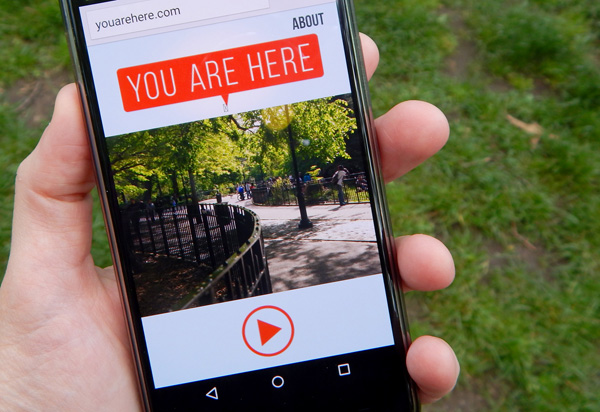
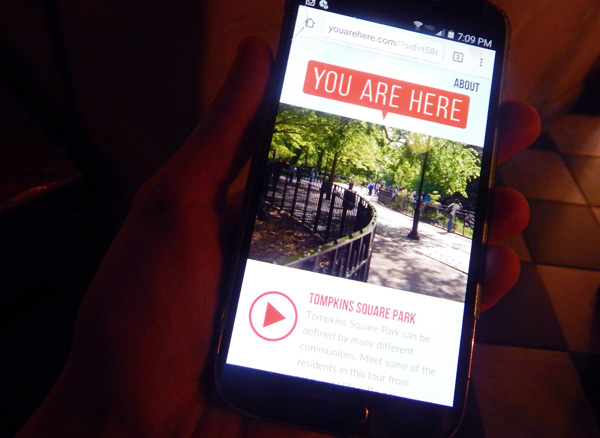
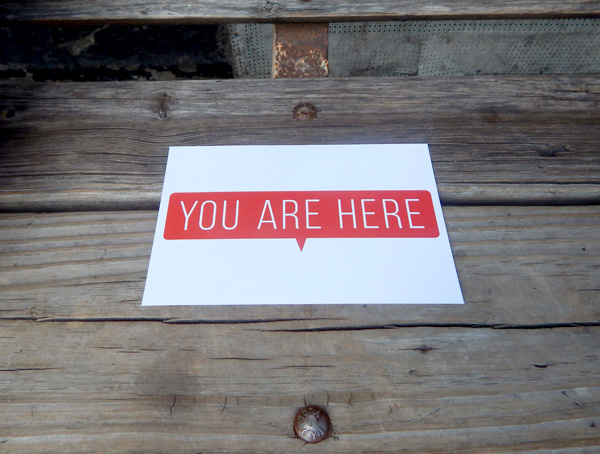
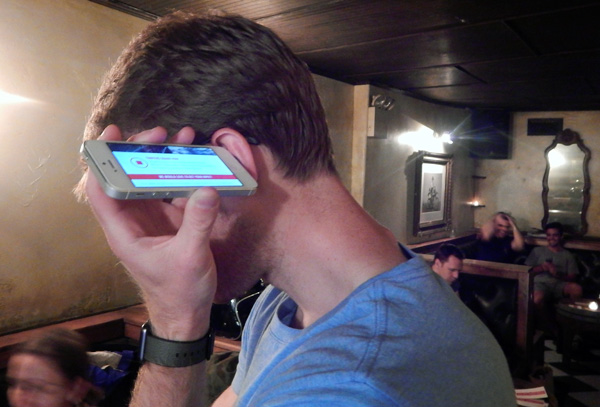
At a time when the accuracy of news sources is in question, and politicians want to restrict access to information, hyperlocal communications have more potential than ever. You Are Here is a project that essentially consists of a Wifi signal that broadcasts a single website. Users can connect to it on their cell phones to leave comments on a curated topic. The project was designed by a team of Tow Fellows including Sarah Grant, Susan McGregor, Benjamen Walker, Dan Phiffer, and Amelia Marzec. Two installations of the project occurred in Tompkins Square Park and the High Line. These are some observations on the challenges of attracting users to a hyperlocal project.

you are here app
The public expectation of an open Wifi signal is simply that there is potential to connect to the Internet for free. If they find they aren’t able to complete their specific task, which may be to post to Instagram in the park, they will drop off and look for another option. This is the biggest hurdle for any Wifi-based project. You Are Here relies on messaging through posters at the sites of installation to instruct users on how to encounter the project. The audiences and needs in those locations–a barber and a restaurant–are different than the audiences that appear in the interviews for the curated content, which are parkgoers to Tompkins Square Park and the High Line.

on location
The design of the system must fit the needs of the community. One of the requirements for success is to go into an existing community and find out what their specific needs are, rather than designing a system and then trying to build a community around it. This was a challenge with You Are Here. Hyperlocal communications would be most beneficial when there is a driving need for us to rely on our neighbors.

postcard
Designing the systems that carry information must be considered from every angle. A couple of the previous projects by the team members of You Are Here were designed as systems of protest: Occupy.here by Dan Phiffer, and Signal Strength by Amelia Marzec. Inherent in their design is the expectation for their use in a democratic setting, where users would set the tone of the conversations. These methods focus on the decentralization of information, and are less effective when used in a setting that requires top-down information.

Recently considered for the purposes of advertising, You Are Here and similar systems lack significant traffic that would validate them for use in a corporate setting. The failures of these systems as money-making machines contain the potential for them to be used for their original purposes—to give rise to citizen journalism and peer-to-peer communications.

user
For the long term, users need to care about the content and their interactions with each other. Within commenting systems, users will return when they are emotionally invested—even if that means they are having an argument online. Would an old-fashioned bulletin board be more effective? One benefit of that would be that people without access to smartphones would be able to participate.

In the event of a true emergency, with no connection to the internet, You Are Here could be a valuable addition to a specific local community, possibly if it were able to operate as a forum. Residents would be able to share how they got access to medical care and ATMs, or to discuss rumors from the outside. As we move into uncertain times regarding the use and delivery of information, we will need to be vigilant in finding the truth tellers in our communities that are focused on the greater good.

New Ideas for Automation in the Newsroom


How can automation help reduce the cost of story discovery in a newsroom? As a Tow fellow in 2015, I had the opportunity to explore this question by building a tool, available online at campaign-finance.org, that automates some of the exploratory data analysis associated with investigative work.

Newsrooms need automated investigative tools now more than ever because their human investigative resources have been decimated. Since the 2008 crash, among the most severely cut departments have been the ones that do long-term, in-depth investigative reporting. Enterprise ideas are the hardest kinds of story ideas to come up with: you don’t know what you don’t know about what’s going wrong in our public institutions. Most investigative stories are reactive, meaning they result from a tip from a whistleblower, versus being proactive, resulting from the reporter’s own inquiry. Since newsrooms were cutting investigative resources, I wondered if we could build computational systems to help the remaining reporters do their jobs more easily and proactively discover story ideas in public data.

During my Tow fellowship, I explored whether a kind of custom software called a Story Discovery Engine could facilitate enterprise reporting on campaign finance issues. (It can.) I was curious about campaign finance in anticipation of the 2016 US presidential election. I had heard a lot about dark money and superPACs in the wake of the 2010 Citizens United decision, but I knew there was a vast amount I didn’t understand about this complex system. However, I did know that reporters who work with campaign finance data spend a lot of time doing the same routine things: downloading data from the FEC and other sources, cleaning it, associating data with known entities, and building basic visualizations. Any time you have routine processes, there is an opportunity for automation.

The last time I built a Story Discovery Engine, I optimized it to find a story in education data. This time, instead of starting with my own story idea, I started by interviewing other journalists. I specifically asked about the kinds of stories they look for, and what the indicators are that suggest a story might be hiding in the data.

To an outsider, these indicators are almost impossible to spot. But to these campaign finance gurus, the signs of corruption were clear as day. One common indicator is administrative overspending. Nonprofit organizations are required to report their income and spending. If the organization spends an unusually high percentage of its income on administration, it is often an indicator that something is amiss internally, and there is likely an opportunity for a story.

However, deciding what percentage is “unusually high” is a judgment call. It is also a judgment call to determine whether there is a story worth pursuing. Some fluctuation in administrative expenses is normal. There might be a perfectly good reason for an organization to have unusually high administrative expenses; a high percentage does not necessarily imply corruption. This ambiguity is the reason that it is unwise to build a system that claims to automatically identify investigative story ideas. It would be unfair (not to mention unethical) to accuse an organization or a public servant of misdeeds based on a naïve computational analysis. It requires human decision-making to fully consider what is going on in a given situation.

This human component is essential for newsrooms to remember. Computers can’t independently determine corruption. Currently, a human is necessary in any automated investigative system. Instead of a fully automated investigative system, in this case I built a human-in-the-loop investigative system. Most people dream of full automation: cars that drive themselves, robots that deliver packages. I don’t dream of this. I’m fine with a world that includes people. I like human judgment, as flawed as it is. I like the drama and the idiosyncrasies of human systems. The difference between a fully autonomous system and a human-in-the-loop system is like the difference between a drone and a jet pack. The drone is autonomous: it is programmed to go to a particular location, drop a bomb or take a picture, and then come back to base by itself. A jet pack (in theory) is designed to be strapped onto the back of a human being in order to accelerate the human’s effort. Both are legitimate system models, and each is useful for a different type of task.

Bailiwick, the system that I built, automates some of the grunt work associated with downloading FEC data, cleaning it, putting it into a database, organizing it into recognizable categories, and creating simple visualizations. The visualizations, plus the knowledge engineering layer that organizes the data into recognizable categories, allow a reporter to quickly make sense of complex data. Bailiwick analyzes data for each of the thousands of 2016 federal candidates and for 17,000+ active political committees. There is also an alerting function that allows a user to set up a personal profile of candidates or races to follow. A Pennsylvania reporter, for example, could choose to follow the two frontrunners in the PA Senate race and a handful of frontrunners in PA House races. Bailiwick sends an alert to the reporter via a private Slack channel every time there is a filing by a candidate the reporter follows. Setting automatic alerts, via Slack or a service like IFTT or Zapier, has long been known as an effective way to use automation in the newsroom.

Bailiwick is not small. As of January 1, 2017, the system included 11,032 lines of Python; 13,158 lines of HTML; 40,113 lines of JavaScript; 13,601 lines of CSS; 2.9 million lines of text; 2,892 lines of markdown; and approximately 94.2 million records in the database. The number of records increases every time new filings are added to the FEC site. The system gathers small updates from FEC every night, and then it completely refreshes all of its data from FEC once a week.

Bailiwick is not designed for beginners, but rather for experienced reporters who are specifically looking to find stories in campaign finance data. Top-tier news organizations like the New York Times or ProPublica or the Center for Public Integrity have software developers on staff who build custom, non-public-facing software for reporters to use on campaign finance data. Bailiwick is designed for organizations that don’t have internal developers.

For an investigative project, Bailiwick was relatively inexpensive to build. In Democracy’s Detectives: The Economics of Investigative Journalism, James T. Hamilton outlines some of the costs and benefits associated with complex investigative projects. He estimates that “Deadly Force,” the Washington Post’s 1999 Pulitzer Prize-winning story on D.C. police shootings, cost about $487,000 (in 2013 dollars) to create. Hamilton writes: “While accountability reporting can cost media outlets thousands of dollars, it generates millions in net benefits to society by changing public policy.” Watchdog reporting is good for society, but measuring its impact and its cost is not straightforward. The starting price varies by industry as well. Video is more expensive than print or digital: production costs for a single hour-long news documentary for a show like PBS Frontline start around $500,000 and can go upwards of $1 million.

A news app like Bailiwick starts at about $50,000 in up-front software development costs. It currently costs me about $1,000 a month to maintain; I plan to offer it for free online for about a year. Newsrooms are likely hesitant to commit to spending $50K on custom software projects. In the future, newsrooms could consider joining together to fund similar projects.

It is clear that news apps like Bailiwick can help newsrooms to produce more data-driven investigative work and can lower the cost of discovery for these investigative stories. Newsrooms who want to adopt this kind of automation will need to commit to up-front costs that are not insubstantial, and will need to plan for a development time frame that is longer than the customary time frame for daily or weekly news production. However, newsrooms excel at developing and meeting production timelines, so this challenge will likely not be an obstacle. It is also helpful to think about automated investigation as a kind of artisanal production. Data-driven enterprise stories are not easily mass-produced; they are artisanal products. Small-scale automation using human-in-the-loop systems is a cost-effective way to increase production of these high-quality stories, just as a small bakery might buy a large-capacity mixer in order to produce more loaves of bread. As newsrooms increase their production of watchdog reporting in the public interest, society will benefit.

Image via Sakena on Flickr.

Help Support and #FreeThePress in 2017

In December 2016, the Committee to Protect Journalists counted 259 journalists imprisoned worldwide, more than at any time since the group began its annual imprisoned census in 1990. On January 25th and 26th, we hope you will join our effort to offer moral support and call for greater press freedom, by sharing the image below on social media along with the #FreeThePress hashtag. 


Journalists and others imprisoned for “crimes” like exercising free speech have said that communication from the outside world is a vital form of support. As a Chinese activist once put it:

“When letters and cards arrive at the prison like snowflakes, the prison knows that a lot of people are paying attention to these prisoners.”

With input from the Committee to Protect Journalists, the following group of organizations are holding postcard-writing and social media campaigns to highlight the situations of seven journalists. We hope you’ll join us by lending your support on social media.

cjs_square #cjsglobal-3edited1 TowCenter-CSJExternal-NoHeart
TMAC logo_no outline PhilipMerrillLogo_Fearless

ETHIOPIA

Ethiopian journalists work in some of Africa’s most restrictive conditions. Of the 16 journalists imprisoned there in December, two have spent a decade behind bars.

Darsema Sori, Radio Bilal
#DarsemaSori

Darsema and a colleague at the faith-based Radio Bilal were arrested in early 2015 and charged with 18 other defendants for allegedly inciting extremist ideology and planning to overthrow the government. Darsema is senior editor at the radio station, which extensively covered the Muslim community’s protests of a number of government actions – including the closing of Ethiopia’s only Muslim college. 

VENEZUELA

A year ago, there were no journalists imprisoned in the Americas. But this December, CPJ identified journalists jailed for their work in Cuba, Panama and Venezuela.

Braulio Jatar Alonso, Reporte Confidencial
@BraulioJatarA

Jatar was arrested in September a day after he wrote about protestors who greeted President Marduro with jeers and by banging pots and pans. Authorities claimed he was found with thousands of dollars in cash to be used for a “terror attack.” A legal rights lawyer charged that authorities planted the money and arrested Jatar, who is also a lawyer and political activist, for posting videos of the protest on his site.

CHINA

China has ranked among the world’s worst jailers of journalists for years; 38 were in prison in December, as Beijing deepened its crackdown on coverage of protests and human rights abuses.

Ilham Tohti, Uighurbiz
#IlhamTohti

Tohti is a Uighur scholar, writer and blogger who was arrested in early 2014. Authorities closed his website, which published articles on social issues in Chinese and Uighur. Tohti was sentenced to life in prison for promoting Uighur separatism on his website. He denied the charges, and his sentence was protested by the U.S. State Department, the European Union, and human rights organizations. 

INDIA

One of the riskiest areas for journalists in India is the Bastar region in the state of Chhattisgarh, epicenter of the conflict between Maoists and security forces. Pressures come from both sides in the conflict and are most severe for those reporting there full-time.

Santoch Yadav, freelance

Yadav, a freelancer in the Bastar region, reports for several local dailies, often on allegations of human rights abuses by police against tribal communities. In 2015 he was arrested and charged with rioting, criminal conspiracy, attempted murder, and supporting and aiding terrorist groups. His colleagues said the charges were fabrications brought in retaliation for Yadav’s human rights reporting.

TURKEY

Following the failed coup attempt of summer 2016, the Turkish government intensified its media crackdown, shutting more than 100 news outlets and arresting dozens of journalists. The 81 imprisoned in Turkey in December accounted for nearly a third of the global total of imprisoned journalists.

Musa Kart, Cumhuriyet
@MusaKart

Cartoonist Musa Kart was one of 12 staff and board members of Cumhuriyet, Turkey’s oldest newspaper, detained in October.  An official statement said they were suspected of producing propaganda for the Kurdistan Workers’ Party (PKK) and for what the government calls the Fethullah Gülen Terror Organization (FETÖ), two rival groups the government labels terrorist organizations. No date is set for Kart’s trial. 

IRAN

CPJ’s December census marked the first time in eight years that Iran was not among the five countries with the largest imprisoned journalist populations. But eight journalists remained jailed in December, two of them arrested in 2016.

Issa Saharkhiz, freelance
#IssaSaharkhiz

Saharkhiz has been imprisoned three times in seven years. His most recent arrest was in 2015, which led to his conviction for “insulting the Supreme Leader” and a three-year prison sentence, later reduced to 21 months. Saharkhiz is a prominent journalist who contributed to the opposition website Rooz Online. He still faces charges of “insulting the head of the judiciary.” 


EGYPT

Egypt had the third-largest population of imprisoned journalists – a total of 25 – in CPJ’s 2016 census, after Turkey and China.

Mahmoud Abou Zeid (Shawkan), freelance
#shawkan

Freelance photographer Abou Zeid was detained in 2013 while covering clashes between Egyptian security forces and supporters of ousted President Mohamed Morsi. After more than two years of pretrial detention, he was charged with weapons possession, illegal assembly, murder, and attempted murder. His trial was ongoing in late 2016, In November, he was honored in absentia with CPJ’s International Press Award.  

Twitter and managing journalistic work: Between distraction and optimization

Paul-Stickland_Dinosaur-&-Twitter-web

Note: This is the fourth post in the Beyond 140 characters series, which investigates how, why, and under what circumstances political journalists engage with Twitter. This piece shares some of the project’s key findings. The previous post reflected on how the nature of news events shape political journalists’ Twitter engagement.


Multi-platform and digital storytelling, understanding metrics and audiences, interactivity, and branding—these are just some of the issues facing journalists today, all while using tools and techniques that weren’t possible ten years ago, and with the added pressure of identifying a unique angle or scoop. If only some of these tasks are to be achieved and well executed in a given work shift, 24 hours in a day may not be enough. This is a theme—one of managing the many tasks and workflows—that has emerged in my interviews with 26 political journalists who work for some of the top legacy media organizations in the U.S.

Twitter has become an established journalistic resource, one that reporters are expected to constantly and actively utilize (as I discussed in a previous post on organizational pressures and institutional policies). Early skepticism appears to have morphed into conventional wisdom that, to use one journalist’s own words, “if you’re a journalist and not on Twitter, you’re a dinosaur.” But the story is not that simple. Rather, it is one of constant negotiation and evaluating opportunity costs.


Twitter as a distraction from core tasks

Among the journalists I spoke to, there appear to be two dominant, but opposing perceptions about Twitter’s place in everyday workflows.

The first narrative is one of Twitter as a distraction, where it competes for attention with traditional operations and production goals. Resources are limited, and the more space Twitter takes up in a journalist’s day, the less disposable time and energy remains for the items he or she needs to deliver. One journalist extensively talked about Twitter as a constant stream of overwhelming information and described his experience with the platform as follows:

It’s sort of like telling me that I should be watching 15 TV channels at the same time. I’m sorry, but I’m going to report and write and give you something of value, and I’m going to turn all that crap off that’s not going to matter to me.

Many others provided examples of distraction and information overload, which are taking a toll on productivity. Individuals with such experiences tended to engage with Twitter selectively and developed an increased awareness of the need to switch off. These journalists unanimously said they benefited from being more focused on their work. After all, as many highlighted, good writing is a craft and to do it well takes time and attention. One journalist explained his frustration:

We’re getting hit every week with a new tool or something else that’s cool. I got an email yesterday saying, ‘Hey, come learn Instagram.’ And then last week it was ‘Hey, come learn something else’. Are you kidding me?

On the flip side, minimizing distraction clearly involves opportunity costs. Many journalists are aware of this tradeoff, but have come to terms with it as the lesser of two evils. For example, not logging on at all or turning off push notifications can lead to missing breaking news or content shared by key individuals, especially politicians and their operatives, who are amongst the keenest adopters of Twitter as an immediate and interactive tool for public dialogue, outreach and mobilizing. These journalists risk falling a step behind colleagues and competitors, especially so when news might not be available elsewhere.

While news organizations may be willing to trade occasional Twitter abstinence for a better journalistic end product, things become trickier when journalists’ personal preferences immediately challenge their employer’s overall social media strategy. For example, how does management deal with those journalists who engage infrequently or inconsistently, when Twitter has long become an integral channel of content distribution for that news organization? Or how does one reconcile the incompatibility of the brand a journalist cultivates on Twitter with the core values and cultures of his or her employer? One journalist admitted:

I’ve kind of made my peace with it. It is what it is. If I don’t get a job because I don’t have a Twitter presence then, well, I don’t get a fucking job. That’s fine… But hire me or fire me for the stories, not Twitter or my tweets. I’m sure my bosses would like me to tweet more, but frankly, it’s just not a priority.


Twitter as a tool to optimize workflows

The second narrative is an opposing and more optimistic one, of Twitter as a tool to manage and optimize workflows. The factors that shape such perceptions aren’t dissimilar from those discussed above: journalists also referred to editorial and temporal pressures to produce content, for example, or an institutional drive towards branding or creating multi-platform visibility. But rather than considering Twitter a distraction from any one of such objectives, journalists view the platform as an extension of or an addition to the available means of achieving these. What sets those individuals apart is how they appropriate Twitter in such a way that it “fits into” the tasks and procedures they are already working on.

The vast majority of journalists I spoke to were generally hesitant to pinpoint concrete, realized benefits of their engagement with Twitter, largely due to the difficulty of assessing both short- and long-term outcomes. Yet, four distinct ways of perceiving Twitter in their day-to-day routines emerged, especially during intense news periods:


  • Twitter as an early warning system, which immediately signals breaking news and alerts journalists of big stories. One journalist told me:

    I like the immediacy of Twitter and I like all the things that it’s designed to do. I can get the news that I want from various sources all at the same time, and I get it quickly. I feel like when something big is happening, I know it instantly – 20 minutes before you’re going to get the breaking news or an email from a news organization. It has become a constant in my life. It’s my favorite.

  • Twitter as a digital notebook, which allows journalists to record (in a note-taking style, after all a tweet is only 140 characters) and immediately publish short snippets of information. Not only are journalists able to realize a competitive advantage with this approach in terms of being first to push out content. They are also later able to go back to their Twitter timeline and use its content as the backbone of the actual story they are tasked to produce. One journalist explained:

    I initially did not want to use Twitter at all. I thought I was just going to stay [at my news organization] as a writer on the web and for print.  But my editor at the time said we really need to adapt to social media. Use it as your notebook. And so I have really taken that to heart. A reporter’s notebook traditionally has always been where they keep their notes, their asides, observation, color, different scenes.  And they eventually call from their notebook and put it into a story. Twitter to me is groundbreaking for political reporters especially because you can now share your notebook with the whole world. If I know something is accurate, I’ve seen it with my own eyes, or I’ve heard them say it to me, I put it in my notebook and I have it there. Now I can also put it on Twitter. So it enables me to build a bigger story. Twitter I think is a component of your storytelling as a reporter.

  • Twitter as a modern wire service, which already provides a curated selection of stories. This selection of stories is biased, of course, as it is determined by the users and conversations every journalist chooses to follow.
  • Twitter as a direct line to political elites. Twitter tends to be driven by communities of interest, and the political community on Twitter is particularly strong. Many journalists described just how accessible politicians and their operatives are on the platform, when they are removed from their PR teams and personally share updates (as opposed to exclusively communicating via public statements or press releases). One journalist explained:

    I think for politicians, I’ve seen it especially in the past two or three years, that’s how they like to break news. They are getting a huge amount of political capital from Twitter – however hollow that might be – but they can certainly raise their profile from a single tweet. I think people see that; politicians see that. And it’s almost like a snowball effect. They see someone get some real mileage off a tweet, a series of tweets or an active Twitter presence, and they do the same.

Journalists also can’t be as easily shaken off, when tweeting at a politician is a publicly visible inquiry that demands a response, if only for the sake of accountability. One journalist says he has “definitely used Twitter to reach out to politicians,” but is also careful about the nature of their tweets, explaining that he “tend[s] to lose interest in those that just strictly use it as a PR tool.”

Despite all this talk around managing productivity and optimizing workflows, it was striking to find that only a handful of reporters use content management systems, such as TweetDeck or SocialFlow, that help to keep tabs on relevant topics and accounts of key individuals, especially those of political elites. Many admitted that they “probably should” be using a CMS. Others confessed their fatigue with the constant evolution of technology and scarcity of resources, leading to an unwillingness to learn how to use yet another (possibly short-lived) tool, however useful it might be.


Struggling to switch off

Journalists are naturally drawn to spaces rich with knowledge about current events, and Twitter’s “constant stream of information” makes the platform ever more appealing. News never stops and neither does Twitter. This makes it hard for heavily engaged journalists to switch off. One reporter described the following:

I mean we all feel this way, and it’s not really about journalism at this point, but all of social media – they’re apps, but they’re worlds. They’re platforms, but they’re actual worlds and communities. I think this creates a level of mental noise that might be unhealthy. There are always these conversations happening everywhere. I think the big challenge for me will be knowing when to unplug. So that when I wake up in the middle of the night I’m not reading Twitter.

Another journalist confessed:

I’ve become a little – I mean I hate to say addicted, but it’s just become much like we are. Our phones are always in our hands, or our pockets. I pick up my phone and I go through Twitter. In the middle of the night when I wake up, I go to Twitter. When I wake up in the morning I check Twitter. I find that it’s kind of become my primary news source.

The above accounts link to wider phenomena, such as concerns over work-life balance and the relationship between quantity and quality, as well as questions around the content and context of meaningful engagement. These insights are especially prominent in light of scarce resources and fierce competition in journalism and as concrete outcomes remain rather elusive beyond traditional journalistic practices and routines, both for those who heavily invest into the platform and those who engage selectively.

Image copyright Paul Strickland, used with permission.

Mercy Street Season 2 Digital Assets

Mercy Street returns this Sunday, January 22,  and a wide variety of assets and opportunities exist for digital to support the second season of this exciting drama.

Promotional Assets

A full suite of promotional assets is available now to help you continue your support of Season 2 of Mercy Street, including several recently-posted video elements and more to roll out during the season. Check out the assets listed below on the Source, and learn more about some of the newest elements on myPBS.

Website and Social Media
Building on the dynamic Mercy Street website from Season 1, new assets include an expanded character hub, a Season 2 episode guide and sneak-peek photo galleries, a host of Season 2 costumes and costume sketches, and more information about the real people, battles, and places behind this historical series.

The Mercy Street Revealed blog follows series production news, cast interviews and more. In-season, look out for historical analysis and GIF recaps for each episode — check back each Monday! Two bloggers have been added to the expert lineup: Kenyatta Berry, co-host of Genealogy Roadshow and Jeffrey S. Reznick, PhD of the National Library of Medicine of the National Institutes of Health. The Tintype Me photo maker is back (and available as a Bentomatic) and the Mercy Street Social Hub has been expanded to highlight all the #MercyStreetPBS social activities.

360°
Lastly, immerse yourself in two 360° projects! First, experience “A Letter Home,” a narrative 360° VR video that takes place in the Mansion House Hospital, the main location for Mercy Street. Next, spin around 360° degree images and experience a behind-the-scenes look at the making of Season 2.

As with Season 1, all episodes of Mercy Street will be available for two weeks after broadcast via PBS.org, on PBS apps for iOS and Android devices, and via station-branded digital platforms including Roku, AppleTV, Amazon Fire TV and Chromecast. After the two-week free streaming window, episodes will be available in Passport.

Follow along with the Mercy Street social accounts using @PBS and @MercyStreetPBS. A social media outline highlighting in season assets for Mercy Street will be made available shortly, with suggested language to promote upcoming web assets (including the new 360 projects, sneak peek photo galleries, and GIF recaps) as well as episodic preview videos. Other assets include costume sketches, a story map with episodic tie-ins, and a "Meet the New Characters" video. 

TechCon 2017 Registration is Now Open


Viva Las Vegas!

Its that time of year again when public media descends upon Las Vegas to get our Tech on.

TechCon 2017 registration is now open. This year's digital track will focus on multi-platform strategy and tactics, with the sessions covering a variety of topics. More specifics on the digital track will be able in the coming weeks, but look for sessions that explore:

Social Media Collaborations and Facebook LIVE

Building a Digital Department

Optimizing Production Workflows and Digital First Content

Serving Niche Audiences through Digital Marketing

Engaging Audiences through Multi-platform Approach

and many more!

Also, check out the Digital Immersion Project professional development opportunity, created by PBS Digital with support from CPB, that will be launching at this year's TechCon. More information can be found here.

The agenda can be found here, and will be updated as we get closer to conference time.

PBS has reserved a block of rooms at Caesar's Palace, and hotel information can be found here.

Key dates to remember:
  • Early Bird registration deadline is Friday, March 17, 2017
  • Hotel cut-off date: Friday, March 17th
  • Advance Registration closes Friday, April 7, 2017

Stay Tuned for more information....Register Now!

APPLY NOW: PBS Digital Launches the Digital Immersion Project, Kicking off at TechCon 2017

It’s a new year, and with it comes the urge to set new goals and objectives, buoyed by the promise of new possibilities.

In the spirit of harnessing those ambitions, PBS Digital is excited to announce a new professional development opportunity for stations and their digital professionals aimed at improving local efforts across platforms.

The Digital Immersion Project, developed by PBS Digital with support from the Corporation for Public Broadcasting, is a unique opportunity that mixes in-depth training, hands-on workshops, and collaborative mentorship to improve overall expertise in digital strategies and tactics. Twenty-five (25) digital professionals from PBS member stations will be selected to become Digital Immersion Partners. 

The professional development program also focuses on strategic and organizational tactics, with the selected participants being able to draw on the project’s learnings and a national network of public media contacts to further digital success at the local level. Follow the link below to apply, or keep reading for more details.

Follow this link to apply: 
Deadline: February 28, 2017


KEY DIGITAL IMMERSION PROJECT ACTIVITIES

After an initial onboarding, meet and greet, and assessments, the core in-person training week of the project begins with participants sponsored to attend PBS TechCon 2017 from April 19-21. In addition to general conference activities, Digital Immersion Partners will attend a curated program of workshops, sessions, and events, that will lead into post-conference follow-up and goal setting.

For more specifics on activities and schedule, check out the first page of the application.

Following the initial immersion training experience, participants will work with each other and mentors for six additional months to not only gain  knowledge, but also achieve a uniquely set goal that is specific to their station.

Key concepts covered by the training curriculum include:
  • Digital-first Production
  • Distribution Platforms
  • Key Infrastructure Technologies
  • Audience Development 
  • Organizational Structure and Culture
  • Multi-platform Strategy and Tactics 
  • Digital Marketing
  • Data Analysis and Metrics
Upon completion, each participant will also have completed a Digital Strategy exercise that takes the project’s learnings and maps them to station’s goals, complete with tactics and deliverables.

APPLICANT CRITERIA AND DETAILS
The primary requisite for applicants will be a responsibility for digital strategy or execution at a PBS Member Station, which can be either direct or a part of a larger set of job duties. Recipients will be selected from with a wide-range of skillsets and experience in public media.

Ideal applicants have demonstrated leadership in their field of expertise and a commitment to strengthening public media’s reach across platforms to communities around the country.

Since the project emphasizes ongoing learning, applicants should articulate how they would use this digital training to improve their station’s overall digital efforts. A letter of support from a supervisor or GM is also required for the application.

Recipients will be required to participate in all activities detailed in the application introduction, available here.

The Digital Immersion Project application deadline is February 28th, 2017, with recipients being announced in March. 

Our goal for the Digital Immersion Project is to work with individuals from stations of all size and license types. Applications will be reviewed by a multi-discipline group of colleagues from PBS and the Digital Media Advisory Council (DMAC), a representative body of station leaders focused on advocating for station digital needs.

PBS Digital is excited to offer this unique opportunity to stations and their digital professionals with CPB’s support. We hope the talented professionals across the system join us in further developing our industry’s multi-platform capabilities.

If you have any questions, feel free to reach out to PBS Digital at spi@pbs.org.


DIGITAL IMMERSION PROJECT OPPORTUNITY SUMMARY
What: An immersive professional development opportunity developed by PBS Digital, with support from the Corporation for Public Broadcasting, that mixes in-depth training, hands-on workshops, and collaborative mentorship to improve overall expertise in digital strategies and tactics. Participants will attend PBS TechCon 2017 for an in-person training week, followed by six months working with each other and mentors to gain not only knowledge, but also achieve a uniquely set goal that is specific to their station.
Application Deadline: February 28, 2017
Application Link: https://www.surveymonkey.com/r/digitalimmersionproject
Core Applicant Criteria: PBS Member Station employee; any discipline or skillset with total or partial responsibility for station digital efforts; all levels and all station sizes/types welcome
Project Duration: 7 months (April - October 2017)
Total Available Slots: Twenty-five (25)


Hacks/Hackers enters 2017

Welcome to a new year, hacks and hackers! 2016 was a tumultuous one for many Hacks/Hackers groups around the world, and 2017 may or may not be more stable. Last week we featured NiemanLab’s...

Visit Hacks/Hackers to read the full post and join our community.

Innovative Ideas & Amazing Possibilities: The Digital Media Advisory Council


by Cheraine Stanford | Senior Producer/Director | WPSU

What do you get when you gather a group of smart, thoughtful, people from public media stations around the country in a room to talk about the future of digital media?

The answer is a lot of innovative ideas and strategies and a clear sense of the amazing possibilities on the horizon for public media.

For two days in November, members of the PBS Digital Media Advisory Council (DMAC) gathered for its annual Summit at PBS Headquarters to discuss the future of the digital space in public media. We shared successes and challenges and spent some time defining our role in advocating for digital in public media. Members serve as a voice for stations large and small.

As a newly minted member of the council, this was my first DMAC Summit. I filled pages with notes about new program and funding ideas and information learned from presenters. I also shared feedback and ideas from my experiences at WPSU.

A few highlights from the Summit:
  • We heard from PBS Digital & Marketing about work they are doing to better understand how younger audiences consume media as well as how we can successfully incorporate services like Passport.
  • We heard from a representative from Facebook Strategic Partnerships who helped us think about ways to use the platform creatively to reach our desired audiences. He noted that successful organizations are creating platform-specific content.
  • We heard presentations from DMAC members about successful events around phenomena like Pokémon GO and ways those events brought in people who had never visited their stations.
  • DMAC members shared advice and questions to ask as we navigate the digital world. The most important ones for me were: what are your goals and who are you trying to reach? It’s very easy to get caught up in new technologies or the latest social media platform and lose sight of our goals and how these trends can help us serve our communities.
  • We discussed ways to work across platforms to collect data and how to use analytics to determine whether we are reaching and serving our audiences.
  • We heard from PBS Digital Studios about ways they can work with stations to develop projects, give advice and help them navigate digital. PBS is a great resource for stations.
  • We discussed the exciting sessions coming up at the PBS TechCon (the digital and technology conference) which will be held April 19-21 in Las Vegas.

I realized that things that in the past would have been seen as hindrances for smaller stations (fewer people, less funding) don’t have to be limitations in the digital space. There are ways to use the size and ability to move quickly to your advantage.
Innovations in digital media are already impacting every aspect of the work we do. We have the opportunity to use cutting-edge technology to tell compelling stories in new ways, to broaden and diversify our audiences, to engage with our communities in ways we couldn’t before, to reach new supporters and find new ways of fundraising.

The possibilities are endless, which can be daunting, but it’s been important to me to focus on how digital can help public media better fulfill its mission of “using media to educate, inspire, entertain and express the diversity of perspectives.”

Above all else, DMAC reinforced a realization I have had several times during this past year when I have been a public media Next Generation Leadership Fellow. That is, that as public media stations, we are our best resources. Stations in major and smaller markets are doing incredible work, taking chances, making mistakes, learning from them and having great successes.

One of the most important roles of the DMAC is fostering this kind of station collaboration.

In a time when technology, platforms, and modes of storytelling are changing rapidly, it’s important for all of us in public media to be sharing our successes and challenges. No one has all the answers, there is no one-size-fits-all strategy, but we can all be working together to learn and grow and make an impact.

Because, as our very wise DMAC Chair Colleen Wilson noted: Digital is our present. Digital is our future.


2016 Press Picks: Best of Radiotopia

2016 was a banner year for Radiotopia. We performed our first live show, ran an hugely successful Podquest competition (look for Ear Hustle this summer!), added three new podcasts, and much more. We are so grateful to our fans for the love and support this year. To give 2016 a proper send-off, we gathered up the ‘Best of 2016’ podcast episode articles published this month, many included Radiotopia episodes. Check out our roundup below and take a listen, or load up our playlist. More audio goodness to come in 2017!

The Memory Palace

From The Atlantic– The Wheel 
and Below, from Above

From VultureGallery 742

From IndieWireFinishing Hold

From Outside MagazineArtist in Landscape

The Heart

From Vulture, Audible Feast, and The Atlantic– Mariya, Extended Cut 

From The Guardian and The AtlanticSilent Evidence (four parts)

From Audible FeastMy Everything, My Bear

Criminal

From Wired– Money Tree 

From The Atlantic– One-Eyed Joe

From Audible FeastThe Editor

From IndieWireMelinda and Judy (two parts)

Theory of Everything

From The Atlantic– Honeypot
and Sudculture (two parts)

From Outside MagazineA Light Touch and a Slight Nudge

Love + Radio

From The Guardian, Thrillist, and Outside MagazineA Girl of Ivory 

From The Atlantic– The Man in the Road

Millennial

From The Atlantic– Double Life
and You Can’t Go Home Again

From New StatesmanMen, Moms & Money

Mortified

From The Atlantic– Totally Juvenile Election Special

From The Guardian– Summer Camp Spectacular

99% Invisible

From The GuardianMojave Phone Booth

From WiredMiss Manhattan

From Outside MagazineThe Green Book

From Audible FeastThe Giftschrank

From NPRAmerica’s Last Top Model

Song Exploder

From The GuardianMGMT’s Time to Pretend

From Audible FeastWeezer’s Summer Elaine and and Drunk Dori

The Allusionist

From New Statesman– Getting Toasty

and Please


Radio Diaries

From ThrillistMajd’s Diary

From Audible FeastFrom Flint to Rio

Strangers

From ThrillistThe Truth

From IndieWireJo & Fayaz

The Truth

From IndieWireCommentary Track

Check out our playlist with (almost) all the episodes here.


The post 2016 Press Picks: Best of Radiotopia appeared first on PRX.

Sherlock Season 4: Tune in or Streaming Event


To take advantage of the new season of Sherlock on Masterpiece, streaming availability in COVE will be available directly after the East Coast broadcast. This opportunity will allow stations to promote broadcast tune-in or streaming online starting at 10PM ET.

Streaming release times for these episodes
  • January 1, 2017: Episode 1, The Six Thatchers | PBS Video Link
  • January 8, 2017: Episode 2, The Lying Detective
  • January 15, 2017: Episode 3, The Final Problem
These episodes will now be available by the time each east coast broadcast concludes. 

Each episode will be available for two weeks after broadcast.  Passport rights are not available for this program. Promotional assets for Sherlock on Masterpiece are available on Pressroom and the Source.

Announcing the Project Catapult Cohort!

Project Catapult Podcast TrainingPRX is excited to announce the first cohort of Project Catapultan innovative podcast training project for public media stations, made possible by a $1 million grant from the Corporation for Public Broadcasting (CPB).

The project initially intended to include five stations, but will now total seven. “The final pool of applicants was so strong, we found a way to expand the first Catapult class to seven station teams,” said PRX CEO Kerri Hoffman.

The stations are located across the US, have varying market sizes and represent diverse production teams and topics. They’ll kick things off at the PRX Podcast Garage in Cambridge, MA in January with a podcast bootcamp, and will continue an intensive production sprint for 20 weeks.

The Catapult process will create a professional network of diverse talent across the country, and help the podcasters hone skills in digital content development, audience engagement and monetization. At the end of the curriculum each station, in co-production with PRX, will launch a new, or re-launch an existing, podcast.

PRX has hired Enrico Benjamin as Catapult’s project director. Benjamin is an Emmy award-winning producer with a background in video and digital production, most recently KING-TV in Seattle. During his time at Stanford University, Benjamin was exposed to design thinking, a method that will guide Project Catapult.

“Through this innovative program, we’re pleased to help more stations increase their multimedia production capacity and increase the diversity of voices heard in public media,” said Erika Pulley-Hayes, CPB vice president, radio. “We hope the new podcasts that these stations produce will lay the groundwork for more multimedia content that connects with a broad range of audiences.”

“Project Catapult is an ambitious first step,” said PRX CEO Hoffman.  “We are investing in station capacity so they can make digital content that is sustainable and relevant, both locally and beyond.”

Project Catapult will culminate in an open listening session in Boston in May to show off the work and progress to date.

Project Catapult Stations

Inflection Point, KALW – San Francisco, CA
Extraordinary women are leading the change in our world join the KALW team to tell their stories–to help us understand a moment when women are embracing their power as never before, and to inspire a future generation of women leaders.

Versify, Nashville Public Radio – Nashville, TN
Versify is a podcast with a twist on storytelling: Nashville poets travel to neighborhoods across the city, hear stories from people they’ve never met, and then capture them in verse.

Us & Them, West Virginia Public Radio
Stories of people on either side of the fault lines that divide Americans, from culture wars, to education and religion, to the basic beliefs about what defines Americans in a troubled time. From DuPont Award-winning producer Trey Kay.

We Live Here, St. Louis Public Radio – St. Louis, MO
We Live Here empowers you by untangling policy and systems so you can better understand how race and class influence everything from what we learn to how long we live.

Que Pasa Midwest, WNIN – Evansville, IN
Whether you speak Spanish, English, or both, come along on a rich journey of discovering El Sueño Americano, the many definitions and faces of the American Dream with Que Pasa Midwest.

Out of Blocks, WYPR – Baltimore, MD
Each episode is a collage of life-stories from a single city block. The episodes are rich with the sounds of people in their own spaces, talking about life on their own terms. The soundscape is enhanced when the natural sounds of the block are fused with an original musical score. There is no host; rather, the people on the block are the hosts.

Second Wave, KUOW – Seattle, WA
Thanh Tan takes the listener along on a quest to better understand her Vietnamese American identity and to explore the heartbreak and triumph of refugees who fled Southeast Asia en masse 40 years ago after the Vietnam War to pursue new lives in the United States.

—-

About PRX
PRX is shaping the future of public media content, talent and technology. PRX is a leading creator and distributor, connecting audio producers with their most engaged, supportive audiences across broadcast, web and mobile. A fierce champion of new voices, new formats, and new business models, PRX advocates for the entrepreneurial producer. PRX is an award-winning media company, reaching millions of weekly listeners worldwide.  For over a dozen years, PRX has operated public radio’s largest distribution marketplace, offering thousands of audio shows including This American Life, The Moth Radio Hour and Reveal. In 2015, PRX opened the Podcast Garage, a community recording studio and educational hub dedicated to the craft of audio storytelling. Follow us on Twitter at @prx.

The post Announcing the Project Catapult Cohort! appeared first on PRX.

How We Cleaned Up And Ranked Our Listeners’ Favorite Albums of 2016

Header of All Songs Considered articleAll Songs Considered asks listeners for their favorite albums of 2016

At the beginning of December 2016, All Songs Considered followed a nice tradition and asked listeners for their favorite albums of 2016. Users could enter up to five different albums in a Google form, ranked according to their preferences. The poll was open for eight days and resulted in more than 4,500 entries.

In the end, the All Songs Considered team wanted a ranked list of the best albums. Sounds easy, right?

But data is always messy and there are a few problems to solve with this dataset. First, there were some obviously not-so-awesome things going on with the Google spreadsheet that gathers the results:
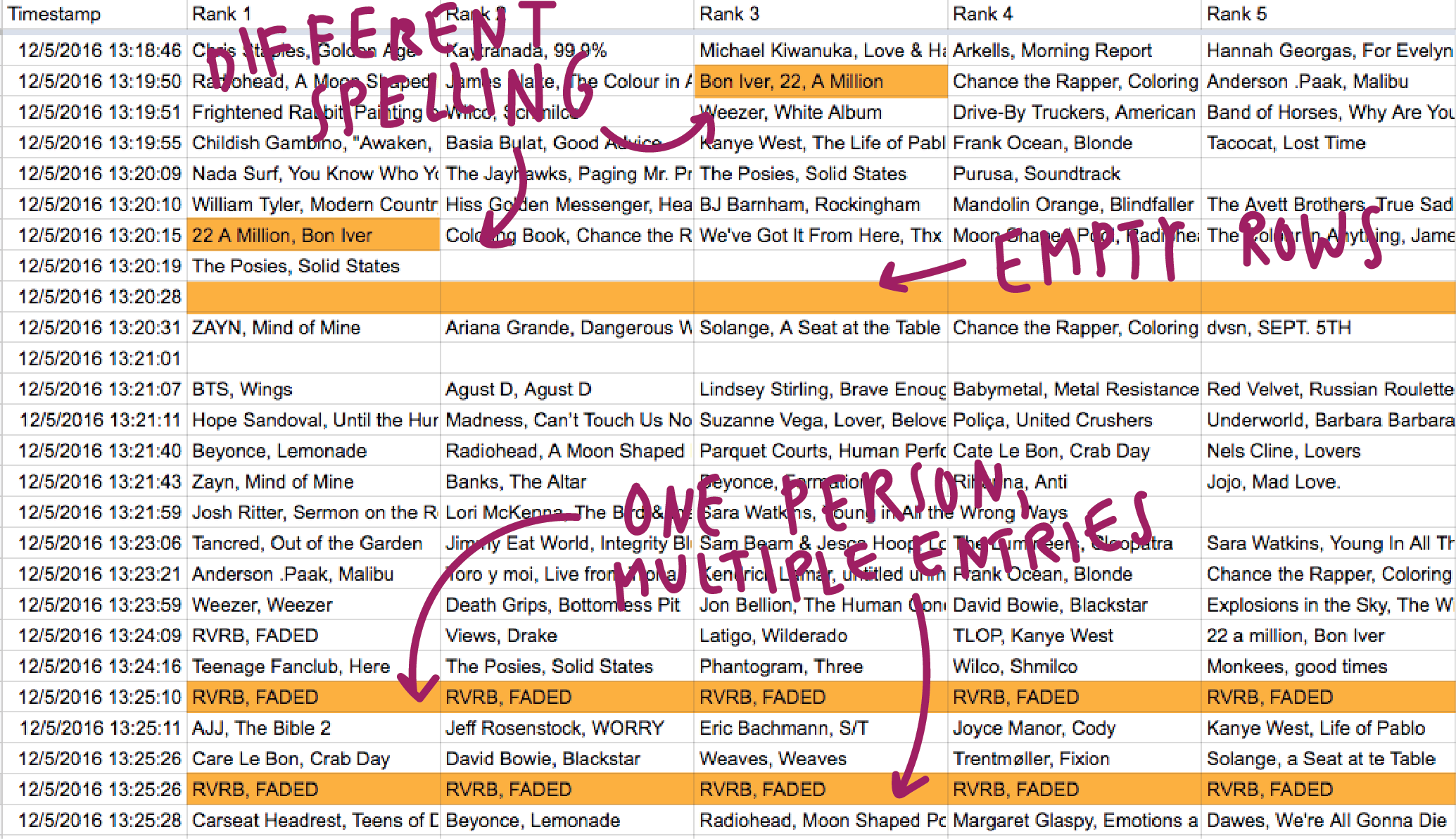
Header of All Songs Considered articleDifferent spelling, empty rows, multiple entries by one person: Ugh

In addition to cleaning up the data to make it usable, we had to decide on a weighting algorithm for the five different ranks and calculate it.

Since the whole project had a tight deadline, our process wasn’t pretty, but we did it. Here’s how:

Step 1: Combining Like Entries

The poll asks listeners to type in the artist and album, separated with a comma. But humans are faulty creatures who make spelling mistakes, don’t obey the rules or don’t remember the name of an album correctly. This faultiness results in a nice compilation of a dozen different ways to write one and the same thing:

Bon Iver - 22, a Million
Bon Iver -22, A Million
Bon Iver 22 a million
Bon Iver, '22, A Million'
BON IVER-22 A MILLION
Bon Iver
bon iver, "22, a million"
Bon Iver, 22/10
Bon Iver, 20 a Million 
Bon Iver 22
bon iver, 22 a million
Bon Iver, 22, A Million
Bon Iver, 22a million
BonIver, 22 a million
Bon Iver, 33 a million
Bon Iver, 22 million
Bon Iver,22,a Million
22, A Million 
Bon Iver: 22, A million 
bon iver. 22,a million
…

…and that’s still a relatively easy album name. I rely on your imagination to think of all the possible ways to spell “A Tribe Called Quest, We Got It from Here… Thank You 4 Your Service”.

To fix that mess, we used a combination of cluster analysis in OpenRefine and “Find and Replace” in Google Spreadsheet.

First, OpenRefine. To run the cluster analysis on just one column instead of five different ones, we needed to transform the data from a “wide” format into a “long” format. This can be easily achieved, e.g. with R:

library(reshape2)
d = read.csv("data.csv",stringsAsFactors = FALSE)
d = melt(d,id.vars = c('Timestamp'))
write.csv(d,”data_long.csv”)

Then we imported the CSV into OpenRefine, selected our one column that states all artist-album entries and chose Facet > Text Facet and then Cluster.
OpenRefine interfaceText Facet in OpenRefine

So what is cluster analysis? Basically, OpenRefine can run different algorithms on the data to cluster similar entries. Depending on the algorithm, “similar” is defined differently. OpenRefine offers different methods and keying functions, and we used all of them one after another.
OpenRefine interfaceClustering in OpenRefine

OpenRefine then lets us select and merge similar entries and give them all a new name.

After successfully running through lots of different cluster methods, our data was approximately 95 percent clean. Our Bon Iver entries looked like this:

Bon Iver, 22, A Million
Bon Iver
Bon Iver, 22, A Million
22, A Million 
Bon Iver, 22, A Million
…

So much better! But OpenRefine doesn’t take care of the cases in which only the album or artist is mentioned. So we imported the data back into Google Spreadsheet and took care of that by hand – with a combination of “Find and Replace” and sorting the list alphabetically (which places all the Bon Iver’s before Bon Iver, 22, A Million).

Step 2: Roughly clean up with a Python script

Once we made sure that the albums were written in the same way, they were countable. But we still needed to only count the entries that are from individual listeners who don’t abuse the poll. To do so, we ran the cleaned data through a Python script. The Pandas library is a great choice for our first easy task, dropping the empty rows:

# Drop empty rows
albums.dropna(subset=RANKS)

But Pandas proved to be a bad choice for the next task: Deleting duplicate rows that appears within one hour. Doing that makes sure that we eliminated the entries that obviously come from one and the same person. We saw dozens of these copy-and-pasted entries (especially for the album Mind of Mine by Zayn). To get rid of all the duplicate entries within one hour, we first transformed the Pandas dataframe to a Python list and then checked for identical entries:

# Do row values match? If not, not a dupe
for rank in RANKS:
    if row1[rank] != row2[rank]:
        return False

The last piece is checking for mentions of the same album within one entry, eg “Beyonce, Lemonade” on rank 1 and on rank 3. We wanted to delete these rows as well. To do so, we used a solution that we found on StackOverFlow:

# check if all elements in a list are identical
iterator = iter(iterator)
try:
    first = next(iterator)
except StopIteration:
    return True
return all(first == rest for rest in iterator)

That whole process removed 1200 empty or duplicate rows and brought the CSV from 4,500 entries down to 3,300 entries.

Step 3: Weight and rank with an R script

Wooooooohoo! We went from messy, human-made data to clean, machine-readable data! Next, we did the actual calculations that got us to a ranked list of the top albums.

To spice things up a little bit (or maybe because we have people with different favorite tools on the team), we did this part of the process not with Python, but with R.

After converting the data back into a long format, it looks like this:
data in RData with ranks in long format

Next, we gave each album a ranking value. To do so, we just replaced the rank columns with ranking values:

d$rank[d$rank=="Rank.1"]= 5
d$rank[d$rank=="Rank.2"]= 4
d$rank[d$rank=="Rank.3"]= 3
d$rank[d$rank=="Rank.4"]= 2
d$rank[d$rank=="Rank.5"]= 1

Note here that we are giving the number one albums the most points and the number five album the least points. This means a sum of these points will lead to the most popular album.

With numerical rank values, we could try out different ranking methods and different ways of aggregating these ranks. We quickly found that artists like Zayn who had campaigns on their behalf had huge spikes on certain days in terms of entries:
Zayn pollsThe table shows how often Zayn’s Mind of Mine was mentioned on all days of the poll. He was really successful on the first and the second-to-last day.

In contrast, artists like Bon Iver have a very consistent number of entries each day. We decided to favor these consistent entries. Our final calculations gave back a rank of albums for each day and then summed these daily rankings.

To do so, we reduced the Timestamp column to the month and day with d$Timestamp = substr(d$Timestamp,1,5), which removes all characters after the first 5 characters. Then we used the dplyr library to sum up the rankings to calculate points for each album on each day:

d = d %>% 
  group_by(Timestamp,album) %>%
  summarise(points = sum(rank))

After getting rid of the n/a values, we sorted the albums by these points and give it a rank number. Meaning, the album with the most points per day gets the rank “1”, the album with the second most points per day gets the rank “2” etc:

d = d %>% 
  arrange(Timestamp, -points, album) %>%
  group_by(Timestamp) %>%
  mutate(rank=row_number())

After transforming the data back to a wide format and summing up the ranking for each day, we arrive at the final ranking:
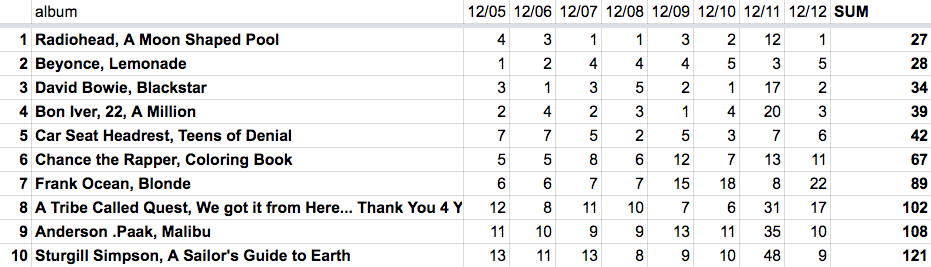
Final rankingThe final ranking: the sum of the rankings for each day.

For days where an album did not get mentioned, we used the ranking 200. We achieved this with d_wide[is.na(d_wide)] <- 200:

Final ranking with empty valuesWe replaced empty values with a high number, so that they didn’t show up at the top of the ranking

If we wanted to be more correct, we could get the max number of mentioned albums for each day, and then replace the n/a values with this max number. Since we only want to show the very top albums and they were all mentioned at least once every day, we didn’t need that method for our goal.

We made it! To recap this complicated process, let’s look at the steps again:

  1. To unify the spelling of these albums, we ran some cluster analysis in OpenRefine and cleaned up the data in Google spreadsheet
  2. Then we wrote a Python script to remove duplicate rows/cells and empty rows
  3. At the end, we calculated the ranking for each album per day and summed them up with an R script

The final ranking is also published on All Songs Considered. Next time we’ll do an autocomplete survey, yeah?

PRX Remix Picks: Dreams Deceived, Deferred, Fulfilled

This month, I’m featuring stories about dreams: the tale of a woman who dreams of a bigger apartment, the consequences of a jail system that puts dreams on hold, and a mother-daughter team helping each other to fulfill lifelong ambitions.

dreams
Time to “biggerize”

“Quadraturin” from Jon Earle and Emma Wiseman

A young woman lives in a New York City apartment so cramped there’s no room for a couch. She doesn’t even need to get out of bed to open the door. So, why wouldn’t she participate in a bizarre science experiment to “biggerize” her digs? After all, as the story’s protagonist exclaims, “there’s nothing on the lease about ‘biggerization!’”

This is the situation in “Quadraturin,” a captivating piece of audio fiction from producer Jon Earle and actress Emma Wiseman, based on a short story by Sigizmund Krzhizhanovsky. The piece won Best New Artist at the 2016 Sarah Awards.

Earle and Wiseman use scenes and natural sounds to great effect, turning the sonic apartment into an imaginary stage on which the story unfolds. In the booming audio fiction genre, it’s especially nice to hear a story that relies on smart staging and careful dialogue instead of the ‘found recording’ crutch, often used in other pieces, to drive narrative.  To understand this crutch in the visual world, imagine a sudden plethora of TV shows with plots hinging on faux-archival videos.

“Off The Block” from KCRW’s Independent Producer Project

dreams
Palm trees distract from the largest jail system in the country

The Los Angeles jail system is the largest in the country, with 17,000 people incarcerated at any given given time. The consequences are explored in “Off The Block,” a six-part series from KCRW. Bail, mental health, and jailhouse weddings are some of the topics covered in the series, which explains that even a short stint in the system can have numerous lasting impacts.

The episodes are short—most well under 10 minutes—and not an exhaustive investigation into the issues presented. But the series does a good job finding characters whose experiences and perspectives provide an access point for listeners who aren’t directly impacted by the jail system themselves.

“Now There’s Only Time To Live Forever” from Jessica Ripka

dreams
It’s a story within a story!

When I listened to this piece I felt like I’d emerged from diving underwater, when the world looks slightly different than it did before the plunge. It’s the mark of a good story, one that shifts your life experience by just a few degrees so everything feels a bit shinier and more surreal.

There are two main stories nestled into one here. First, producer Jessica Ripka tells the story of her mother, Penelope DeWitt, whose creative dreams fell dormant for decades due to fear and insecurity. A car crash renews her interest in pursuing those dreams. Ripka then uses her mother’s story to reflect her own life, how she quit her desk job to pursue a dream career in radio storytelling. This piece represents an important first step towards that dream.

It’s a joy to follow the mother and daughter pair along on their overlapping journey to fulfill lifelong ambitions. Ripka’s piece is funny, surprising, and, perhaps unsurprising given the relationship between producer and subject, very tenderly told.

This piece was produced at the Fall 2016 Transom Story Workshop.

How To Listen to PRX Remix:
Download the PRX Remix app or go to prx.mx and press ‘play’. If you’re a satellite radio kind of person, check out channel 123 on Sirius XM or XM radio. If you’re a traditionalist and stick to the radio dial, check these listings to find Remix on a station near you.

Josh Swartz is the curator of PRX Remix. Email him at remix@prx.org

The post PRX Remix Picks: Dreams Deceived, Deferred, Fulfilled appeared first on PRX.

Mercy Street Season 2 Digital Content


Season 2 of Mercy Street premieres January 22 and to help you with promotion, below is an overview of some of the digital support you’ll see in the coming weeks:

Website
Continuing to build on the dynamic Mercy Street website from last season, there will be new content and experiences to excite your viewers for Season 2.

New assets include:
Popular returning assets:
Even more exciting content, including 360 videos and photos, will be rolling out in January, so stay tuned for more website information.

Social Media – #MercyStreetPBS and @MercyStreetPBS
An in-season social media outline, including brand new videos, will be available the week of January 16. Leading up to the premiere an overview of this content highlights the new characters and provides a countdown calendar to the premiere.

PBS LearningMedia
Here are the Mercy Street education materials available:
Make sure you check out the wide collection of promotional assets on the Source – don’t miss the brand new program guide feature for use around Black History Month – and publicity assets on PBS PressRoom.


Radiotopia Fall Fundraiser 2016: We Did it Again!

We recently wrapped up our Radiotopia 2016 fall fundraiser, and were blown away by the love and support from our fans, both old and new. With every drive, we gain new and important insights into the podcast fundraising universe and our dedicated fanbase. We’re always keen to learn how to best engage with listeners, make a genuine appeal, and secure the funds our shows need to keep creating quality, independent content.

Our fans: Whether they’ve been with us since the beginning, or just started listening…they’re the best.

This campaign taught us just how dedicated, generous and committed our fans truly are. A whopping 80% of our recurring 2015 donors stayed on as part of our active donor community this year. We aimed to steward existing relationships while encouraging steadfast donors to expose friends, partners, siblings and co-workers to the quality craft producing within Radiotopia. It worked!
challenge-coin-collage

As a surprise, we rewarded active sustaining members with our second challenge coin, this time Radiotopia themed.

Interestingly, of the 6,300 donors who contributed to this campaign, 64% had never before donated to Radiotopia.

Partnerships: Work together to drive donations.

Last year, we began a tradition of bringing our sponsors into the fundraiser to help provide donor challenges. These partners have become important tools that generate fan excitement and showcase our important corporate sponsors.

This year, Podster Magazine—a digital magazine dedicated to podcasts—jump-started the fundraiser by offering to chip in $10,000 if we hit 1,000 donors in the first two days. When we missed our goal by a few hours, our fans sprang into action and helped us ultimately secure the challenge funds from Podster (by the way, you can still get a free subscription). A big thank you to Podster!

A few days later, our friends at FreshBooks—who offer cloud-based accounting software for small businesses—issued another key challenge: a $40,000 donation if we snagged another 5,000 donors by the end of the campaign. This helped energize our fans to spread the word to friends and family, allowing us to soar beyond that goal to finish with over 6,000 donors. Thanks again to FreshBooks!

Producer rewards: Engaging, unique and original premiums.

This year, our producers offered up their time and talent to create exclusive, custom reward items that were incredibly popular with donors. Some rewards showcased their creative talents, like the curated mixtape from Song Exploder’s Hrishikesh Hirway (which quickly sold out), and the custom recording from Criminal’s Phoebe Judge.

Others gave lucky fans the opportunity to engage on more a producer-collagepersonal level. These included a VIP Dinner with the Kitchen Sisters, one-on-one phone calls with Megan Tan from Millennial, a virtual documentary viewing with team Mortified, a museum tour with Nate DiMeo of The Memory Palace… oh, and a wedding ceremony officiated by Helen Zaltzman of The Allusionist. Overall, we found the personalized gifts were a great way to way to drive excitement and, sometimes, laughter.

Benefit without the reward: The choice of no gift.

A whopping 40% of donors opted for no reward at all. Despite the long-time association of public media with t-shirts and tote bags, nearly half of our donors opted to support us directly. This ultimately allows our independent producers to keep more of the funds and for Radiotopia to save on fulfillment expenses and benefit more directly from the campaign’s success.

The result: The reach of Radiotopia’s message is impressive (if we do say so ourselves).

  • We surpassed our original goal of 5,000 donations by over 1,000 people
  • 64% of donors were brand new to our community
    • The industry average is 20% new donors for any fundraising drive
  • 80% of our sustaining members from last year maintained their monthly commitments
  • 12% of donors who has previously cancelled their recurring donations came back in 2016
  • We had donors from all 50 states and 73 countries/territoriesradiotopia-donors-by-country

The post Radiotopia Fall Fundraiser 2016: We Did it Again! appeared first on PRX.

What makes a great photo editing intern (Apply now for Winter/spring 2017!)

NPR Interns at workPhoto by Rachael Ketterer

This is not your standard photo internship!

This internship is an opportunity to learn more about the world of photo editing. Our goal isn’t to make you into a photo editor; we view this internship as a chance for you to understand what it is like to be an editor and improve your visual literacy, which can help you become a better photographer.

The internship runs from January 9, 2017 to April 21, 2017. Applications are due October 23, 2016 at 11:59pm eastern.

What you will be doing

  • Editing: You’ll be working closely with the Visuals Team’s photo editors (Ariel and Emily) on fast-paced deadlines – we’re talking anywhere from 15 minutes to publication, to short-term projects that are a week out. You’ll dig into news coverage and photo research, learning how to communicate about what makes a good image across a range of news topics, including international, national, technology, arts and more.

  • Photography: Depending on the news cycle, there may be opportunities to photograph DC-area assignments. This can mean you’d have one or two shoots in a week, or maybe just a couple shoots in a month. You’ll work closely with a radio or web reporter while out in the field, and a photo editor will go through your work and provide feedback for each assignment. There will also be a chance to work on portraiture and still lifes in our studio.

  • We also encourage each intern to create a self-directed project to work on throughout the semester. It can be an Instagram series, video, photo essay, text story or anything in-between. You can work independently or with another intern or reporter.

You will be part of NPR’s intern program, which includes 40-50 interns each semester, across different departments. There will be coordinated training and intern-focused programming throughout the semester, which includes meeting NPR radio hosts, career development and other opportunities. As an intern, you will be treated as a member of the team. Many NPR employees are former interns and they’re always willing to help current interns.

Eligibility

Any student (undergraduate or graduate), or person who has graduated no more than 12 months prior to the start of the internship period to which he/she is applying is eligible. Interns must be authorized to work in the United States.

Who should apply

We’re looking for candidates that have a strong photojournalism background. An interest in editing, or experience with video/photo editing is a nice plus. It’s also helpful if you’ve completed at least one photojournalism-focused internship prior to applying (let us know if you have!), though it’s not necessary. A portfolio, however, is required.

We also want folks who can tell us what they would like to accomplish during their time at NPR. What do you want to learn? What do you want to try? We try to shape each internship around our intern, so we rely on you to tell us what goals you have for your time with us!

So how do I apply?

Does this sound like you? Read about our expectations and selection process and then apply now!

Into code, design, and data? Check out our design/developement internship.

Be our design/code/??? intern for winter/spring 2017!

Semi-Automatic Weapons Without A Background Check Can Be Just A Click AwayMap by Visuals Team intern Brittany Mayes

Are you data-curious, internet savvy, and interested in journalism? Do you draw, design, or write code? We are looking for you.

We’ve had journalists who are learning to code, programmers who are learning about journalism, designers who love data graphics, designers who love UX, reporters who love data, and illustrators who make beautiful things.

Does this sound like you? Please join our team! It isn’t always easy, but it is very rewarding. You’ll learn a ton and you’ll have a lot of fun.

The internship runs from January 9, 2017 to April 21, 2017. Applications are due October 23, 2016 at 11:59pm eastern.

Here’s how to apply

Read about our expectations and selection process and then apply now!

Into images? Check out our photo editing internship.