
As the climate gets hotter, plants could need to move to new habitats. But animals that eat their fruit and help spread the seeds are disappearing.
(Image credit: Karl-Josef Hildenbrand/DPA/AFP via Getty Images)

As the climate gets hotter, plants could need to move to new habitats. But animals that eat their fruit and help spread the seeds are disappearing.
(Image credit: Karl-Josef Hildenbrand/DPA/AFP via Getty Images)

Significant damage is being reported on the Pacific island of Tonga and thick ash on an airport runway is preventing aid from arriving.
(Image credit: AP)


Nuclear power is emerging as an answer as states transition away from coal, oil and natural gas to reduce greenhouse gas emissions and stave off climate change.
(Image credit: Michael Mariant/AP File Photo)

Hiya! Welcome back to Starting Out from me and Transom! Just a quick bit of business: there won’t be a newsletter next month, so that I can focus on prepping the next set of issues for you. I’ll make sure to tweet out any job postings that I see in February so you don’t miss […]
The post Starting Out: Issue 6 appeared first on Transom.
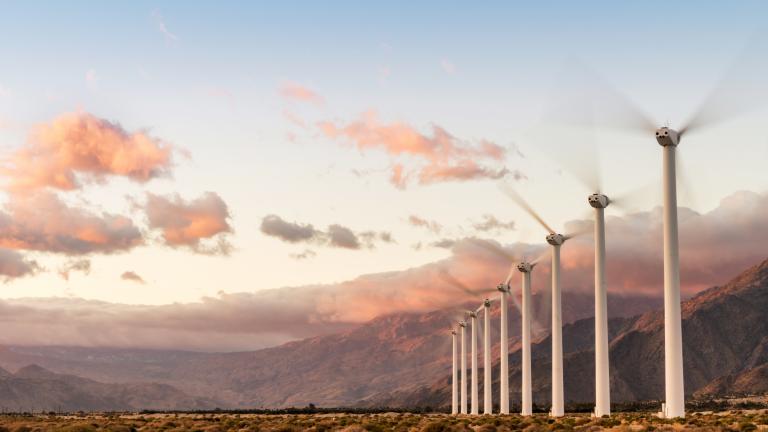
Wind energy plays a critical role in reducing greenhouse gas emissions by providing carbon-free and low marginal cost energy. In 2018, a quarter of all additional power capacity in the world was wind energy, and it is expected to become one of the dominant sources of power in the next couple of decades. As wind generators produce clean electricity, it offsets some thermal generators’ production. The substitution patterns of wind generation effectively determine its environmental value.
As more wind energy is deployed, it should be accompanied by the retirement of high carbon emitter thermal power plants to achieve higher decarbonization. In 2018 wind generation only accounts for 5% of world electricity consumption. Nevertheless, increasing wind generation is already affecting generators’ revenue in the wholesale market by lowering the prices due to its low marginal cost. Understanding this revenue impact of renewable generation is essential for determining the path for decarbonization in the future.
In this paper, I ask what the substitution patterns for large-scale wind generation are and how they affect existing firms’ revenues. To answer this question, I use Karaduman (2021)’s framework to quantify the potential effects of large-scale wind generation in the wholesale electricity market. My model uses data from an electricity market to simulate the equilibrium effects of a wind capacity expansion in electricity markets. I account for the price impact of wind generation and find a new market equilibrium in which I allow incumbent firms to respond to wind capacity increases.
To model firms’ decisions, I represent the electricity market as a multi-unit uniform price auction. Each day, before the auction, firms observe a public signal containing information such as publicly available demand and renewable production forecasts. They then bid into the electricity market a day ahead of the actual production. I simulated wind generation and modeled it as a decrease in demand for a given wind generation profile. I estimate incumbent firms’ best responses to this shift in demand by using observed variation in demand and renewable production in a market without wind expansion. In this research, I use South Australia Electricity Market data from 2017 -2018. In the observed period, almost 35% generation comes from wind energy, one of the highest wind energy ratios among electricity markets. The current high penetration level creates a considerable variation in residual demand, which helps my model recover firms’ best responses.
First, I compare offset by wind patterns with reduced form analysis for different wind expansion scenarios. I decompose offsets by the wind into two parts, merit order effect, due to price change, and market power effect, due to market power change. For small-sized wind expansion, my model give similar results to the literature on marginal impact, as market power changes are insignificant. However, as the new wind generator’s capacity increases, marginal units that new wind generation offsets change, and the market power effect amplify the difference between estimates of my model and marginal approach Surprisingly, I find a similar carbon emission decrease with both models, 1.05 tons per MWh.
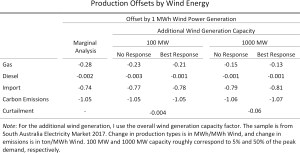
Next, I evaluate substitution patterns for wind generation at a much larger scale, up to 100% of the market generation capacity. South Australia trades with its neighbor region Victoria, which has a lot of brown coal generation. For a low level of wind generation investment, gas power plants with flexible technologies adjust their strategies and do not get replaced by wind generation much. Most of the renewable generation is exported to Victoria to replace brown coal. However, as the penetration level increases, the transmission between the two regions gets congested, and almost half of the renewable production gets curtailed. On the other hand, all other power plants’ production in South Australia is cut almost half. In terms of emissions, large-scale wind generation cuts South Australia’s carbon emissions by 60% and two times more in terms of tons in Victoria.
The impact of wind generation on different generators’ revenue varies a lot at different expansion scales. For small capacity expansion, generators with flexible technologies lose the least by adjusting their bids. However, as the penetration level increases, wind generation suppresses prices, and flexible but high-cost generators stop producing. Some gas technologies lose up to 90 percent of their revenue. The existing wind generation gets the most considerable reduction in revenue and loses up to 91% of its revenue. These results have some policy implications. In a pathway with an aggressive wind capacity target, low carbon emitting generators may exit due to price reduction. On the other hand, as new renewable generation cannibalizes existing renewable technologies, it can be more costly to incentivize further investment in renewable technologies.
Lastly, I find that wind project production differs from each other based on their capacity factor, and this can affect the potential value of a wind generation investment. I look for potential heterogeneity between 18 existing wind projects in South Australia, and I find a significant dispersion in projects’ price effects, 35%, and revenue effects, 30%. This heterogeneity leads to a policy discussion. If a policymaker has a particular concern about the capacity, price impact, or revenue impact of a project, a policy must differentiate between competing investments to ensure that the socially optimal renewable investments are made.
Karaduman, Ömer (2021), “Large Scale Wind Power Investment’s Impact on Wholesale Electricity Markets,” MIT CEEPR Working Paper 2021-020, December 2021.
Karaduman, Ömer (2021), “Economics of Grid-Scale Energy Storage in Wholesale Electricity Markets,” MIT CEEPR Working Paper 2021-005, February 2021.
Ömer Karaduman is a Postdoctoral Research Fellow at Stanford University Bits and Watts Institute. His research focuses on the transition of the energy sector towards a decarbonized and sustainable future. In his research, he utilizes large datasets by using game-theoretical modeling to have practical policy suggestions. Prior to coming to Stanford, Ömer completed his Ph.D. in Economics at MIT in 2020, and got his bachelor’s degree in Economics from Bilkent University in 2014.






This course covers fundamentals of thermodynamics, chemistry, and transport applied to energy systems. Topics include analysis of energy conversion and storage in thermal, mechanical, chemical, and electrochemical processes in power and transportation systems, with emphasis on efficiency, performance, and environmental impact. Applications include fuel reforming and alternative fuels, hydrogen, fuel cells and batteries, combustion, catalysis, combined and hybrid power cycles using fossil, nuclear and renewable resources.
The OCW site includes complete lecture slides and problem sets with sample solutions.
Instructor: Prof. Ahmed Ghoniem
What’s in a number? The goals of the 2021 United Nations’ climate summit in Glasgow, Scotland, called for nations to keep a warming limit of 1.5 degrees Celsius “within reach.” But when it comes to communicating climate change to the public, some scientists worry that too much emphasis on a specific number is a poor strategy.
Focusing on one number obscures a more important point, they say: Even if nations don’t meet this goal to curb global climate change, any progress is better than none at all. Maybe it’s time to stop talking so much about one number.
On November 13, the United Nations’ 26th annual climate change meeting, or COP26, ended in a new climate deal, the Glasgow Climate Pact. In that pact, the 197 assembled nations reaffirmed a common “ideal” goal: limiting global warming to no more than 1.5 degrees C by 2100, relative to preindustrial times (SN: 12/17/18).
Holding temperature increases to 1.5 degrees C, researchers have found, would be a significant improvement over limiting warming to 2 degrees C, as agreed upon in the 2015 Paris Agreement (SN: 12/12/15). The more stringent limit would mean fewer global hazards, from extreme weather to the speed of sea level rise to habitat loss for species (SN: 12/17/18).
The trouble is that current national pledges to reduce greenhouse gas emissions are nowhere near enough to meet either of those goals. Even accounting for the most recent national pledges to cut emissions, the average global temperature by 2100 is likely to be between 2.2 and 2.7 degrees C warmer than it was roughly 150 years ago (SN: 10/26/21).
And that glaring disparity is leading not just to fury and frustration for many, but also to despair and pervasive feelings of doom, says paleoclimatologist Jessica Tierney of the University of Arizona in Tucson.
“It’s something I’ve been thinking about for a while, but I think it was definitely made sort of more front and center with COP,” Tierney says. She describes one news story in the wake of the conference that “mentioned 1.5 degrees C, and then said this is the threshold over which scientists have told us that catastrophic climate change will occur.”
The article reveals a fundamental misunderstanding of what the agreed-upon limit really represents, Tierney explains. “A lot of my students, for example, are really worried about climate change, and they are really worried about passing some kind of boundary. People have this idea that if you pass that boundary, you sort of tip over a cliff.”
The climate system certainly has tipping points — thresholds past which, for example, an ice sheet begins to collapse and it’s not possible to stop or reverse the process. But, Tierney says, “we really should start communicating more about the continuum of climate change. Obviously, less warming is better.” However, “if we do blow by 1.5, we don’t need to panic. It’s OK if we can stop at 1.6 or 1.7.”
Tierney notes that climate communications expert Susan Hassol, director of the Colorado-based nonprofit Climate Communication, has likened the approach to missing an exit while driving on the highway. “If you miss the 1.5 exit, you just slow down and take the next one, or the next one,” Tierney says. “It’s still better than hitting the gas.”
Target numbers do have some uses, notes climate scientist Joeri Rogelj of Imperial College London. After decades of international climate negotiations and wrangling over targets and strategies, the world has now agreed that 1.5 degrees C of warming is a desirable target for many countries, says Rogelj, who was one of the lead authors on the Intergovernmental Panel on Climate Change’s 2018 special report on global warming.
A global temperature limit “is a good proxy for avoiding certain impacts,” he adds. “These numbers are basically how to say this.”
But Rogelj agrees that focusing too much on a particular number may be counterproductive, even misleading. “There is a lot of layered meaning under those numbers,” he says. “The true interests, the true goals of countries are not those numbers, but avoiding the impacts that underlie them.”
And framing goals as where we should be by the end of the century — such as staying below 1.5 degrees C by the year 2100 — can give too much leeway to stall on reducing emissions. For example, such framing implies the planet could blow past the temperature limit by mid-century and rely on still-unproven carbon dioxide removal strategies to bring warming back down in the next few decades, Rogelj and colleagues wrote in 2019 in Nature.
Banking on future technologies that have yet to be developed is worrisome, Rogelj notes. After all, some warming-related extreme events, such as heat waves, are more reversible than others, such as sea level rise (SN: 8/9/21). Heat wave incidence may decrease once carbon is removed from the atmosphere, but the seas will stay high.
Rogelj acknowledges that it’s a challenge to communicate the urgency of taking action to reduce emissions now without spinning off into climate catastrophe or cliff edge narratives. For his part, Rogelj says he’s trying to tackle this challenge by adding a hefty dose of reality in his scientific presentations, particularly those aimed at nonscientists.
He starts with pictures of forest fires and floods in Europe from 2021. “I say, ‘Look, this is today, 1.1 degrees warmer than preindustrial times,’” Rogelj explains. “‘Do you think this is safe? Today is not safe. And so, 1.5 won’t be safer than today; it will be worse than today. But it will be better than 1.6. And 1.6 won’t be the end of the world.’ And that kind of makes people think about it a bit differently.”
This story by ESI Journalism Fellow Alex Schwartz was originally published as part of the Project Klamath interactive website by the Herald & News, where it appears with additional photos and resources.
__________
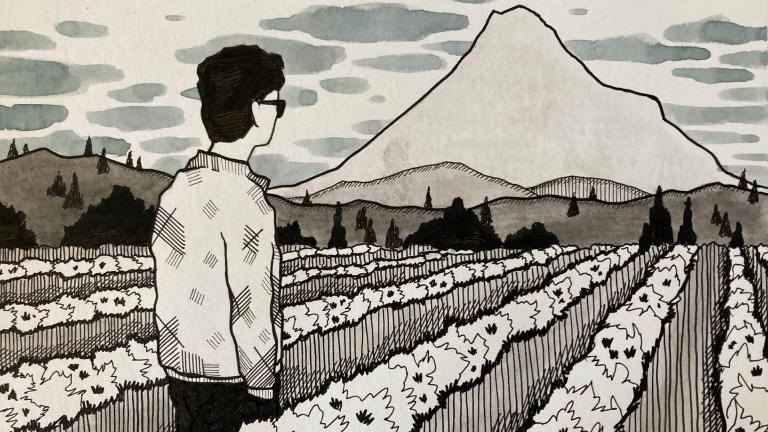
Picture the Klamath Basin in March, as the summer of 2050 looms on the horizon. It’s been a warm, dry winter. Only specks of white remain on the mountaintops, streams languish with no snowmelt to surge their riffles and forests and grasslands already thirst for moisture. What will the experience of drought in the basin feel like if we do nothing to change the way we manage it? And what could it look like if the watershed’s stakeholders right the ship?
Plucked from a slew of possible futures, below are two scenarios the Klamath and its communities could face by the mid-21st Century. Though fictional, they are based on the impacts associated with a specific degree of warming determined by climate and economic modelers. Representative Concentration Pathways, or RCPs, are socioeconomic models that describe four different trajectories of carbon emissions, each resulting in a specific average temperature increase by the end of this century. Researchers can then use those trajectories to model the behavior of the atmosphere, assessing future impacts like extreme heat, fire danger, snowfall and more.
Both of these scenarios exist within RCP 4.5, which projects a global average temperature increase of about 3.24˚F by the end of this century relative to the period between 1986 and 2005 (for comparison, the Klamath Basin has already warmed by about 1˚F since the mid-20th century). For this to occur, global carbon emissions must peak by around 2040 and decline rapidly over the following 30 years to half of what they were in 2000.
Climate modelers consider RCP 4.5 a middle-of-the-road pathway. It emits more carbon and results in worse impacts than the best-case-scenario model that has become the goal for the 2015 Paris Agreement, but it’s not as catastrophic (or even as unlikely) as RCP 8.5, the worst-case pathway that more than doubles the increase in global temperatures by 2100.
For that to occur, humans would have to continue increasing fossil fuel use and emissions, despite market forces driving down the price of renewable energy even in the absence of robust climate policies.
In the Klamath Basin, future impacts based on RCP 4.5 and 8.5 only differ toward the end of this century, with the latter being more intense. For the purposes of imagining the Klamath Basin in 2050, both scenarios result in roughly the same outcome because previous emissions will have already locked in a certain level of warming by then.
In both of these futures, the annual average temperature of the basin will be 51.9˚F, nearly 4˚ warmer than it was in 2000. Each summer, the atmosphere will draw nearly an inch more water from plants than it used to, requiring that much more precipitation to replace it. Soils are 7% drier, and three fewer inches on average of snow-water equivalent are available to make it into streams and lakes by April 1. The average number of “extreme” fire danger days has increased by five each fire season because wildlands have become so parched.
But this isn’t a doomsday scenario — or at least it doesn’t have to be. The sparsely populated Klamath Basin can’t single-handedly reverse global emissions trends, but it can control how it responds to their related impacts. Though the first future described in “The Lone Farmer” could be considered the “bad” future, while the second described in “Lodgepole and Ponderosa” could be considered “good,” neither is any more likely than the other, and neither is set in stone.
This story by ESI Journalism Fellow Alex Schwartz was originally published as part of the Project Klamath interactive website by the Herald & News, where it appears with additional photos and resources.
___________
On November 5, 1922, in the volcanic scrublands just south of the Oregon-California border, a group of people gathered on a hill above the Klamath River to celebrate a newly minted, 126-foot wall of concrete.
A local band played “America the Beautiful” and the American flag unfurled from a flagpole on the dam. Soldiers fired a salute from atop the mountain. The attendees had a picnic and local officials made speeches praising the utility bringing large-scale hydroelectric power generation to the area. At the time, the Siskiyou Daily News called the project “one of the largest hydroelectric power plants in the world,” able to produce 12,500 kilowatts of energy.
At the end of the event, the daughter of the California Oregon Power Company’s board chairman flipped a switch, turning the generator on and feeding the power of the Klamath River into the regional grid. Copco Dam was officially in operation.
The newspaper paraphrased a Yreka judge who told a romantic story of development in the region, of how white American settlement had progressed the area by leaps and bounds. Horses had been upgraded to oxen and then to cars in a matter of decades. And thanks to the booming development of hydropower, the sky would be the limit.
“It is but a matter of a few years until we will be coming to the Copco picnics and future dedicatory ceremonies flying through the air,” the article read.
But one community’s progress was another’s decline. The dam almost perfectly bisected the Klamath Basin, and due to its height, it wasn’t feasible to construct fish passage infrastructure at the dam. Salmon lost access to hundreds of miles of spawning habitat in the tributaries to Upper Klamath Lake.
A June 1921 article in the Klamath Evening Herald had pointed out that the watershed was at a crossroads. Would it become a major hydropower-producing stream or California’s salmon stronghold?
“Along with it is the problem (of) whether the need for electricity ranks higher in the law than a food supply for the Indians,” the article read.
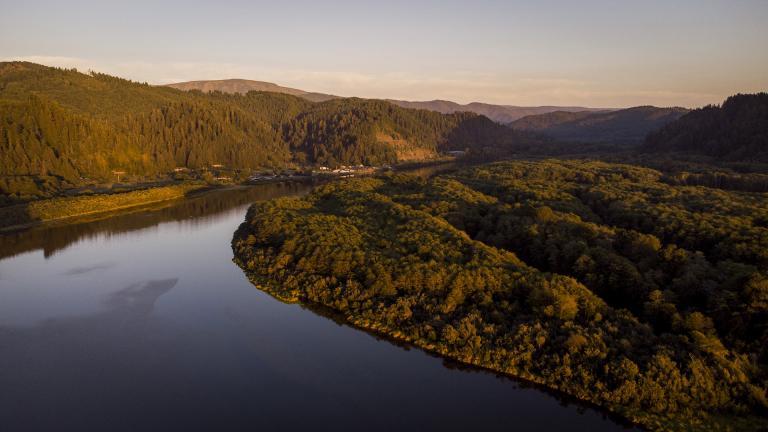
Fast forward 100 years, and the Klamath is known for neither an abundance of hydropower nor an abundance of salmon.
This story by ESI Journalism Fellow Alex Schwartz was originally published as part of the Project Klamath interactive website by the Herald & News, where it appears with additional photos and resources.
__________
Most people in the Klamath Basin agree that restoring streams, wetlands and forests is a more effective way to revive species and communities than fighting over a dwindling water supply.
Re-empowering nature to store and filter water doesn’t often require anyone to give up their share of it.
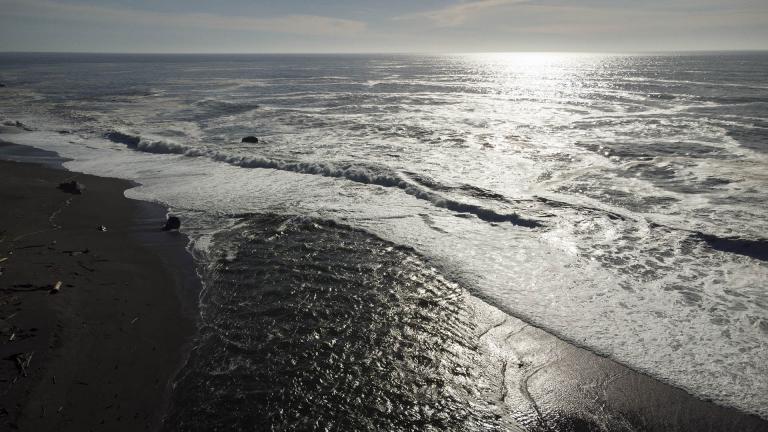
But first, stakeholders must meaningfully address the basin’s uncomfortable history and reconcile two cultures that seem at odds with each other. Until farmers, ranchers and tribal members can agree on how to do that, many say there’s little hope for eliminating the physical chokepoints that harm the watershed.
In August 2021, the Klamath Falls Equity Task Force presented recommendations to city council on how to promote equity in the area. One of the first items was recognizing the role of racism in the Klamath Basin water crisis.
“Our water crisis still exists, in part, due to racism against the Tribes and that racism against the Tribes still exists, in part, due to our water crisis,” wrote the task force.
At the city council meeting where the task force made its recommendations, several Klamath tribal members made public comments about how they’ve experienced anti-Indigenous behavior in the basin.
“There are communities worldwide that deal with drought, but this is one of the only communities where drought is really just focused around racism and blaming the Tribes for what’s going on, when really what we’ve been doing is rearranging the chairs on the Titanic,” said Klamath tribal council member Willa Powless. The city has since disbanded the equity task force and has not carried out its recommendations related to the Klamath Basin water crisis.
This story by ESI Journalism Fellow Alex Schwartz was originally published as part of the Project Klamath interactive website by the Herald & News, where it appears with additional photos and resources.
___________
It had been three years since Brook Thompson caught a salmon.
Growing up on the Yurok Reservation in Klamath, Calif., she used to eat it year-round — canned, smoked, boiled, pattied — benefitting from Chinook salmon’s exceptionally high protein and omega-3 fatty acid content. But the rest of Thompson’s diet consisted of flour, sugar, pasta and the occasional canned fruit or vegetable, all provided by the federal government. There was (and still is) no grocery store in Klamath. The only fresh food comes from the river.
“I didn’t get a lot of good food growing up,” said Thompson, who has Yurok and Karuk ancestry. Doctors even considered her malnourished until she moved to Portland for college. Now in a graduate environmental engineering program at Stanford University, she has access to healthier foods and grocery stores and is able to eat a balanced diet.
But Thompson said Whole Foods salmon can’t nourish her like the river can. The spiritual practice of catching a salmon near the mouth of the Klamath, cleaning it and putting it on ice can’t be replicated over a fish counter. To her, the fish just taste better at home.
“Our culture is really energy-based,” Thompson said. “You want to put that good spirit and energy into your food, and you feel that when you eat it. You put that back into yourself. Salmon tastes so bad everywhere else. I don’t know how people like it.”
Beyond nourishing its people, the salmon run can also nourish the economy of the Yurok Reservation, which has a median income of about $11,000. Thompson said a good commercial fishery could allow some tribal members to buy Christmas presents for their relatives, school supplies for their kids and even gas for their cars to be able to get to the nearest grocery store half an hour away in Crescent City.
Recently, the Yurok commercial fishery processing building at the foot of Requa Hill, along the Klamath’s estuary, has sat empty more often than not. For decades, and especially since 2015, the Klamath River fishery has been in sharp decline.
Between 2016 and 2020, the annual harvest of fall Chinook salmon has averaged fewer than 5,000 for a tribe that has more than 6,000 members. Between 1989 and 2015, tribal members had caught an average of nearly 24,000 fish a year.
“The fish are kind of the canary in the coal mine. Salmon are telling us that things aren’t working,” said Barry McCovey, the Yurok Tribe’s fisheries director and a Yurok tribal member. “Things haven’t been good for a long time — the system has been disconnected and thrown out of balance for generations — but things have gotten worse exponentially.”
Dear you, I’m reading these words aloud as I type them. Words carrying sounds on their backs are my path to you and I’m trying to close the gap between us. Because at root, whether through words, sounds or images, it’s the connection I’m after. In the audio industry we often talk about intimacy and […]