All posts by media-man
Why Do Firms Issue Green Bonds?

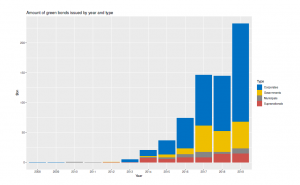
Green finance certification allows investors to link their decisions to firms’ commitments toward the environment. Green bonds are the most emblematic and prominent green finance instrument: Their issuers commit to use the bond proceeds to a certified climate-friendly project. For example, Unilever announced on March 19, 2014, one of the now most famous certified green bond issues, earmarking more than $400m to new climate-friendly production capacities. This commitment confirmed the success of years-long plans to develop new green detergents and refrigerants. It was received enthusiastically by investors, generating stock returns of more than 5%. In the past few years, a rapidly increasing number of firms have made similar commitments, leading to a boom in the global green bond market (now around 3.5% of total corporate bond issuance in 2020).
![]() |
| Figure 1. Green bonds issuance In the past few years, a rapidly increasing number of firms have issued green bonds, leading to a boom in the global green bond market, whose volume has nearly doubled every year since 2013. |
Economists have long recommended to price carbon. In practice, however, this direct approach is less successful than hoped; even in developed countries, the effective price of most CO2 emissions is far below the social cost of carbon. The urgency of the climate challenge calls for examining all instruments that are feasible and potentially effective.
Firms’ issuance of green bonds is voluntary. Nevertheless, recent empirical evidence rules out the possibility of greenwashing (Flammer, 2021). Now more than ever, governments and financial institutions are paying a lot of attention to the rapid growth of green finance markets, hoping that it could play an effective role in climate policy. Yet economists know very little about the mechanisms that make green bonds work.
Recent empirical analyses of the green bond boom further establish the following stylized facts. First, firms’ stock price increases when they announce the issue of certified green bonds and financed projects, unlike conventional bonds. Second, firms’ certified green bonds do not allow them to obtain less costly financing; green and conventional bonds pay the same to investors. Third, certification of green bonds is critical. So-called “self-labeled” green bonds are associated with neither CO2 reduction, nor stock market reaction (e.g., Flammer, 2021).
How to account for stock market reactions at green bond announcements? In the absence of green bond yield spread, one can reasonably rule out that concerned investors play a significant role. Positive stock market reactions, therefore, indicate that green bond certification of firms’ projects conveys positive information about these projects’ expected profitability.
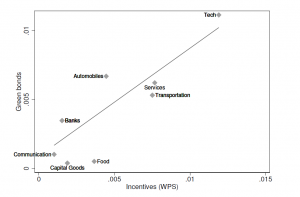
Our theory points to the crucial role of managers’ interest in the stock price of their firm. For example, managers’ actual compensation schemes feature stock components. Edmans, Gabaix, and Landier (2009) measure managers’ incentives as the sensitivity of their compensation to their firms’ stock price, an incentive measure that is comparable across sectors and over time. Figure 2 shows, for example, the unconditional relationship between the proportion of issued green bonds and Edmans et al.’s managerial incentive measure: Sectors in which managers’ pay is more stock-price sensitive issue more green bonds.
![]() |
| Figure 2. Green bond issuance and managerial incentives (2007-2019) This figure shows the unconditional relationship between the proportion of green bonds and the stock-price sensitivity of managers’ compensation in sectors that issue green bonds. It illustrates that sectors in which managers’ pay is the most stock-price sensitive issue more green bonds. |
Our analysis unveils that it is existing carbon penalties that explain this relationship! Besides green bonds, effective carbon prices in most countries already provide firms with some, although insufficient, incentives to undertake CO2 reducing projects. Our model highlights that with green bonds, the effect of carbon prices is twofold: It induces firms to undertake more certified green projects not only because carbon prices penalize conventional technologies, but also because, all else unchanged, these penalties amplify the stock market reaction to green bonds and, therefore, managers’ interest in certified green projects.
We obtain a testable positive relationship between, on the one hand, the proportion of green bonds issued in an industry, and, on the other hand, the interaction between the carbon price that this industry is applied and managers’ concern for their firms’ stock price.
To verify this prediction, we use data that relate public firms’ certified green bonds to the stock-price sensitivity of managers’ compensation in their industry and to the effective carbon price that prevails where they are based. We find that the total role of managerial incentives is positive on average, and statistically different from zero as carbon prices are sufficiently high, e.g., around the average effective carbon price in the EU, where the green bond market is the most developed.
We draw the following conclusions. First, certified green bonds can induce firms to commit to effective CO2 reductions even though green bond issuance is voluntary. Second, perhaps surprisingly, firms’ incentives to issue green bonds is likely a matter of short-term financial interest. Third, green bonds are complementary to carbon pricing, with important practical implications. With green bonds, governments cannot dispense with carbon penalties; on the contrary, the latter are instrumental in the effectiveness of the latter. At the same time, if carbon prices are sufficiently high, green bonds are likely to make them more effective.
References
Edmans, A., X. Gabaix, and A. Landier (2009), A Multiplicative Model of Optimal CEO Incentives in Market Equilibrium, Review of Financial Studies, 22: 4881-4917.
Flammer, C. (2021), Corporate Green Bonds, Journal of Financial Economics, 142: 499-516.
OECD (2018), Effective Carbon Rates 2018 – Pricing Carbon Emissions Through Taxes and Emissions Trading.
Further Reading: CEEPR WP 2022-001
About The Authors
Julien Daubanes is an Assistant Professor at the University of Geneva, an External Research Affiliate at MIT CEEPR, and a CESifo Research Fellow. He received his PhD from the Toulouse School of Economics. Julien studies the markets for energy resources, the effectiveness of climate policies, corporate social responsibility, and NGOs.
Shema Mitali is a postdoctoral research fellow at Ecole Polytechnique Fédérale de Lausanne (EPFL). His current research focuses on sustainable and climate finance as well as investments. Prior to joining EPFL he was a researcher at the University of Geneva. He received a PhD in Finance from the University of Warwick. During his doctoral studies, he was a visiting student at Bocconi University. Prior to his PhD studies, he graduated from HEC Lausanne with a Master degree in Financial Engineering & Risk Management.
Jean-Charles Rochet is Professor of Banking at Geneva University, Senior Chair and Head of Research at Swiss Finance Institute, and research associate at Zurich University and Toulouse School of Economics. He holds a Ph.D. in mathematical economics from Paris University. He was President of the Econometric Society in 2012 and has been a Fellow of this society since 1995. He has published more than 90 articles in international scientific journals and 7 books, including “Microeconomics of Banking” (with X. Freixas) MIT Press, “Balancing the Banks” (with M. Dewatripont and J. Tirole) and “Why are there so many banking Crises?” Princeton UP. His research interests include banking, financial stability and sustainable finance.
Climate Nucleus Minutes from December 20, 2021

MIT Climate Nucleus
Committee Meeting
Monday, December 20, 2021
Held Virtually
MINUTES
The meeting began with a brief review of all of the action items contained in the Fast Forward plan, across its five pillars (Spark, Foster, and Speed Adoption of Important Innovations; Educate Future Generations of Leaders, Problem Solvers, and Citizens; Inform the Work of Governments and Leverage Their Power to Accelerate Progress; Reduce MIT’s Own Climate Impacts; and Coordinate MIT’s Climate Efforts, Maximize Impact, and Enhance Accountability).
Members then used the bulk of the meeting to discuss ideas for advancing one action item in the plan: organizing and hosting a new series of climate symposia. Ideas raised by members included:
- Organizing the symposia according to themes, such as environmental justice and equity; student leadership; and immediate opportunities for greenhouse gas emissions reductions.
- Thinking about how the symposia series could connect to existing MIT efforts and initiatives (for example, using the symposia as an opportunity to highlight solutions put forward through the Climate Grand Challenges initiative).
- Moving away from traditional symposia formats to present climate research, solutions, and other topics through narrative/storytelling. This could also mean calling the events something other than climate “symposia” – for example, one member suggested calling the events a “solution series.”
- Incorporating student projects that seek to produce practical climate solutions.
Following the symposia discussion, members of the Nucleus provided climate-related updates from their departments, labs, centers, and initiatives, in order to provide the entire committee with situational awareness of activities happening across the Institute on climate.
Next steps
- The co-chairs of the Nucleus will develop a strawman proposal for the climate symposia based on the discussion in today’s meeting and present it for feedback and refinement at a future Nucleus meeting.
A Fight Over Rooftop Solar Threatens California’s Climate Goals
Temple Grandin Wants Us to Think Differently About Kids Who Think Differently
As States Move to Electrify Their Fleets, Activists Demand Greater Environmental Justice Focus
Melissa Miles has long thought the heavy traffic and abundant industry that surrounded her former neighborhood in Newark, New Jersey was to blame for her two young sons being diagnosed with asthma despite having no family history with the condition.
California’s embattled utility leaves criminal probation, but more charges loom

Since 2017 the utility has been blamed for more than 30 wildfires that wiped out more than 23,000 homes and businesses and killed more than 100 people.
(Image credit: Noah Berger/AP)
Data may be Colorado’s best bet to mitigate increasing wildfire risk on the Front Range
By Michael Booth, The Colorado Sun and John Upton, Climate Central

Grass fires have threatened the meadows and homes near Chatridge Court and U.S. 85 three times in five years, and firefighters work hard to keep flames from moving over the hill into thousands of homes in Highlands Ranch. These photos are from the 2016 Chatridge fire. (South Metro Fire Rescue file photos)
DOUGLAS COUNTY — The future of climate change and suburban firefighting in Colorado is here, in a dull brown meadow at the corner of Chatridge Court and U.S. 85.
They know the future will arrive on this spot, because the kind of raging grass fires near thousands of suburban homes that keep emergency planners awake at night has already been here three times in five years.
|
This story was produced through a partnership between The Colorado Sun and Climate Central. |
The Chatridge 3 grass fire on Dec. 14, just before Boulder County’s horrific Marshall fire, swept east up the hill from U.S. 85 toward an isolated mansion and threatened 100,000 people in Highlands Ranch, a few miles away.
Ruth lives in that mansion at the top of the hill, with her husband, where they’ve seen all three Chatridge grass fires. In December, it was just another beautiful day to enjoy the stunning 360-degree views from her upstairs windows, until the police knocked. Again.
“We didn’t know why they were here until we looked down to our yard, and the firefighters were already there,” said Ruth, who asked that her last name not be used. A rancher usually brings cattle to keep the grass down between their house and the highway, but the animals hadn’t arrived yet to do their job. The pasture was flaming. Scorched roots of scraped-up yucca plants dot the ground.
“They evacuated us. When we came back, we didn’t know if we’d have a house left or not,” Ruth said. “But we did.”

Grass fires have threatened the meadows and homes near Chatridge Court and U.S. 85 three times in five years, and firefighters work hard to keep flames from moving over the hill into thousands of homes in Highlands Ranch. These photos are from the 2020 Chatridge 2 fire. (South Metro Fire Rescue file photos)
The weather that day was dry, warm and windy — fire weather, the increasingly familiar conditions that can blow small fires quickly into infernos. South Metro Fire Rescue knew soil there was historically dry – a worry confirmed by detailed new satellite data from a Boulder firm that wants to reach out to Front Range firefighters. Just 16 days later and 45 miles away, fire weather would stoke the Marshall fire.
As heat-trapping pollution pushes up temperatures, the region that’s home to the state’s largest cities has seen one of the nation’s sharpest increases in the frequency of fire weather. Climate and fire experts say they must now do even more to layer new sensor technology atop decades of firefighting experience to prevent fires like the one that devastated Louisville and Superior.
New data resources for prevention
An analysis of weather data shows the region, known as Colorado’s Platte Drainage Basin, is experiencing fire weather nearly 40 days a year on average now, up from fewer than 20 days annually in the 1970s. The increase is steepest during the winter months.
“When I look at that climatology change, it lines up exactly with the amount of large historical fires that South Metro has specifically had. We saw an uptick in the size and intensity of wildland urban interface fires,” department spokesman Eric Hurst said.
“The fires tend to be more intense and grow faster than they used to.”
Firefighters were overwhelmed by the speed and intensity of the Marshall fire, which destroyed more than 1,000 homes in just a few hours.

Grass fires have threatened the meadows and homes near Chatridge Court and U.S. 85 three times in five years, and firefighters work hard to keep flames from moving over the hill into thousands of homes in Highlands Ranch. These photos are from the 2020 Chatridge 2 fire. (South Metro Fire Rescue file photos)
Landscaping including bushes and lawns growing alongside houses and roadways were parched by the dry and windy weather and by the shortage of snow and rain in the months beforehand. That provided an abundance of kindling for the flames, which were carried swiftly from one block to another by the fierce seasonal gusts.
But the inferno’s rapid spread didn’t surprise planners in departments from Larimer County to Colorado Springs. They are watching fall snow disappear, and open space soils grow desiccated. They see extreme heat season expanding.
And they are trying to prepare.
How firefighting can adapt
South Metro dreams of acquiring its own road graders to supplement those owned by Douglas County. A satellite data company executive whose own home was ruined by smoke from the Marshall fire pictures fleets of suburban brushcutters ready to trim fire breaks on red flag days. Colorado Springs scrambles to warn a constant turnover of new homeowners in its military-transient community of new urban interface fire dangers.
While some years still bring good snow cover as a fire deterrent in November and December, said Colorado State University climatologist Peter Goble, “the dry years hurt more with warmer conditions.” While much of the western half of Colorado is in a 20-year drought, average statewide temperatures in the last six months of 2021 were the hottest ever recorded. Denver set a record in 2021 for the number of days between the last spring and the first winter snowfall.
Not only are suburban grass fires threatening in mid-winter, but recent years have brought grass fires on the Eastern Plains before plants there have the chance to green up, Goble said.

Front Range fire planners and civic leaders have to now contend with far more fire danger days under climate change than in past decades, with chances for damaging events like the Marshall fire ever more present in the suburbs. (Climate Central)
“It’s made me wonder if maybe we’ve been a little bit lucky that we haven’t had more of these brush fire incidents closer to urban centers before,” he said.
Dazed by the fury of the flames in their neighborhoods on the border between open space and town centers, homeowners and elected leaders on the Front Range are reassessing their disaster priorities.
David Gross spent 30 years planting shrubs and trees to slowly transform his Louisville home south of Harper Lake into his version of paradise, just across McCaslin Boulevard from the city’s Davidson Mesa open space. He was away on vacation at the end of December when the Marshall fire torched his house and his illusions of relative security.
“Never in a million years,” would he have imagined a foothills wildfire arriving at his doorstep, Gross said. “We were certainly far away enough that I never would have imagined this. Let alone on Dec. 30.”
Louisville Mayor Ashley Stolzmann said city firefighters keep bringing up the fact that the fire jumped a six-lane highway next to a two-lane concrete road — “that’s a pretty big fire break,” she said. “This just jumped right over, like nothing.”
Until now, Stolzmann said, Louisville has worried much more about flooding from the seasonally expansive creeks that shoot down the canyons from the high country. Grassland fire, she said, is “certainly something we’ll be thinking about now.”
“The reality is, when we do have a wildfire event, each individual home is not going to have a fire truck sitting in its driveway,” said Ashley Whitworth, wildfire mitigation administrator for the Colorado Springs Fire Department. What planners keep researching, Whitworth said, is “anything that a homeowner can do on the front end to help firefighters help their home give it that chance of survivability.”

David Gross, who lived in a neighborhood south of Harper Lake in Louisville for 30 years, surveys the damage to his home on Jan. 1, after the Marshall fire. (Steve Peterson, Special to The Colorado Sun)
Doubling down on looking ahead
The fire departments, government agencies and homeowner associations bent on defending against suburban grass fires are now doubling down on the kind of climate change analysis they’d begun before a December fire exploded into the most destructive in Colorado history.
Urban development is increasing fire risks while climate change is boosting droughts by sucking moisture from plants and soils, which is causing Western forests and grasslands to burn more frequently and intensely. The rising temperatures are also increasing the frequency with which fire weather strikes. (Changes in how forests and other lands are managed are also affecting fires; so, too, is the spread of invasive plants and tree damage caused by beetles.)
Climate Central analyzed data from federal weather stations operating since the early 1970s to investigate fire weather trends. Climate Central based its definition of fire weather on criteria developed by NOAA’s Storm Prediction Center for elevated fire weather forecasts. To count as fire weather, thresholds set by the federal government must be met for a certain number of hours each day for temperature, relative humidity and wind speeds, with thresholds varying from one region to another.

Front Range fire planners and civic leaders have to now contend with far more fire danger days under climate change than in past decades, with chances for damaging events like the Marshall fire ever more present in the suburbs. (Climate Central)
The analysis revealed sharp increases across the Western U.S. of occurrences of fire weather, with modest increases in temperature playing outsized effects on dryness. When the Chatridge 3 and Marshall fires broke out, the region’s powerful yet natural winds were strong enough locally to satisfy the conditions for fire weather. So, too, were relative humidity and temperature.
During the Marshall fire, the winds were “particularly violent, but they were where and when you’d expect them to appear,” said Daniel Swain, a climate scientist based in Boulder whose affiliations include UCLA and the National Center for Atmospheric Research. Swain advised Climate Central on its fire weather analysis.
There was no official red flag warning banning open burns the day of the Marshall fire, though other burn bans were in place. The National Weather Service’s Boulder office is now reviewing whether its standards should change for issuing red flag warnings, which may carry more weight with the public than other no-burn notices.
That the winds blew embers through suburban vegetation that was parched and dry just one day before the region’s first major snowfall of the fall or winter might just have been “bad luck,” Swain said.
The effects of those winds in spreading the Marshall fire, however, highlighted that the same climate change influences that are worsening forest fire risks can also lead to suburban wildfires igniting scrub vegetation first, then taller grass, and then moving on to ignite fences, rooftops and then entire homes and blocks.
“While the Marshall fire wasn’t really a traditional wildfire, in the sense that much of what it burned were highly populated suburbs rather than just vegetation, it turns out the climate conditions leading up to the event were still important,” Swain said.
More “fire weather” days
An analysis of fire weather trends from the region including Denver and Boulder from December through February shows fire weather remains far rarer then than during summer months, but the frequency is increasing at a faster pace — roughly five days per winter now on average, up from an average of about one in the early 1970s.
Kevin Petty watched Front Range soils dry out in November and December in his work as a vice president at Spire Global, which uses data collected from low-orbit satellites to understand the impacts of extreme weather. In January, he has been trying to figure out how to get more of his company’s weather and climate data to civic leaders, while he tallies near-total smoke damage to his Louisville home from the Marshall fire.

Satellite collection of sensor data shows how dry soils have been on the Front Range in recent years, including in November and December when suburban grassland fires have grown more dangerous. (Spire)
The day Petty talked to The Sun about Spire’s identification of historic levels of soil dryness in late 2021, he was also fielding phone calls from his daughter looking for a smoke-free dress for an honor society induction. He had never before had to think of his family as a victim of natural disasters, Petty said.
“Now, allowing people to make better decisions about what to do in these situations is even more near and dear to me,” he said. “We want to live in a great state, and we want to see the natural beauty. But when you have a population that’s growing, and houses being built close together, you have to take certain mitigation actions.”
Similar to NASA soil moisture missions, Spire satellites indicate surface moisture levels falling steeply below the historic mean in November and December. From the foothills of Larimer, Boulder, Jefferson and El Paso counties and heading east, soil moisture in late 2021 flares an angry, subnormal red on Spire generated maps.
Spire’s hourly forecasts on Dec. 30 also had Petty on the edge of his seat. “I was actually praying for the sun to go down, because I knew our forecasts were showing a decrease in wind speeds at sunset, and that was going to help these firefighters fight the fire.”
The company is reaching out to local weather and fire agencies to offer partnership in information, Petty said. Satellites have useful environmental data, but researchers haven’t perfected conveying those risks to civic planners or the public.
“To take the appropriate actions at the right time – that’s something in the scientific community that we haven’t necessarily focused on quite as much,” Petty said.
High winds grounded any aerial firefighting or prevention that day, Petty noted. But with more advanced data on local climate conditions, like dry soil or potential fuels, planners could do more in grassland areas previously thought safer than forests. They could mow ultra-dry grass and weeds in more open space buffers during droughts, or have more cutters and bulldozers available for making firebreaks “in real time.”

A meadow at Chatridge Court and U.S. 85 has burned three times in five years, threatening hilltop mansions and thousands of homes over a ridge in Highlands Ranch. Photos of firefighting efforts were taken on Dec. 14. (South Metro Fire Rescue files)
Other civic agencies already do this, drawing on information from Spire and other data companies, he said. An airport or highway department looks at precise weather reports to schedule snowplow drivers and other crews for maximum impact.
“You can figure out the same in terms of fighting and mitigating fire hazards,” he said.
South Metro Fire, whose map straddles C-470 and takes in thousands of acres where grassland and suburbs meet, from the foothills to the prairie east of Parker, is trying to think ahead in that way.
South Metro looks at long-range historical data showing the Front Range climate in their service area to be warmer and wetter to the east of Interstate 25, but warmer and drier than normal in the southwest metro area, Hurst said. That trend fits “exactly” with the uptick in grass and brush fires the department has fought since the massive Hayman fire in 2002 first alerted southwest metro counties that they were in a new era, Hurst said.
The department watches National Weather Service red flag warnings carefully, he said, but also adds in other criteria they find relevant in its suburban territory. South Metro’s planning “recipe,” Hurst said, adds in a burn index, fuel moisture levels and “energy-release components” – “things that are a bit more into the weeds of the weeds, so to speak.”
On a normal day in a relatively wet year, Hurst said, when a 911 caller reports vegetation fire of less than an acre, one wildland fire engine, one structural fire engine and a chief officer and safety officer are dispatched. That team is about 10 people.
“On a day that South Metro has identified as high risk, we triple that response of firefighters, immediately,” he said. “It’s a conversation that happens around 6:30 every morning.”
Douglas County and Highlands Ranch, among others, work with South Metro to identify high-risk grassy areas and keep as much mowed during high risk times as possible. When flame height or length reaches 4 feet from waist- or chest-high grass, firefighters can no longer attack it directly, Hurst noted.
But firefighters wishing all grass was an inch high doesn’t match up with what the public wants, Hurst said. “We know that’s unlikely.”
Ground zero at Chatridge Court
The Dec. 14 fire at Chatridge in South Metro was 24 acres. The previous fires on the same spot were 461 acres and 205 acres, both of them breaking out when fire weather was detected by nearby weather stations, and the 2020 edition prompted evacuation of 1,000 homes in Highlands Ranch. Just to the south, the Cherokee Ranch fire in 2003 burned 1,000 acres. South Metro now develops detailed maps of such wildland high-risk spots, with bird’s eye views of terrain and structures. The terrain is graded to show what fire behavior and movement is likely, and access points and structure evacuations are marked.
The firefighters’ ideal of a home in such areas is “standalone,” like the mansion that sits on Chatridge Court in the middle of a thrice-burned pasture. The homeowners had cut grass and avoided any tall shrubs around their property, Hurst said. But of course Highlands Ranch and other more dense neighborhoods will never be like that.

Residences at U.S. 85 and Chatridge Court photographed on Jan 20. The Chatridge 3 grass fire on Dec. 14 swept east up the hill from U.S. 85, potentially threatening 100,000 people near Highlands Ranch before being contained. (Olivia Sun, The Colorado Sun)
What department outreach staff tell homeowner associations in vulnerable areas is to defend themselves with simple tasks, like cleaning leaves and pine needles out of their gutters and off their decks. Avoid landscaping with 12-foot-tall plume grass that grows to the eaves and dries to a crisp in September.
“We try to describe to them what an ember shower is going to look like,” Hurst said. Websites like Firewise describe safe landscaping down to the leaf type.
What South Metro firefighters wish for is more road graders and bulldozers. Douglas and Arapahoe County offer access to their road equipment and skilled operators, Hurst said, “but not all fires are created equally, and being able to get those in the right spot at the right time is a challenge.”
California towns keep more aerial and road building equipment on site, and local Colorado departments will likely seek those kinds of resources, he said.
What keeps Colorado Springs awake
Similar interface areas have been an intensive focus of Colorado Springs fire planners for years now, since their own terrifying events.
The wildland urban interface for sprawling Colorado Springs stretches from the Air Force Academy on the north to Cheyenne Mountain on the south, running through densely populated neighborhoods near Garden of the Gods and the Mountain Shadows area, burned by the Waldo Canyon fire, said Whitworth, the mitigation expert for the city. The steep firefighting terrain of Cheyenne Mountain State Park runs right down into the forested homes around the Broadmoor.
“It all keeps me up, to be honest with you,” Whitworth said.
Whitworth takes daily state fire danger bulletins and adds local emphasis on cloud cover, relative humidity, expected temperatures and fuel moisture. The longer-term work, such as homeowner education and building-code changes, is meant to make incident commanders’ jobs easier.
The Waldo Canyon fire burned 347 homes in 2012, the most notorious loss in Colorado until the Marshall fire knocked it down the list. Before Waldo Canyon, the fire department worked with 63 neighborhoods on education and preparation. Today, it works with 142 neighborhoods.
The help includes an offer of a free walkaround for homeowners with a city mitigation specialist. Homeowners on designated days can clear and stack brush from scrub oak and junipers, and the city chips and hauls it away for free.
Post-Waldo Canyon, firefighters went to city council and sought codes requiring rebuilding or new building in interface areas with ignition-resistant material, like stucco or cement fiberboard. Decking must be composite, instead of wood. Hazardous vegetation needs to be at least 15 feet from the home.
The educators don’t take winters off.
“People think, oh, December, January, nothing is going to happen. But some of the most deadly fires in Colorado have happened in winter months,” Whitworth said. “So we are constantly educating. Twelve months of the year.”
El Paso County’s large military presence – the Air Force Academy, Fort Carson, Peterson and Schriever Air Force bases and other facilities – increases the need for round-the-calendar education. “We get a lot of turnover in homeownership and renters,” she said.
Spark to ember to flaming, flying chunks
Independent wildfire investigators are sifting through damage in Louisville and Superior to deepen their research and spread the results as far as possible. The Insurance Institute for Business and Home Safety, a nonprofit trade group, combines notes from its field researchers with results from a lab where it can subject home materials and landscape to embers blown on 100 mile per hour winds, and other threats.
Burning particles of grass at the front edge of a fire usually travel only 60 or 70 feet before they cool off, the IBHS Marshall fire investigators said. But those grasses in Boulder County were being driven much farther by the hurricane-force winds that day. And the grasses were within a few feet of many structures.
Once smaller grass embers hit wood fences, chunky landscape mulch, and the houses themselves, then bigger embers start flying and igniting the next structure, said IBHS engineer Faraz Hedayati.
Once an entire house is on fire amid furious winds, larger and larger embers can skip hundreds of feet across roads and other perceived firebreaks. At the Marshall site, the investigators found downwind homes burned with all the other structures around them still intact, a sign of those flaming chunks hopscotching large distances.
Under those conditions, said IBHS investigator Daniel Gorham, an engineer and former firefighter, federal designations of which neighborhood is in a wildland interface and which isn’t suddenly disappear. As does the perceived security of sitting on the east side of a six-lane concrete highway.
“It’s oftentimes not a clear line in the sand,” Gorham said.
Individual homeowners increasingly worried about the vulnerability of their neighborhoods can consider practical steps, the investigators said. Those include adding noncombustible siding, keeping wooden fences detached from the home itself, using double-pane windows, and keeping volatile landscaping 5 feet from the house. Yard sheds often burn first, and may contain accelerants like lawnmower gas or sawdust, they noted.
As a group, neighbors can help out homeowners who haven’t been able to take basic steps like clearing gutters or cutting back landscape plants, they said. Neighbors should look at the Marshall fire and realize the source of their potential fire might be coming from a roof burning next door.
At the community level, the insurance investigators said, solutions to climate change layered on top of suburban realities are less clear.
“Maybe it’s fuel modification,” Gorham said. “Maybe it’s not mowing all the grass but maybe strategically mowing it, such that if there’s a fire that spreads into there, the intensity is reduced.”
Fire investigators will continue digging into the Marshall and other fires at the urban interface for messages they can send to communities and emergency planners. Much like the Marshall fire victims who are rethinking their ideal landscape, though, Colorado’s Front Range communities will have to reconsider their sense of place.
“The balancing of wanting to live in a place that you want to live, and have it look the way you want it to look, with the reality of the potential for wildfire . . . “ Gorham said. “I don’t have the answer for that.”
High atop Chatridge Court near Highlands Ranch, Ruth and her family don’t attribute their frequency of fire to climate change. They’re used to it being bone dry in December, and people make mistakes and start fire, she said. They keep the brush cleared outside their fence, as firefighters have advised, welcome the hungry cows, and know it can happen again.
She thinks neighbors atop the hill, also in big houses, across wide stretches of former pasture, also try hard to build their own versions of a firebreak.
“I think everybody’s doing as good a job as you can expect, living in a rural area,” she said, waving again at the view plans north to Highlands Ranch and west to the Rampart Range.
“This is why we love it out here,” she said. “Rural. But close to everything.”
It’s a wet heat . . . or a dry snow . . .
Weather, climate and fire watcher Peter Goble has a complicated phrase he thinks Coloradans might want to learn: Standardized Precipitation Evapotranspiration Index.
But there’s a simpler way to think of it: Rain + Snow – Water lost to heat = Danger level.
While Coloradans keep hearing about historic drought and temperature levels, Goble, who watches the climate from the Colorado State University climatology center, said we actually aren’t doing that badly lately on rain and snowfall. He offers this chart of precipitation in recent years – at a glance, green years are good, brown years are bad:

Watching fire danger means not just counting snowfall, but also account for how fast hotter climate change temperatures burn up the moisture. This graphic shows how precipitation has seen fairly normal fluctuation in recent years. The next chart shows how fast it has dried up in recent drought years. (Peter Goble, Colorado State University)
“And it’s remained just highly variable over time,” Goble said.
Now, add in the higher temperatures from global warming, which is impacting the western United States and Colorado in particular at a faster rate than the rest of the nation. The wetter years don’t help nearly as much if scorching hot days are sucking all the moisture out of the grown and out of river watersheds. Here’s what that more ominous evapotransipiration chart looks like for Colorado:

Watching fire danger means not just counting snowfall, but also account for how fast hotter climate change temperatures burn up the moisture. This graphic shows how precipitation has dried up quickly in recent drought years. (Peter Goble, Colorado State University)
The last 20 years have been awful, frankly. And that’s one major contributor to the high fire danger in both mountainous areas and in the grassy, wildland urban interface areas that burned so disastrously at the Marshall fire and other Front Range locations.
“It shows how even if you don’t have a trend in precipitation, if you take into account the changes in temperature when looking at our overall water story, it makes a big difference,” Goble said.

ConocoPhillips’ Plan for Extracting Half-a-Billion Barrels of Crude in Alaska’s Fragile Arctic Presents a Defining Moment for Joe Biden
The Biden administration is facing a major test for its climate agenda in the Alaskan Arctic, where an oil company is proposing a 30-year development that would pump more than half-a-billion barrels of petroleum from a fragile and rapidly-warming ecosystem.
Warming Trends: Winterless Olympics, a Disaster Novel Shows the Importance of Storytelling in Climate Conversations and a New Lab Studies Parks and Warming
During the century in which the Winter Olympics have been held, 21 cities in Europe, Asia and North America have hosted skiers, snowboarders, hockey players, figure skaters, lugers, curlers and bobsledders. But if climate-warming emissions continue to rise on their current trajectory, all but one of these cities would become unsuitable for the games by the end of the century.
A study led by researchers at the University of Wat
A teen’s solo transatlantic flight calls attention to wasteful ‘ghost flights’

Kai Forsyth relished being the only passenger on a flight from London to Orlando. But his solo trip highlights the wastefulness of near-empty flights that environmentalists are trying to ban.
(Image credit: Frank Augstein/AP)
Could the world become too warm to hold Winter Olympics?

If nations don't address high greenhouse gas emissions, by the 2080s, all but one of the 21 cities that previously hosted the Winter Games wouldn't be able to do so again, a new study has found.
(Image credit: Alessandro Trovati/AP)
River flows linked to the ups and downs of imperiled Chinook salmon population
Intense drought or flash floods can shock the global economy
Extremes in rainfall — whether intense drought or flash floods — can catastrophically slow the global economy, researchers report in the Jan. 13 Nature. And those impacts are most felt by wealthy, industrialized nations, the researchers found.
A global analysis showed that episodes of intense drought led to the biggest shocks to economic productivity. But days with intense deluges — such as occurred in July 2021 in Europe — also produced strong shocks to the economic system (SN: 8/23/21). Most surprising, though, was that agricultural economies appeared to be relatively resilient against these types of shocks, says Maximilian Kotz, an environmental economist at the Potsdam Institute for Climate Impact Research in Germany. Instead, two other business sectors — manufacturing and services — were the most hard-hit.
As a result, the nations most affected by rainfall extremes weren’t those that tended to be poorer, with agriculture-dependent societies, but the wealthiest nations, whose economies are tied more heavily to manufacturing and services, such as banking, health care and entertainment.
It’s well established that rising temperatures can take a toll on economic productivity, for example by contributing to days lost at work or doctors’ visits (SN: 11/28/18). Extreme heat also has clear impacts on human behavior (SN: 8/18/21). But what effect climate change–caused shifts in rainfall might have on the global economy hasn’t been so straightforward.
That’s in part because previous studies looking at a possible connection between rainfall and productivity have focused on changes in yearly precipitation, a timeframe that “is just too coarse to really describe what’s actually happening [in] the economy,” Kotz says. Such studies showed that more rain in a given year was basically beneficial, which makes sense in that having more water available is good for agriculture and other human activities, he adds. “But these findings were mainly focused on agriculturally dependent economies and poorer economies.”
In the new study, Kotz and his colleagues looked at three timescales — annual, monthly and daily rainfall — and examined what happened to economic output for time periods in which the rainfall deviated from average historical values. In particular, Kotz says, they introduced two new measures not considered in previous studies: the amount of rainy days that a region gets in a year and extreme daily rainfall. The team then examined these factors across 1,554 regions around the world — which included many subregions within 77 countries — from 1979 to 2019.
The disparity over which regions are hit hardest is “at odds with the conventional wisdom” — and with some previous studies — that agriculture is vulnerable to extreme rainfall, writes Xin-Zhong Liang, an atmospheric scientist at the University of Maryland in College Park, in a commentary in the same issue of Nature. Researchers may need to incorporate other factors in future assessments, such as growth stages of crops, land drainage or irrigation, in order to really understand how these extremes affect agriculture, Liang writes.
“That was definitely surprising for us as well,” Kotz says. Although the study doesn’t specifically try to answer why manufacturing and services were so affected, it makes intuitive sense, he says. Flooding, for example, can damage infrastructure and disrupt transportation, effects that can then propagate along supply chains. “It’s feasible that these things might be most important in manufacturing, where infrastructure is very important, or in the services sectors, where the human experience is very much dictated by these daily aspects of weather and rainfall.”
Including daily and monthly rainfall extremes in this type of analysis was “an important innovation” because it revealed new economic vulnerabilities, says Tamma Carleton, an environmental economist at the University of California, Santa Barbara, who was not involved in the new work. However, Carleton says, “the findings in the paper are not yet conclusive on who is most vulnerable and why, and instead raise many important questions for future research to unpack.”
Extreme rainfall events, including both drought and deluge, will occur more frequently as global temperatures rise, the United Nations’ Intergovernmental Panel on Climate Change noted in August (SN: 8/9/21). The study’s findings, Kotz says, offer yet another stark warning to the industrialized, wealthy world: Human-caused climate change will have “large economic consequences.”
China Moves to Freeze Production of Climate Super-Pollutants But Lacks a System to Monitor Emissions
China has begun to rein in production of hydrofluorocarbons (HFCs), highly potent greenhouse gasses that are widely used as chemical refrigerants in household appliances and automobiles, two years before it is required to under an international agreement.
Dozens of former guests are rallying to save a Tonga resort

It's just one of the ways the world is rallying to help the people of the remote Pacific island nation rebuild.
(Image credit: Emma Schwenke/AP)
Female leadership is good for the world. Just look at Barbados
Mia Mottley is just one of a raft of strong women across the Caribbean and South America tackling society’s most pressing issues. The world could learn a lot from them
There is a common misconception that the developing world is full of archaic values and that women struggle to have their voices heard. The more countries I visit and the more female leaders I speak to, the more I am convinced the contrary is true.
In fact, those in positions of power worldwide could learn important lessons from these strong women when it comes to tackling some of society’s most pressing issues, including pandemics, the climate crisis, education and infrastructure.
Continue reading...Make no mistake – Labor and the Coalition have starkly different climate policies | Thom Woodroofe
Both sides have committed to net zero emissions but voters will hopefully reward the one that knows how to get there
Shortly before the 1996 election, Paul Keating warned the country that “when the government changes, the country changes”. With both major parties entering this year with a commitment to reaching net zero emissions by 2050, none of us should be fooled that this means there is barely a crack of daylight between them when it comes to tackling the climate crisis.
That is because the climate policies of each of the two parties put us on track for a vastly different country as soon as the end of this decade. And while there is a tendency to only focus on international targets and timelines when it comes to the fight against climate change, the reality is that these fundamentally affect what kind of economy, society, and environment we want to live in.
Continue reading...Just what is a ‘resilient’ forest, anyway?
The radical intervention that might save the “doomsday” glacier

In December, researchers reported that huge and growing cracks have formed in the eastern ice shelf of the Thwaites Glacier, a Florida-size mass of ice that stretches 75 miles across western Antarctica.
They warned that the floating tongue of the glacier—which acts as a brace to prop up the Thwaites—could snap off into the ocean in as little as five years. That could trigger a chain reaction as more and more towering cliffs of ice are exposed and then fracture and collapse.
A complete loss of the so-called doomsday glacier could raise ocean levels by two feet—or as much as 10 feet if the collapse drags down surrounding glaciers with it, according to scientists with the International Thwaites Glacier Collaboration. Either way, it would flood coastal cities around the world, threatening tens of millions of people.
All of which raises an urgent question: Is there anything we could do to stop it?
Even if the world immediately halted the greenhouse-gas emissions driving climate change and warming the waters beneath the ice shelf, that wouldn’t do anything to thicken and restabilize the Thwaites’s critical buttress, says John Moore, a glaciologist and professor at the Arctic Centre at the University of Lapland in Finland.
“So the only way of preventing the collapse ... is to physically stabilize the ice sheets,” he says.
That will require what is variously described as active conservation, radical adaptation, or glacier geoengineering.
Moore and others have laid out several ways that people could intervene to preserve key glaciers. Some of the schemes involve building artificial braces through polar megaprojects, or installing other structures that would nudge nature to restore existing ones. The basic idea is that a handful of engineering efforts at the source of the problem could significantly reduce the property damage and flooding dangers that basically every coastal city and low-lying island nation will face, as well as the costs of the adaptation projects required to minimize them.
If it works, it could potentially preserve crucial ice sheets for a few more centuries, buying time to cut emissions and stabilize the climate, the researchers say.
But there would be massive logistical, engineering, legal, and financial challenges. And it’s not yet clear how effective the interventions would be, or whether they could be done before some of the largest glaciers are lost.
Read the full article here: https://www.technologyreview.com/2022/01/14/1043523/save-doomsday-thwaites-glacier-antarctica/
Stories to Watch — and Cover — in 2022
Sign up to receive our weekly newsletter.
At this stage in the climate emergency, every year is a make-or-break year. Our role as journalists is to focus public attention on what needs doing and how it can be achieved, and to hold governments, corporations, and other powerful interests accountable for delivering that change. To that end, here are some of the most important climate stories of the coming year, along with news pegs and tips for telling them.
Democracy backslide
Can we defuse the climate emergency without also defusing the global crisis of democracy? In the United States, former President Donald Trump and his followers, still embracing the Big Lie that the 2020 election was stolen, are threatening retaliation and violence against election officials and trying to change voting rules to rig upcoming elections. If they prevail, “there is zero chance the US government will take the strong climate action needed to avert global catastrophe,” CCNow Executive Director Mark Hertsgaard wrote in the Guardian. The many links between the climate and the democracy emergencies around the world demand high profile coverage from news outlets everywhere — an ideal opportunity for climate reporters to collaborate with their colleagues on the politics, foreign, and other newsroom desks.
Another cornerstone of democracy, the right to protest, is also under threat. Lawmakers pushing proposed laws in the UK to restrict protest have admitted they were motivated in part by recent Extinction Rebellion demonstrations. The same appears to be happening in the US, where lawyers defending Indigenous-led water protectors protesting the Line 3 pipeline in Minnesota say many of the charges against their clients were overly aggressive and meant to send a clear message. Dozens of laws restricting the right to protest have been enacted in the US since 2017, with many more pending. Journalists should alert the public to such measures and press government officials on the rationale for them.
US climate policy
If the world is to “keep 1.5 C alive,” as the COP26 summit pledged last November, the world’s biggest emitters must dramatically accelerate the transition away from fossil fuels. News outlets can help by highlighting what governments in Washington, Beijing, New Delhi, Brussels, and Brasilia are — or are not — doing. In the US, that means sustained focus on President Joe Biden’s push to pass the Build Back Better Act and whatever related initiatives emerge. Just because BBB’s political opponents would have the public believe that the bill is dead is no reason to abandon the larger story. Lawmakers in both parties — especially the Republicans whose lockstep opposition has blocked climate legislation so far — should be pressed on what they support doing instead to save young people from an unlivable planet.
Also worth watching is an upcoming US Supreme Court case that could gut the Environmental Protection Agency’s authority to regulate greenhouse gas emissions. The court’s 6-to-3 conservative majority has climate advocates concerned that the Clean Air Act, the bedrock of US environmental regulation for 50 years, is in jeopardy.
Meanwhile, officials in California and Florida want to make it costlier to install rooftop solar systems. Yes, you read that right. With record wildfires and rising seas already walloping two of the US’s most populated states, some bureaucrats seem to think too much solar power is a bad thing. Juicy stories investigating how utility companies persuaded regulators to embrace that hairbrained idea await any journalist ready to report them.
Solutions
Another 2022 priority should be solutions journalism — which, to be clear, is not cheerleading or activism but simply telling the entire story: both explaining a given problem and scrutinizing potential solutions. A major opportunity here will be the US Interior Department’s auction of 480,000 acres across six lease areas off the New Jersey shore — the most area ever offered in a single auction — for the development of wind energy. (For more climate solutions to chew on, check out this recent story in The New Scientist by Adam Vaughan.)
Climate science
The Intergovernmental Panel on Climate Change is projected to release in late February the second installment of its Sixth Assessment Report (media registration here and see this two-page overview from Climate Nexus). The focus will be on climate change impacts, adaptation, and vulnerability. This spring, the third installment, on responses and solutions to climate change, will be released. Journalists wanting to get up to speed in advance can attend a CCNow press briefing on February 17 on the latest climate science. We’ll have more details on that in next week’s newsletter.
The Road to COP27
Following countries’ pledges at COP26, reporters should be asking: Are governments improving their climate action plans enough between now and COP27 in November to keep 1.5 degrees Celsius alive?
Over 100 countries pledged in Glasgow to cut methane emissions, which science tells us would have the fastest, greatest effect on slowing global temperature rise. While major emitters China, Russia, and India did not sign, the US and China released a joint declaration to increase cooperation on climate change, including on methane. Governments should also be held to account for their COP26 commitments to end deforestation and quit coal. Be sure to check out Al Jazeera’s helpful overview of individual country pledges.
This year isn’t going to be easy but we’re glad to be working alongside you all to tell the climate story with the rigor, creativity, and accountability it demands.
From Us
CCNow Q&A: Read our interview with Oregon Public Radio’s environment reporter Monica Samayoa, who serves on the steering committee of the Uproot Project. Samayoa shares how she unexpectedly “fell in love” with climate journalism, her tips for finding undercovered stories, and advice on covering climate and environmental impacts on communities of color. Read now.
Essential stories
A $4.7-billion clean-up. President Joe Biden’s infrastructure czar Mitch Landrieu announced that federal departments and agencies will coordinate a clean-up campaign of oil and gas wells abandoned by the energy industry. By Mark Ballard at The Advocate…
Clean energy corps. The US Energy Department will hire 1,000 clean energy workers with funding authorized by last year’s infrastructure package. By Maxine Joselow at The Washington Post…
About that Humvee. Do taxpayers know the carbon footprint of the US military? Nope. That’s because the US military – which research shows is a huge polluter – and their global counterparts have no obligation to report their greenhouse gas emissions. InsideClimate News via Sonner Kehrt at The War Horse…
Wait, what? Texas Gov. Greg Abbott has written a letter to the state’s Supreme Court in support of ExxonMobil’s highly unusual claim that lawsuits by San Francisco and other California governments violate the First Amendment and — wait for it — Texas’s sovereignty. By David Schechter at WFAA…
It can be done. The state of South Australia sourced 100% of its energy from renewables — wind, solar farms, and rooftop solar — for almost a week straight. It’s a record for the state, and possibly similar energy grids around the world. By Nick O’Malley at The Sydney Morning Herald…
Oil drop. More than 450 scientists are calling on major public relations and advertising firms to drop their fossil fuel clients that “seek to obfuscate or downplay our data and the risks posed by the climate crisis.” By Valerie Volcovici at Reuters…
Republication recommendation
The following story deserve special consideration for republication by CCNow partners:
- How Exxon Is Using an Unusual Law to Intimidate Critics Over its Climate Denial — From the Guardian’s & CCNow’s “Climate Crimes” series
For partner outlets: To submit stories for sharing, please use this form. Instructions for republishing and the full list of stories available for republication can be found in our Sharing Library.
Odds & Ends
Happening today. Join the Boston Globe’s climate team for a Twitter Space to hear more about their newly launched climate vertical, Into the Red. January 20 at 8pm Eastern Time: Join here.
Student request. A University of Colorado PhD student is looking for journalists around the world who report on climate change to participate in a study exploring the influence of culture on journalistic practices. Participants will take part via a Zoom interview that lasts about an hour. Contact Alaimo at kathleen.alaimo@colorado.edu
Events. Join Earth Journalism Network for the launch of their new free course for journalists interested in reporting on biodiversity. January 25 at 11am US Eastern Time: RSVP here. For Spanish-language outlets, the National Association of Hispanic Journalists and Climate Nexus are hosting a webinar on making climate headlines. January 27 at 6pm US Eastern Time: RSVP here.
Jobs. Three full-time local reporting positions are open for ProPublica’s new Local Reporting Network project. Report for America is recruiting environmental journalists. Mother Jones is hiring a climate reporter.
The post Stories to Watch — and Cover — in 2022 appeared first on Covering Climate Now.
Mount Etna’s exceptional CO2 emissions are triggered by deep carbon dioxide reservoirs
Q&A: Monica Samayoa on Climate Coverage by and for Communities of Color
Each month, Covering Climate Now speaks with a different journalist about their experiences on the climate beat, their reporting tips, and their ideas for pushing our profession and craft forward. This month, we spoke with Monica Samayoa, who is the environment reporter at Oregon Public Radio and serves on the steering committee of the Uproot Project, a network for environmental journalists of color. The Uproot Project, which launched last spring, aims to bring a greater diversity of voices to the forefront of the climate and environment stories. At Oregon Public Radio, Samayoa has covered clean energy, extreme weather, and the growing climate and environmental justice movements in the Pacific Northwest. Our conversation has been edited for clarity. Follow Samayoa on Twitter.
Tell us a bit about the Uproot Project. What gaps in the industry does it aim to address?
We’re a newly-launched network of environmental journalists of color, created by environmental journalists of color. We saw the need for a space where we can come together, to share our experiences, talk about the stories we’re not seeing, and figure out how we can help do better. We want to encourage more journalists of color to get interested in the environment and climate beats. Climate change disproportionately affects communities of color and lower-income communities, but these stories really get overlooked; because of that, the climate crisis is not seen as a crisis by everyone. By encouraging journalists of color to work on these stories, we want to make clear, “Hey, this is already happening. It’s not something we’re expecting in the future. The climate crisis is here.”
We also want to work with news organizations so that they will hire more journalists of color to cover these issues. From big news organizations down to small, local ones, we always hear, “Well, people of color aren’t applying” or, “Oh, we can’t find people of color to report these stories.” But they’re not really looking. At the Uproot Project, we have so many members—nearly 200, and we’re continuing to grow—so that’s just not an excuse anymore.
To my knowledge, I’m the only journalist of color in Oregon working full-time on the environment beat. And that’s sad. There needs to be more—and again, that’s why the Uproot Project is so important. I see where the gaps in coverage in this state are, and I hope that when there are open positions, as more news organizations realize they need to fix this, that they’ll know where to look and that I’ll know where to point them.
That said, at Oregon Public Broadcasting, my colleagues have really stepped up. We recognize that our audience is predominantly white—but we’re trying to figure out how we can bring in more audiences of color. We want our coverage to reflect the actual demographics of our community.
What led you personally to climate journalism, and to the Uproot Project?
Covering climate and the environment wasn’t on my mind when I started out as a journalist. I was interested in tech and also immigration, because of my Guatemalan background. I was looking for a job, and having such a hard time getting my foot into any door. Finally, after I applied for a job I didn’t get at Oregon Public Broadcasting, they reached out about an open science and environment reporter position. I thought, “Oh my god, I don’t know anything about the environment.” Back then, I thought of science reporters as these people who are all super smart, they all have masters degrees, they’ve been thinking about this stuff their whole lives. That’s not who I am. But something in me said, “Do it.” So I did—and, in my first two weeks of covering the environment in the Pacific Northwest, I fell in love with it.
The environment and climate beats really intersect with every other beat, and they’re only going to keep growing. So, when I think about where I want to be as a journalist in five or ten years, the climate crisis is the most important story I could be covering.
Through Uproot, I can share my passion for covering climate and the environment. I love to help younger, early-career journalists. I’m still learning myself, but with the few years I have under my belt I can still pass on knowledge and contacts. I can help young journalists of color network, so it’s easier for them to break into the industry than it was for me and others before them. I want to open doors.
Tell us about your process of seeking out undertold stories in Oregon.
I always want to keep in mind that Black, Indigenous, and other communities of color often don’t get the coverage they deserve. And I want to cover solutions-oriented stories first.
It’s not all doom and gloom when it comes to climate, and there are a lot of great things communities and organizations of color are doing. There’s a predominantly Latino community in north Portland that was recently fighting to shut down a recycling plant. You’d think, “Hey, it’s recycling, that’s a good thing.” But the smokestacks at this plant were emitting toxic pollution into the air, which was having a really negative effect on this community. I wrote that story late last year, and there have been changes since—when public agencies saw people were pushing for this, they stepped in, which was a big win for people in the community.
A problem with climate change is that every day there’s a new disaster somewhere in the world to pay attention to. We forget that people are still suffering from past disasters. In the 2020 Labor Day wildfire in southern Oregon, for example, more than 2,500 homes were burned down by a fire that just ripped through these small towns. It burned a lot of affordable housing and a lot of mobile homes, affecting a lot of families from the Latino community. I checked in months later, and many families were still struggling to find a place to live. But that wasn’t getting any attention.
It’s important to look at these things as journalists, because in the future any of us could be affected by a climate disaster. We’re going to need to figure out how to help those in need.
What guidance would you give to reporters for covering climate and environmental impacts on communities of color—especially to reporters who come from outside those communities?
Reach out to organizations and communities to introduce yourself before you have an assignment. When I first took this job in Oregon, my goal was to represent my own culture as a Latina, but also other cultures, as well. I didn’t want to start off on the wrong foot, so I made sure to build relationships with local organizations early—so that when I reached out I wasn’t just saying, “Hey, I need a voice, do you have anyone?” I wanted people at these organizations to know I care and that they can come to me with stories.
Knowing your information is also important. In Oregon, for example, there are many tribes. Journalists should be aware of where those are located and the issues they care about. If you can’t figure something out, you don’t need to walk on eggshells—just say, “Hey, I’m new, and I want to learn more information about your community.” I had a situation here once where, in a story, I focused on one tribe without naming the others involved. Another tribe’s public-affairs representative contacted me to say I should have included them. At first, I was mortified. But they were understanding; they shared that there’s just such a lack of coverage of their tribe, and so much they felt they needed to teach reporters. Now, they’re a contact of mine, and whenever I need help in that community there’s somebody I can go to.
Part of reporting on undercovered communities is, unfortunately, also needing to convince editors sometimes that these stories need to be told.
One thing it comes down to is simply hiring more editors of color for environmental positions—and more editors of color in general—who will understand the importance of these stories. There also needs to be more training for white editors. It’s sad to say that. But I think if there’s more focus in newsrooms on diversity, equity, and inclusion, we can have better conversations, instead of just getting the immediate response from editors of, “Hmm, is this really a story?” I’ve had that happen, pitching stories about Latino communities, and it’s devastating. We shouldn’t have to keep fighting and repeating ourselves for these stories to be told.
How have people responded to the Uproot Project since you launched? What do you and the team hope for in the year ahead?
We’re definitely getting a lot of, “Oh my god, I’m so happy there’s this network.” Because there’s just not that many journalists of color on this beat, and that can be lonely. We’re happy that we can offer a free and safe space to share ideas and talk about our experiences.
At the Uproot Project, we want to make sure this year that what we’re building is sustainable. We’re all journalists, and we all work full-time, so right now we’re volunteering a lot of time. We’re looking for a director to help Uproot continue to expand. We’re also launching a bimonthly newsletter soon, to keep members up to date not just on what we’re working on but what our members are doing. As we continue to expand, we also want to be a place for journalists of color who do get that “No” from editors to connect with others in the industry who might be willing to pick that story up. We hope this can grow.
The post Q&A: Monica Samayoa on Climate Coverage by and for Communities of Color appeared first on Covering Climate Now.
Satellites reveal world’s most famous ‘mega iceberg’ released 152 billion tons of fresh water into ocean as it scraped past South Georgia
English Channel stops new rockpool species reaching UK
Colorado looks to expand building codes as climate change increases risk of wildfires
There are new calls for stronger building codes in Colorado after devastating suburban wildfires. The towns weren't considered at high risk for fire, but the warming climate is changing that calculus.
Bubbles of methane rising from seafloor in Puget Sound
New simulations can improve avalanche forecasting
Uncovering the underlying patterns in contemporary evolution
Decarbonization tech instantly converts carbon dioxide to solid carbon
Particles formed in boreal forests affect clouds in the troposphere
Climate crisis drives Mediterranean coral populations to collapse
Why did ocean productivity decline abruptly 4.6 million years ago?
Increase in marine heat waves threatens coastal habitats
Sunflowers’ invisible colors help them attract bees and adapt to drought
Rivers speeding up Arctic ice melt at alarming rate
Integrated modeling of climate impacts on electricity demand and cost
‘Rivers’ in the sky likely to drench East Asia under climate change
Nearly half of countries’ shared fish stocks are on the move due to climate change, prompting dispute concerns
Navigating Tricky Story Dynamics
Download a transcript of this episode here. Aviva DeKornfeld says there’s just not enough satisfying reporting on climate grief — especially stories of young people experiencing climate grief. So, when she discovered a climate activist-leaning family, she thought she’d found the right characters for such a story for This American Life. But what she learned […]
The post Navigating Tricky Story Dynamics appeared first on Transom.