All posts by media-man

Baking Chart Data Into Your Page

Do you use our dailygraphics rig to create and deploy small charts? We’ve introduced a new feature: The latest version of copytext.py (0.1.8) allows users to inject serialized JSON from a Google Spreadsheet onto their page with one line of template code.

Benefits:

  • Store your text and your data in the same Google Spreadsheet, making editing a little simpler.
  • The data is baked right into your page, so there’s one fewer file to load.

(Thanks to Christopher Groskopf and Danny DeBelius for making this work.)

If you’re already using dailygraphics, pull the latest code from GitHub (we’ve updated libraries and made other bugfixes in recent weeks), and update requirements:

pip install -Ur requirements.txt

You can see this at work in a graphic published today on NPR.org.


Here’s How It Works

The following examples assume that you are using our dailygraphics rig. Both examples point to this Google Spreadsheet.

The spreadsheet has three tabs:

  • labels: Text information (headline, credits, etc.)
  • data_bar: The data for the bar chart example below
  • data_line: The data for the line chart example below

Note: Copytext works best when all values (even numeric ones) are cast as text/strings in the Google Spreadsheet, rather than numbers or dates. You can convert them to their proper types later in JavaScript.


Bar Chart (Source code on GitHub)

In child_template.html, add a <script></script> tag above all the other JavaScript embeds at the bottom of the page, and then declare the variable for your data.

<script type="text/javascript">
    var GRAPHIC_DATA = {{ COPY.data_bar.json() }};
</script>
  • GRAPHIC_DATA is the variable name you’ll use to reference this data
  • COPY refers to the overall spreadsheet
  • data_bar is the name of the specific sheet within the spreadsheet (in this case, the spreadsheet has three sheets)

The result looks like this, with the keys corresponding to the column headers in the table:

<script type="text/javascript">
    var GRAPHIC_DATA = [{"label": "Alabama", "amt": "2"}, {"label": "Alaska", "amt": "4"}, {"label": "Arizona", "amt": "6"}, {"label": "Arkansas", "amt": "8"}, {"label": "California", "amt": "10"}, {"label": "Colorado", "amt": "12"}, {"label": "Connecticut", "amt": "14"}];
</script>

In js/graphic.js, don’t bother with declaring or importing GRAPHIC_DATA — just go straight to whatever additional processing you need to do (like, in this case, explicitly casting the numeric values as numbers).

GRAPHIC_DATA.forEach(function(d) {
    d['amt'] = +d['amt'];
});

Line Chart (Source code on GitHub)

In child_template.html, add a <script></script> tag above all the other JavaScript embeds at the bottom of the page, and then declare the variable for your data.

<script type="text/javascript">
    var GRAPHIC_DATA = {{ COPY.data_line.json() }};
</script>
  • GRAPHIC_DATA is the variable name you’ll use to reference this data
  • COPY refers to the overall spreadsheet
  • data_line is the name of the specific sheet within the spreadsheet (in this case, the spreadsheet has three sheets)

The result looks like this, with the keys corresponding to the column headers in the table:

<script type="text/javascript">
    var GRAPHIC_DATA = [{"date": "1/1/1989", "One": "1.84", "Two": "3.86", "Three": "5.80", "Four": "2.76"}, {"date": "4/1/1989", "One": "1.85", "Two": "3.89", "Three": "5.83", "Four": "2.78"}, {"date": "7/1/1989", "One": "1.87", "Two": "3.93", "Three": "5.89", "Four": "2.81"}, {"date": "10/1/1989", "One": "1.88", "Two": "3.95", "Three": "5.92", "Four": "2.82"} ... [and so on] ...;
</script>

In js/graphic.js, don’t bother with declaring or importing GRAPHIC_DATA — just go straight to whatever additional processing you need to do (like, in this case, explicitly casting the dates as dates).

GRAPHIC_DATA.forEach(function(d) {
    d['date'] = d3.time.format('%m/%d/%Y').parse(d['date']);
});

Related Posts

Putting Radio On The Television

For election night 2014, we wanted to do something different.

We guessed that the dedicated wonks — the ones who want to drill down into detailed data and maps — would probably go to sources like the New York Times or Washington Post. Rather than reproduce that work, what could NPR do that would be unique, and would serve a broader audience?

To start, we had our organization’s thoughtful reporting and on-air coverage — a live event we could build something around. We had the results “big boards” we make every election year for the hosts in the studio (and shared publicly in 2012 — a surprise success). We had a devoted audience.

So we decided to throw a party — and put radio on TV.

We built an app that people could pull up on their TVs or laptops or mobile phones and leave on in the background during their election parties. We imagined users muting cable news and listening to us instead — or even replacing cable news entirely for some users. We built in Chromecast support and made reaching out to cord-cutters part of our marketing pitch.

Did it work? Here’s what we learned.

Note: The usage figures cited below refer to a one-day slice of data: Nov. 4, 2014 (EST). The practice of measuring web usage is an inexact science — time on site is particularly problematic — so all of these figures are best read as estimates and used for relative comparison, not absolutes.

Traffic / Usage

Average Time On Site (Per Session)
Overall 7 minutes, 01 second
Desktop 10 minutes, 19 seconds
Tablet 5 minutes, 52 seconds
Mobile 2 minutes, 57 seconds
Devices (Share of Unique Pageviews)
Desktop 54.5%
Mobile 33.6%
Tablet 11.9%
Top Browsers
Chrome 41.1%
Safari 21.8%
Safari (in-app) 17.5%
Firefox 11.5%
Internet Explorer 5.0%

(Chrome usage likely also includes Chromecast. Safari (in-app) figures reflect users opening links within iOS apps, such as Twitter and Facebook.)

Browser usage of our app generally tracked with that of the overall NPR.org site. Exceptions: The share of Chrome users was a few percentage points higher for our app; the share of Internet Explorer users, a few percentage points lower.

Non-Interactivity

This project involved a lot of a little experiments aimed at answering one larger question: Will users appreciate a more passive, less-interactive election night experience?

As it turns out, this is a remarkably difficult thing to measure. We can’t know if our users put their laptop down on the coffee table, if they were with friends when they used it or if they plugged their laptop into their TV. Instead, we have to make inferences based on session duration and our relatively meager event tracking.

Overall, the feedback we received was quite positive. We prompted people to email us, and most of the folks who did so said they were happy with the experience.

Slide Controls

Although we optimized for a passive user experience, we needed to include some controls. From the very beginning our stakeholders asked for more control over the experience. We made an effort to balance this against our belief that we were building more for a distracted audience.

For passive users, each slide included a countdown spinner to signal that the display would change and to indicate how much time remained until the app would auto-advance to the next slide.

For more active users, we included “previous” and “next” buttons to allow users to skip or return to slides. 27 percent of users clicked the “next” button at least once to skip, while 18 percent used the “previous” button. 11 percent figured out that they could skip slides using their keyboard arrow keys. (We didn’t include any clue to this feature in the UI.) About a third of those who emailed us said they would have liked even more control, such as a pause button.

Audio Controls

The live radio broadcast would auto-play when users entered the app. 8 percent of users clicked the mute button. (Not including users who may have used the audio controls on their devices.)

Personalization

We guessed that, in addition to national election results, users might also want to see results for their state.

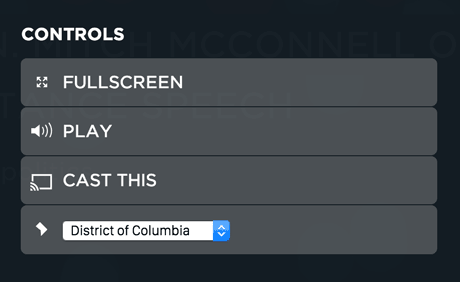
Our original plan was to ask our users to choose their state when they arrived. But as we learned from user testing and fine-tuned the welcome process, we killed the intermediary “pick your state” screen. Instead the site would guess the user’s location, and users could change their state via the controls menu.

6 percent of users interacted with the state dropdown. The list of top states users switched to hints at interest in certain contentious races (Senate seats in Kentucky and Colorado, for example), regardless of where the user was actually located.

  • Kentucky
  • Colorado
  • California
  • Florida
  • Arkansas

We heard feedback that some users who did use the dropdown were unsure of its purpose. If we had more time, we might have put more time into this feature. We hoped that if our attempt at presenting location-specific results worked seamlessly for most users, it would be okay.

The Chromecast Hypothesis

Our working theory was that Chromecast users would be the most passive in their interaction with the app — likely throwing it up on the TV and just letting it run — and therefore they would spend more time with it. And that theory held true: Chromecast users spent an average of 19 minutes and 53 seconds on the site (compared to the overall average of 7 minutes and 1 second).

That said, the Chromecast audience was pretty small: In only 0.7 percent of visits did a user initiate a Chromecast session by clicking on one of our “Cast This” buttons. (This does not include users who may have cast the page using the Chrome browser extension.) But we heard from many Chromecast users who seemed very excited that we built something for them: 15 percent of the feedback emails we received and 13 percent of tweets talking about the app mentioned Chromecast.

(We originally intended to also support Roku and AirPlay “casting,” but the native Chromecast experience proved to be far superior to the “mirrored” offered by other devices. We hope to continue experimenting in this arena.)

On a related note, one surprise: 3 percent of users clicked the fullscreen button — more than double our Chromecast users. And these users stayed on the site even longer, an average of 31 minutes, 38 seconds.

Conclusion

This project gave us some useful insights into how users interact (or not) with an app designed to be experienced passively.

We also learned a lot about user analytics, from what behavior to track to how to query for results. Our insights were limited somewhat by the tools we had and our ability to understand them — Google Analytics can be pretty opaque.

On all these counts, we’ll continue to try new things and learn with future projects. We look forward to refining this experiment as we plan for the 2016 elections.

The Official PRPD Transition

As I leave the office for the last time as PRPD President, just want to thank you all for 8 great years in that job and over 36 wonderful years in public radio.  PRPD is now in the capable hands of Jody Evans... and, of course, the PRPD board.

My own plans are to take a little time to kick back but remain open to selected advising and consulting projects.  Hope I'll get to work with some of you in my "semi-retirement".

Happy New Year to all and all the best wishes for a thriving future.

Arthur Cohen

PRPD Office Move in Progress

As the year end approaches, PRPD files and records are "in the mail" from Hamilton, NY to Asheville, NC - the new World HQ of PRPD.  Jody Evans is now on board and officially becomes new PRPD President next week - Thursday, January 1, 2015.

As of January 1, the new PRPD contact info will be:

PRPD
150 Hilliard Ave.
Asheville, NC  28801
(802) 373-7934
info@prpd.org


Responsive Graphics In Core Publisher With Pym.js

Editor’s Note: Core Publisher is a content management system that staff at many NPR member stations use to maintain their websites. This post is written for that audience, but may be useful for users of other CMSes.

Over time, many member stations have created maps, graphics and other projects for their websites that were sized to fit Core Publisher’s fixed-width layout. But with the responsive mobile-only sites, and Core Publisher going to a fully responsive design, these elements either don’t work or won’t resize correctly to the screen.

Now you can use Pym.js to iframe responsively-built projects within Core Publisher stories.

(Note: NPR Digital Services, the team behind Core Publisher, doesn’t maintain or support Pym.js and can’t help you use it. But they didn’t raise any concerns about this workaround.)

I Was Ready Yesterday, What Do I DO?

I like that enthusiasm. First of all, let’s get a few assumptions out of the way: We’re assuming you are familiar with working in Core Publisher, know the post building process, comfortable with working in the source code view in the WYSIWYG with HTML, and that you have a separate web space to host all of your files (KUNC, like the NPR Visuals team, uses Amazon’s S3 service).

1) Download Pym.js.. Follow the instructions to integrate it into your project. (In Pym.js terms: Your project is the “child” page, while the Core Publisher story page it will live on is the “parent” page.)

2) Publish your project to the service of your choice. Note the URL path: You’ll need it later.

3) Build a post as normal in Core Publisher and then switch to the source code view and locate in the code where you want to place your iframe.

4) Core Publisher often strips out or ignores tags and scripts that it doesn’t recognize when it publishes. We’re going to get around that by using tags that CP does recognize. We’ll use Pym.js’s “auto-initialize” method, rather than inline JavaScript, to embed our project on the page. But, contrary to the example code in the docs, don’t use <div> tags to indicate where the iframe will go — use <p> tags instead. You’ll also need the URL path to your project from step 2: That will be your data target. The tag will look like this: <p data-pym-src="http://example.com/project/"></p>. Your target code for the iframe should look something like this:

<p>Bacon ipsum dolor amet cupim cow andouille tenderloin biltong pork belly corned beef meatball swine pastrami alcatra.</p>
<p data-pym-src="http://example.com/project/">&nbsp;</p>
<p>Cupim beef ribs ribeye swine tail strip steak drumstick venison bacon salami pig chicken.</p>

Beware: Core Publisher often will ignore paragraph tags <p> that are empty when it publishes. To avoid this, insert a non-breaking space &nbsp; between the opening and closing <p> tags for your pym target. Sometimes the CP WYSIWYG hobgoblins will insert this for you as well.

5) Next, point to the Pym.js script file. <script> tags are sometimes hit-or-miss in Core Publisher, so you should save your work right now.

(Note: If you’re embedding multiple Pym.js iframes on a page, you only need to include this script tag once, after the last embed.)

6) Did you save?

7) Good, let’s place that script tag now. It should follow the last iframe target in your post and should only appear once. You’ll need your URL path to pym from step 2. The full tag will look like this: <script type="text/javascript" src="http://example.com/project/js/pym.js"></script>.

8) Your complete code should now look like this:

<p>Bacon ipsum dolor amet cupim cow andouille tenderloin biltong pork belly corned beef meatball swine pastrami alcatra.</p>
<p data-pym-src="http://example.com/project/">&nbsp;</p><script type="text/javascript" src="http://example.com/project/js/pym.js"></script>
<p>Cupim beef ribs ribeye swine tail strip steak drumstick venison bacon salami pig chicken.</p>

Most of the time the script tag should be fine since it is a simple one — only the tag and URL, and no other arguments. Sometimes Core Publisher will still strip it out. This should be the last thing you place in your post before you save to preview or publish.

If you go in later and edit the post, double-check that the script wasn’t stripped out.

A good sign that the script wasn’t dropped? The following text might appear in the normal WYSIWYG text view: {cke_protected_1}. Don’t delete it: That’s script code.

Take a look at your post and revel in how cool that Pym.js-inserted element is. Or take a look at this example or this one.

What Gives? Your Example Isn’t On The Responsive Theme.

We’ll be transitioning to the responsive design in a few months. In the meantime, KUNC has a lot of legacy iframes that we’ll be going back to and embedding with Pym.js. And Pym.js works like a champ on the already-responsive mobile site, so these projects will work better for the quickly-growing mobile audience. Always think mobile.

So, Does It Work On The Responsive Theme?

It sure does! Anna Rader at Wyoming Public Media was kind enough to let me try a Pym.js test post on their newly-transitioned responsive site. Everything worked like a charm and there was much excitement.

Will The Pym Code In A Post Carry Over The API For Station-To-Station Sharing?

I haven’t tested this yet. If you’d like to be a test subject, let me know and we can give it a try. Looking at the raw NPRML in the API for a post with the pym code it in, it all seems to be there.

Have any questions? Find me on Twitter @ejimbo_com and ask away.

Improving User Engagement Through Subtle Changes: Updating the Book Concierge

The NPR year-end 2013 Book Concierge was a big hit. Instead of writing a bunch of lists, the books team solicited over 200 short reviews by critics and staff and put them into a single, beautiful website designed to make discovering great books fun. Readers loved it. For the 2014 Book Concierge, our goal was to build on last year’s success and resist the urge to rewrite the code or wildly redesign.

This is a catalog of small improvements, why we made them, and the difference they made. We’re using analytics for the first five days following the site’s launch. Overall, pageviews are slightly down from last year (337,000 in the first five days in 2014 versus 370,000 in 2013), but engagement appears to have increased fairly significantly.

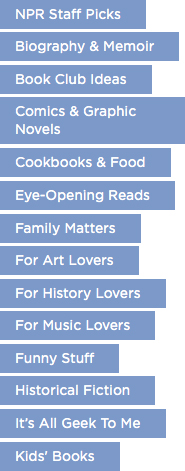
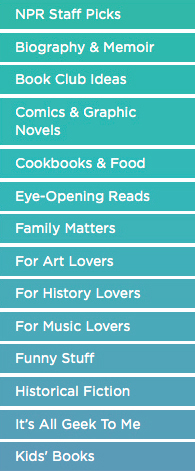
Tag Styling

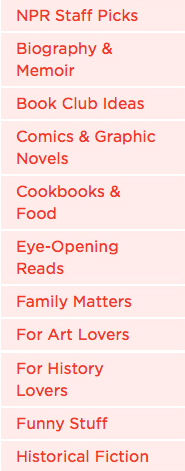
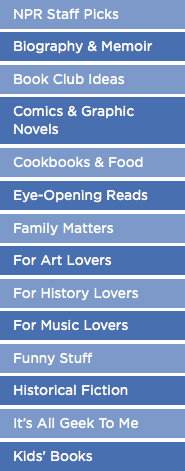
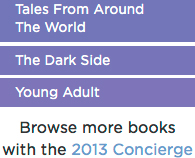
In the 2013 concierge the list of tags blends together, making them difficult to scan. To improve the tags’ legibility and click-ability, we tried different color combinations and styles with varying success. We tried alternating between 2 tag colors, as well as varying the tag length, but neither were satisfying.

Our final solution was to apply a color gradient over the list of tags. This transformed the tags into individually identifiable buttons that still feel like a cohesive unit. This year, there was an average of 2.7 tag selections per visit versus 2.3 in 2013, a 17% increase. In 5 days, about 86,000 people clicked the most popular tag (NPR Staff Picks), up from about 75,000 in 2013.

2013

2014

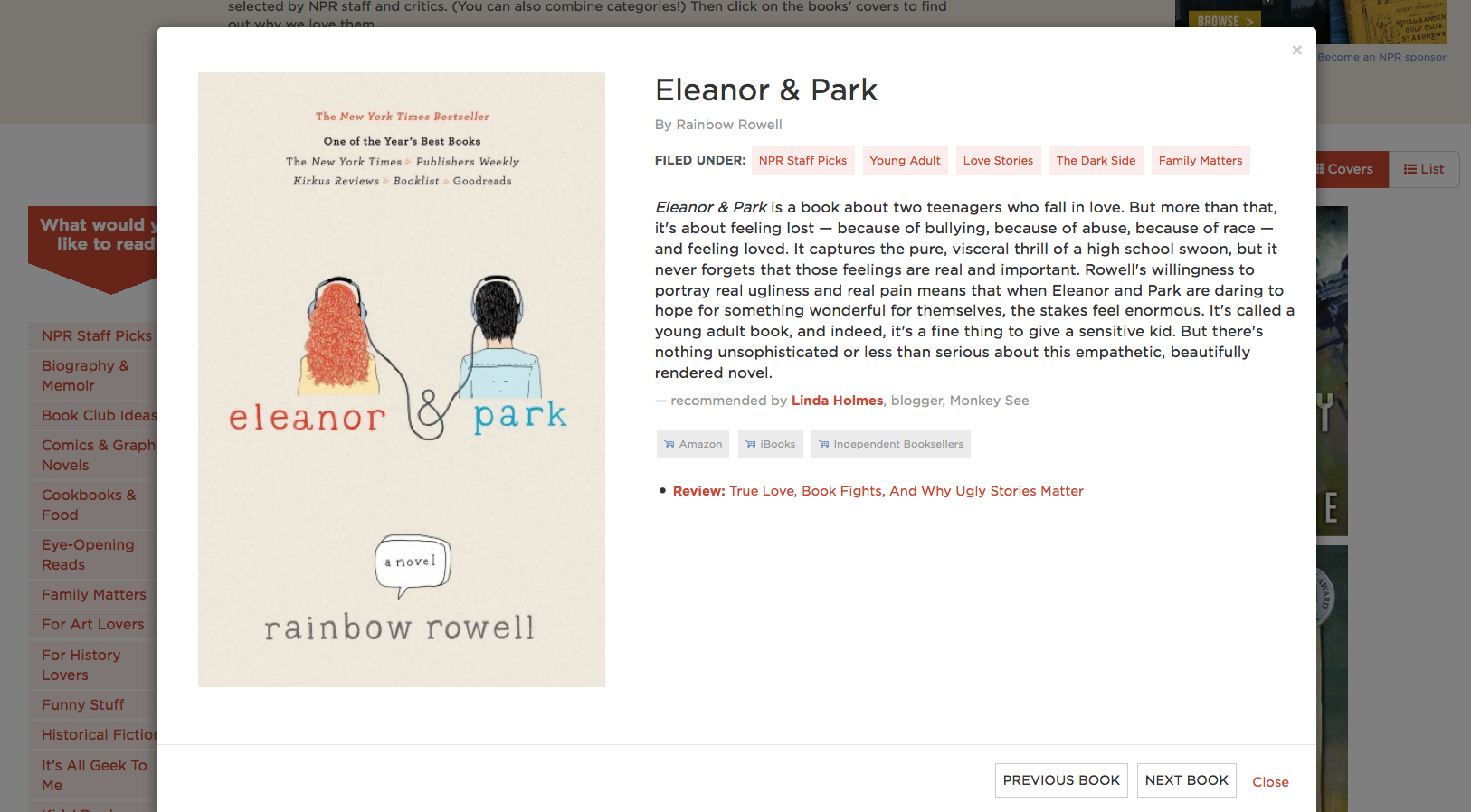
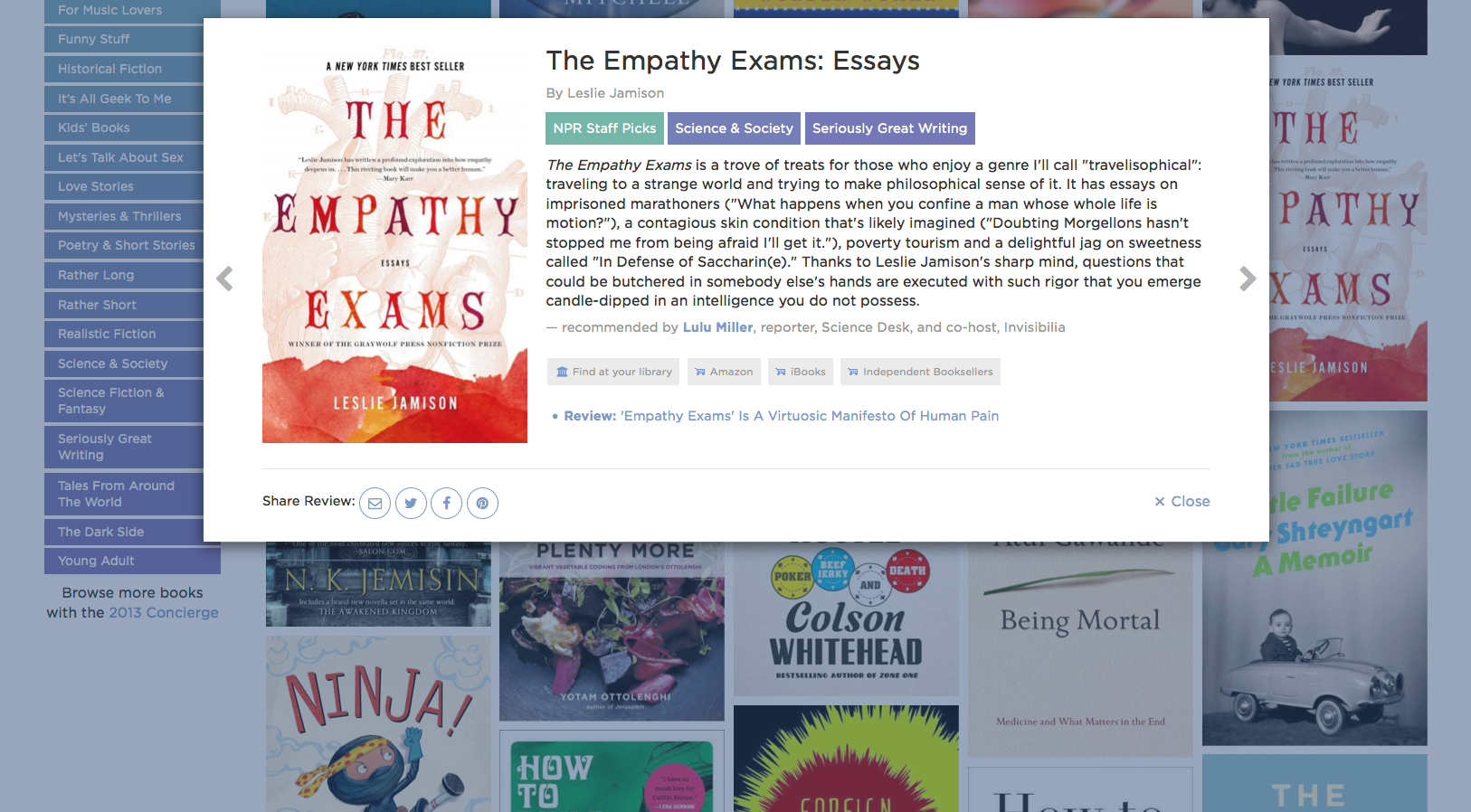
Modal Improvements

We changed the modal design to help encourage users to read more book reviews. We replaced the modal’s ‘previous’ and ‘next’ buttons — which were tucked away at the bottom of the review — with side paddles. This allows viewers to easily click through the reviews without having to hunt for the buttons at the bottom of each review. We also changed the modal proportions so that it fits into a wider range of screen sizes without forcing the user to scroll. By putting a max-width on the modal and limiting the book cover image size, we eliminated a lot of dead white space which improves the user’s reading experience. We believe these changes worked. This year, users viewed an average of 3.7 reviews per visit, up 54% from 2013.

2013

2014

Filter Button Location

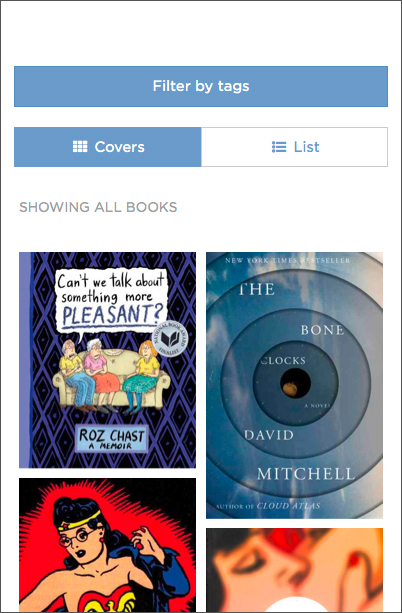
In the 2013 concierge the filter button is positioned in the header above the ad on mobile devices, leaving a gap between the button and the book grid. In the 2014 version, we moved the filter button under the ad below the header, grouping the button with the content that it affects. Although the tag usage per viewer on mobile is similar for both years, we thought that this change created a more organized layout.

2013

2014

Social Buttons

We wanted to help users share their favorite books and reviews, so we added share buttons to the book modal. In the first 5 days, 6,110 reviews were shared through email, followed by facebook (2,866), pinterest (2,091) and twitter (559).

Links to Previous Years

It would have been cool to combine 2013 and 2014 into one big concierge, but we didn’t have time for that. We still wanted to reference last year’s concierge, as well as book lists from previous years, so we added these links to the header. Additionally, we added a link below the tags list to catch people who skipped past the header. On launch day, the 2013 concierge got 20,330 pageviews driven by the 2014 page.

2014

Lighten page load, improve performance

We’ve been able to realize significant performance gains in recent projects by using custom builds of our libraries and assets. We shaved over 300kb off the initial page load by using a custom icon font generated with Fontello rather than including all of Font Awesome. To further lighten the load, we dropped a few unnecessary libraries and consolidated all our scripts into a single file loaded at the bottom of the source.

In 2013 each book had two images, a thumbnail for the homepage and a bigger version for the modal. This year, we cut the thumbnail and aggressively optimized the full-size cover images. The page weight is almost identical, but instead of loading a thumbnail for the cover and a full sized cover when looking at a review, only a single image is loaded. This makes load time feel faster on the homepage, and helps load the reviews faster.

We also disabled CSS transitions at small viewport sizes to improve mobile performance and dropped all CPU intensive 3D CSS transitions.

Responding to users after launch

Finally, some librarians suggested to NPR Books that next year we should include a link to Worldcat, a site that will help you find a book at your local library.

2014

We thought this was a lovely idea and didn’t see why it needed to wait. So we used the Online Computer Library Center identifier API to get the magic book identifier used by Worldcat and added a “find at your library” link the day after launch. This quickly became the second most clicked exterior link after the “amazon” button.

It’s always awesome to make librarians happy.

Nielsen: Milennials DO Listen to Radio

A new Nielsen report, THE MEN, THE MYTHS, THE LEGENDS: WHY MILLENNIAL “DUDES” MIGHT BE MORE RECEPTIVE TO MARKETING THAN WE THOUGHT reports that:
Millennial men are also heavy music listeners. Eighty-eight percent of all Millennial males in the U.S. listen to radio each week, spending more time than their female counterparts tuned in (11 hours and 42 minutes vs. 10 hours and 46 minutes). They also show greater interest in personalized streaming audio services—think Spotify or Pandora—than other demographics.
Not surprisingly, they are major digital users:
Millennial males spend less time on average each week consuming traditional TV—only 20 hours, compared to 23 hours for Millennial females, 28 hours for Gen X males and 38 hours for Boomer males. However, they make up much of the difference online. This group spends significantly more time per week (2 hours 15 minutes) than any other demographic watching videos on the Internet

Thompson to Atlantic, Wilson to NY Times

More news about NPR staff (current and former) this week.  

Matt Thompson
1) Matt Thompson will be leaving NPR to become Deputy Editor of The Atlantic. Matt was NPR's Director of Vertical Initiatives  (and Mischief).  Among his many accomplishments, he originated the Code Switch blog.  He also led NPR's Project Argo.  Earlier this year, Sr. VP of News Margaret Low-Smith left NPR for the Atlantic.

2) Last week the New York Times announced that former NPR EVP and Chief Content Officer Kinsey Wilson will "oversee innovation and strategy" for the organization.  He will begin working for the Times in February

Total Radio Cume Up, TSL Down

Nielsen's latest Total Audience Report, December 2014 shows that radio cume rose year to year for the 3rd quarter.  All Access reports:
"...radio's overall number of 2+ users was up to 258,734,000 in Q3 2014 versus 257,420,000 in Q3 2013. TSL, however, was down to 58:53 in Q3 2014 from 60:42 in Q3 2013."
The report, which mostly discusses TV usage, also shows the same trend among African-American and Hispanic listeners.
"According to the report, this fragmentation doesn't apply just to technology; consumers' viewing and listening habits are following suit. The recent proliferation of new devices allows consumers to connect with content anytime and anywhere. TV is affected the most..."

Baldwin’s Podcast Returns

Photo: WNYC/Mary Ellen Matthews
"Here's The Thing", a weekly podcast series hosted by Alec Baldwin has returned.  The WNYC produced show posted its first in the latest series last week.

According to All Access, the latest (3rd) season will be released every other Monday.  "Guests slated for the new season include JULIANNE MOORE, SARAH JESSICA PARKER, JULIE ANDREWS, and JOHN MCENROE."

Audience 98: Enduring Insights or Now Useless Information?

Yesterday's keynote speech at the Public Radio Super Regional meeting was by Paul Jacobs. He's a radio researcher, radio web app developer, and the incoming Board Chair of Greater Public -- the trade association for fundraising, development, and marketing professionals in public radio and public TV.

Early in his speech, Jacobs took exception to public radio's continued use of findings from a major industry research study published in the late 1990s -- Audience 98

Jacob's criticism was that the research was conducted in 1998. He accentuated that point with a pretty funny set of images of products and services from 1998 that are no longer with us... like Windows 98.

That was it. Audience 98 is old and therefore no longer of value.  "Get over it," he said.

It made for a good laugh. But it also got me to revisit my thinking about Audience 98 and whether its findings could help public radio grow and thrive in this never-ending age of digital disruption. I think the answer is "yes."  And, instead of getting over it, I'm thinking perhaps more people need to get into it. 

In the interest of full disclosure, I worked on the Audience 98 research and I contributed to several Audience 98 reports. After careful consideration of any bias I might have towards my past work, I still think the answer is "yes." 

That's because 16 years later, we continue to successfully apply the lessons learned from Audience 98 in our consulting work with public radio stations and producers. Audience 98 has become especially valuable as we work with people new to public radio who don't know much about the audience and the intersection of listening, values, and giving. It's amazing to see what they can accomplish in radio, in the digital space, and in fundraising once they have that understanding.

Why has Audience 98 endured?

I believe it is because Audience 98 wasn't really a radio research project. It was a research-based blue print for increasing public radio's public service and long-term financial self-sufficiency. Unlike commercial radio research, which is generally designed to help boost the immediate ratings and is expected to have a short shelf life, Audience 98 was designed to provide insights that would stand the test of time. 

What do you think?

Below are a few of the essential insights from Audience 98. Each insight is backed by very specific, actionable research findings to help public radio get more listeners, more listening, and increased financial support from listeners.

I encourage you to spend some time with each of these insights. Ask yourself, "Are these lessons stuck in 1998?" "Are they limited to radio only or could they apply to listening via mobile devices and the desktop?" "Could they apply to public radio generated content that people might read on a mobile device or the desktop?"  "What new information could make them even more valuable to the decisions public radio leaders face today?"


Public radio transcends simple demographics to speak to listeners’ interests, values, and beliefs.
  •       People listen to public radio programming because it resonates with their interests, values, and beliefs. This appeal generally cuts across age, sex and race.
  •       Appeal can also cut across program genres and format types. Different programs and formats may appeal to the same kind of listener as long as they stay focused on that listener’s interests, values, and beliefs.
  •       Changes in the sound and sensibility of programming can alter its appeal. When programming appeal changes, so does the kind of listener it attracts.

Public service begets public support.
  •       Listeners send money to public radio when they rely upon its service and consider it important in their lives.
  •       They are also more inclined to send money when they believe their support is essential and government and institutional funding is minimal.
  •       Public support, like public service, is the product of two factors: the value listeners place on the programming, and the amount of listening done to the programming.
What's your opinion?  Are you over it or into it?  Here's the link to the source material and the entire Audience 98 series of reports if you want more.

Is Local News the New Classical Music?

Digital News Guru Ken Doctor presented the opening session today at the public radio Super-Regional meeting in Las Vegas. 

His premise.  Local news presents a great opportunity for public radio.

His logic. There is great potential in the digital space for national news. Jobs are growing in this sector. There's more than $40 billion in digital advertising out there.  And local news in trouble. Revenues are way down. More than 20,000 jobs have been lost. There is a dearth of local reporting and this represents opportunity for public media.

This is the same logic that was used to program public radio in the late 1970s and early 1980s. Public radio was the place to program dying formats.

The problem, as public radio learned by the late 1980s, is that picking up the failed scraps from commercial media does not make for a viable business model.

We often forget that the success public radio has enjoyed over the past several decades came from inventing something new -- a national news, information, and entertainment service delivered locally that created a non-geographic sense of community among  like-minded listeners.  Public radio built a great multi-stream revenue model on this service.  It is the same model being pursued by the start-ups in the national digital new business.

Focusing on local to the detriment of national is to abandon what has made the public radio business model work.

So what does this have to do with classical music?

There has been somewhat of a classical music radio revival in major markets of late. Stations such as WQXR in New York, KING in Seattle, and KDFC in San Francisco flipped from commercial radio to public radio with great success.

These markets are sufficiently large to accommodate the financial needs of classical music radio stations. But most markets are not. That's why they import their classical from syndicated services.
More important, these are brands committed to classical music full-time. They succeed because of their singular focus, their singular appeal.

News is not the singular appeal of public radio.  National and local news can have very different appeals.

This valuable lesson, first learned in the 1980s, still applies today.  Putting too much local content into today’s service is the same problem as trying to have NPR News, Classical, Jazz, Folk, and 8 others types of programming on a single station. It works against the principle of focusing formats based on the appeal of the content. 


If there is a future in local news for public radio, it is establishing a separate service with a separate brand. It is inventing something new that stands on its own. Adding too much local to the current public radio station brand will diminish, not enhance, the brand.

Three interesting code snippets from NPR’s Election Party

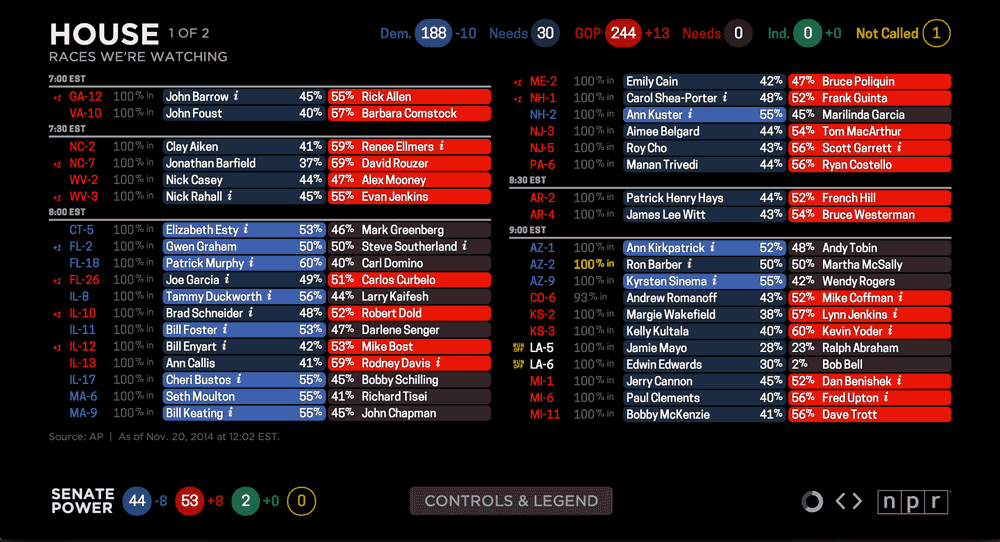
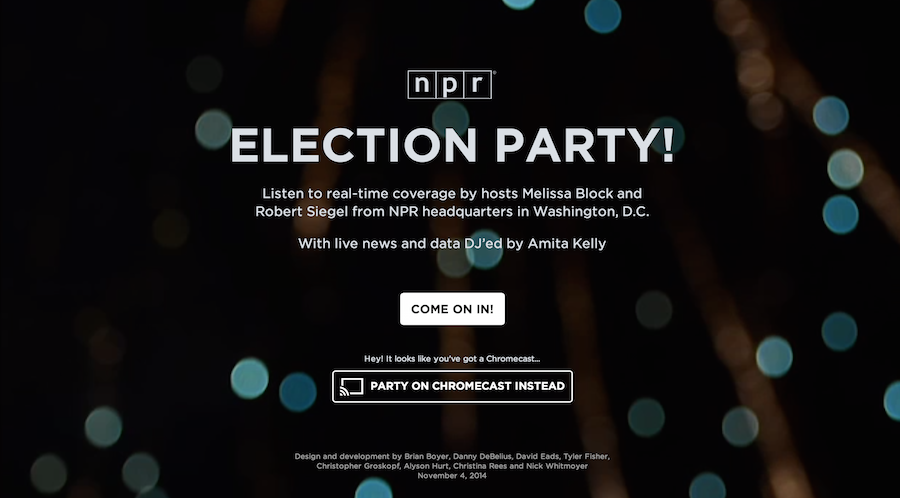
The NPR Election Party welcome screen

NPR’s Election Party app has a lot of moving parts. It displays live election results from the Associated Press, ingests posts from our Tumblr liveblog, bakes out visualizations of our data, and presents all of this in a slideshow that, on election night, was continuously changing through an admin. It even works as a Chromecast app.

All of the code is open source and freely available to read and use, but it can be hard to make sense of all of it without knowledge of our app template and all the things this app actually does.

There are countless little snippets of this app I could share, but I chose three pieces of the app that would be interesting to share in isolation.

Deploying bug fixes by reloading your users’ browsers

Our app was a static web page, as all of our apps are. We had a server separately parsing AP data, ingesting Tumblr posts and baking out the static website every few minutes, but the client never touched the server. This made it difficult to deploy bug fixes if something broke on election night.

To solve this problem, we devised a simple way to force every client to refresh the web page. We deployed a file with a timestamp to S3, and on page load, the client downloaded that file, read the timestamp and stored it. Then, every three minutes, the client would check that file to see if the timestamp had changed. If the timestamp had changed, the browser refreshed the page. Here’s the client-side code:

var reloadTimestamp = null;

var getTimestamp = function() {
    // get the timestamp on page load
    if (reloadTimestamp == null) {
        checkTimestamp();
    }
    
    // continually check the timestamp every three minutes
    setInterval(checkTimestamp, 180000);
}

var checkTimestamp = function() {
    $.ajax({
        'url': '/live-data/timestamp.json',
        'cache': false,
        'success': function(data) {
            var newTime = data['timestamp'];
            
            // if we haven't set a timestamp yet, set it
            if (reloadTimestamp == null) {
                reloadTimestamp = newTime;
            }
            
            // if the initial timestamp doesn't match the new one, refresh
            if (reloadTimestamp != newTime) {
                // set a cookie in case we need to something to happen
                // when the page reloads
                $.cookie('reload', true);
                window.location.reload(true);
            }
        }
    });
}

$(document).ready(function)() {
    getTimestamp();
    
    // stuff you only want to happen if we forced a refresh
    if ($.cookie('reload')) {
        // for example, skip a welcome screen or hide some UI element
        
        $.removeCookie('reload');
    }
});

Locally, we could deploy the new timestamp file with a simple Fabric command and deploy function:

#!/usr/bin/env python

from datetime import datetime
import json

from fabric.api import local, task

@task
def reset_browsers():
    """
    Create a timestampped JSON file so the client will reset their page.
    """
    payload = {}

    # get current time and convert to epoch time
    now = datetime.now().strftime('%s')
    
    # set everything you want in the json file
    payload['timestamp'] = now

    with open('www/live-data/timestamp.json', 'w') as f:
        json.dump(now, f)

    deploy_json('www/live-data/timestamp.json', 'live-data/timestamp.json')

def deploy_json(src, dst):
    """
    Deploy to S3. Note the cache headers.
    """
    bucket = 'elections.npr.org'
    region = 'us-west-2'
    
    sync = 'aws s3 cp %s %s --acl "public-read" --cache-control "max-age=5 no-cache no-store must-revalidate" --region "%s"'

    local(sync % (src, 's3://%s/%s' % (bucket, dst), region))

We used this once early in the night when we discovered an error with how we were displaying some of our slide types. It worked well, and we could assume all of our users were using the latest versions of our code.

Here is a gist of the described code above.

Widescreen slides on any device

For our app, we decided to optimize for 16x9 or wider devices, which gets you most TVs, laptops, tablets and phones (in landscape mode). Fixing these slides to this aspect ratio and getting everything in the slides to size appropriately was tricky. We used an unusual technique to achieve this.

First, we set the base font size to 1 vw (that is, 1% of the viewport width). Then, we scaled everything else with rem units (like an em unit, but based only on the base font size). By doing this, we were able to accomplish a couple things: We ensured that everything scaled to 16x9 based on the width of the viewport. With some JavaScript, we could also shrink the base font size when the client browser is shorter than 16x9.

A demo of this is simple.

Your HTML file needs only a wrapper div and some content in it:

<div id="stack">
    <div class="big">
    BIG
    <div class="em"></div>
    </div>
    <div class="little">
        little 
        <div class="em"></div>
    </div>
</div>

Then, in a CSS file, we set the base font size on the html element to 1vw and ensure there is no margin on the body:

html { font-size: 1vw; }
body { margin: 0; }

On the wrapper div, we set a few critical styles to making this work, as well as some styles that make the demo visible:

#stack {
    box-sizing:border-box;
    -moz-box-sizing:border-box;
    -webkit-box-sizing:border-box;
    
    // 16x9 aspect ratio 
    width: 100rem;
    height: 56.25rem;

    // centering if the screen is wider than 16x9
    margin: 0 auto;

    // for the sake of testing
    border:4px dashed black;
}

In addition, we used rems for all other measurements, including font sizes, widths and heights, so that they would scale appropriately:

.big {
    font-size: 10rem;
}
 
.little {
    font-size: 2rem;
}
 
.em {
    background-color: blue;
    width: 1rem;
    height: .1rem;
}

Finally, to make this fully responsive, we need a JavaScript resize function to change the base font size when appropriate:

var onWindowResize = function(){
    // get aspect ratio of current window
    var aspect = window.innerWidth / window.innerHeight;

    /*
    * If the window is wider than 16/9, adjust the base font size 
    * so that the wrapper stays 16/9, and letterboxes 
    * to the center of the screen.
    */

    if ( aspect > 16/9) {
        document.documentElement.style.fontSize = ((16/9) / aspect) + 'vw';
    } else {
        document.documentElement.style.fontSize = '1vw';
    }
}

This, of course, required prompting users to shift their phones and tablets into landscape mode.

If you want to see this demo in action, see it on Codepen and resize your browser a bunch. In addition, here is a gist of all the code.

Developing Chromecast applications in JavaScript

The functionality we desired for Chromecast users went beyond simple tab mirroring, which Chromecast allows you do to with any website. Instead, we wanted to make your casting device a remote control, able to mute audio and navigate between slides. To do so, we had to use the Google Cast SDK. The Cast SDK allows you to make the Chromecast load your app on an internal version of Chrome installed on the hardware.

The SDK works pretty well, and other people have done good work in documenting how to get a Chromecast app set up. Peter Janak, in particular wrote a Chromecast Hello World application that was very helpful for us.

To make our lives easier, we wrote a simple library to handle initializing Chromecast sessions and passing messages between the connected device and the Chromecast. Next time we develop a Chromecast app, we will probably develop this further into a standalone library, but it works well as is now.

In addition to embedding the SDK JavaScript on your site, we have two files, chromecast_sender.js and chromecast_receiver.js. Read the full source here. These files provide a friendlier API for interacting with the Chromecast. Specifically, they define the CHROMECAST_SENDER and CHROMECAST_RECEIVER objects, which allow you to interact with casting devices and Chromecasts in code.

First, to setup a Chromecast app, you need to check if a user has the Chromecast extension installed:

// define some global vars
var IS_CAST_RECEIVER = (window.location.search.indexOf('chromecast') >= 0);
// is a currently casting device
var is_casting = false;

window['__onGCastApiAvailable'] = function(loaded, errorInfo) {
    // We need the DOM here, so don't fire until it's ready.
    $(function() {
        // Don't init sender if in receiver mode
        if (IS_CAST_RECEIVER) {
            return;
        }

        // init sender and setup callback functions
        CHROMECAST_SENDER.setup(onCastReady, onCastStarted, onCastStopped);
    });
}

An important thing to keep in mind is that, in our model, the Chromecast app actually runs the same code as the client. You need to maintain state across your app so that your code knows whether the client is a Chromecast or a regular web browser. Thus, you would have a function for the sender when a Chromecast session is initiated, and a code path in your ready function for Chromecasts specifically:

// function for casting devices
var onCastStarted = function() {
    is_casting = true;

    // show what you want to appear on the casting device here
    $chromecastScreen.show();
    $castStart.hide();
    $castStop.show();
}

// example code path when the document is ready
$(document).ready(function() {
    if (IS_CAST_RECEIVER) {
        CHROMECAST_RECEIVER.setup();

        // Set up event listeners here
        CHROMECAST_RECEIVER.onMessage('mute', onCastReceiverMute);
    }
});

Note that you can set event listeners on the Chromecast. This allows you to send messages between the casting device and Chromecast, which powered our remote control functionality. Here’s an example message sending function and receiver callback that allowed us to mute the audio on the TV from the casting device:

/*
 * Cast receiver mute
 */
var onCastReceiverMute = function(message) {
    if (message == 'true') {
        $audioPlayer.jPlayer('pause');
    } else {
        $audioPlayer.jPlayer('play');
    }
}

/*
 * Unmute the audio.
 */
var onAudioPlayClick = function(e) {
    e.preventDefault();

    if (is_casting) {
        CHROMECAST_SENDER.sendMessage('mute', 'false');
    } else {
        $audioPlayer.jPlayer('play');
    }

    $audioPlay.hide();
    $audioPause.show();
}

/*
 * Mute the audio.
 */
var onAudioPauseClick = function(e) {
    e.preventDefault();

    if (is_casting) {
        CHROMECAST_SENDER.sendMessage('mute', 'true');
    } else {
        $audioPlayer.jPlayer('pause');
    }

    $audioPause.hide();
    $audioPlay.show();
}

Importantly, we were able to handle both casting devices and one-screen sessions in the same code path thanks to our state variables.

Again, read the full source of our Chromecast code in this gist.

The many moving parts of our elections app created more interesting pieces of code, and you can dig through everything in our repo. As always, the code is open source and free to use.
Hoban, Abramovitz to Fill PRPD Board Positions

Matt Abramovitz
Jon Hoban
Two PRPD board positions vacated by recent resignations were filled today by Matt Abramovitz, PD at WQXR, New York and Jon Hoban, Chief Content Officer at KJZZ, Phoenix.   They will assume their seats immediately and will serve oout the terms of Dale Spear and Gabe DiMaio.   The latter has taken a job outside of public radio and Spear resigned in light of the retirement of WFAE's GM (and former PRPD chair) Roger Sarow.

A complete PRPD Board listing is located at http://www.prpd.org/aboutus/board.aspx

Note: The next PRPD Board Election is coming up soon.  Nominations will begin in December.

The Story Behind the Geezer Grants

Posted To: Ideas & Innovation > Blogically Thinking

Masters Mediapreneurs and the J-Lab were featured in three MediaShift articles: J-Lab’s Jan Schaffer Reflects Back on 20 Years of Journalism InnovationJ-Lab Launches Journalism Grant Program for Baby Boomers; and Reimagining Journalism School as a ‘Gateway Degree’ to Anything

Last week we announced an awards project to help Baby Boomers launch news startups. This week, we chuckle at our new nickname and shine a spotlight on the history that gave the project momentum.

"Geezer grants" is the term some wags have applied to the $12,000 startup funding open to people age 50-plus who want to launch a news project. Bring it on. Fourteen applications have been submitted for the four awards in the first week. The deadline is Dec. 15.

The funding will come as an award, not a grant. That means individuals are eligible; you don't have to be a nonprofit organization. You can preview the application here and fill one out here.

When J-Lab started raising money for the Encore Media Entrepreneurs project, I already knew this cohort group was keenly interested in responsible news and information, were digitally savvy, and had an appetite for launching news startups.

At least 17 of the start-ups J-Lab has funded since 2005 were the vision of adults aged 53 to 70. And they rank among our most enduring projects. They have been winners of seed funding from J-Lab's New Voices program and from our New Media Women Entrepreneurs program. 

They are people like former magazine publisher Ken Martin, who launched The Austin Bulldog in Texas in 2009 at age 70. He has since pugnaciously covered local government, filing 156 FOIA requests just since January 2011.  
     
His stories have led to more open meetings and open records, including a requirement that Austin City Council members must use city email accounts, not personal emails, to conduct city business.

Meet some others:

  • Professor Chris Harper, at 57, launched PhiladelphiaNeighborhoods.com in 2009 and it has since become part of the capstone for Temple University's journalism program.
  • Non-profit executive Sharon Litwin, 69, launched NolaVie.com with journalist Renee Peck, 56, in 2010 in New Orleans. The arts and culture news site has since forged a content partnership with WWNO, the city's public radio station.
  • Environmental journalist Dave Poulson, at 53, launched Great LakesEcho in 2009 to cover environmental issues and his portfolio continues to grow. It is a spinoff from the 2006 Great Lake Wiki.
  • Former San Jose Mercury News journalist Janice Rombeck, at 59, started NeighborWebSJ in 2010 to cover neighborhood issues San Jose, CA.
  • Former Oregonian art critic Barry Johnson launched Oregon Arts Watch in Portland in 2010 at age 59.
  • One-time Yahoo exec Susan Mernit, at 53, launched Oakland Local to focus on social justice issues in Oakland, CA. in 2009.
  • Professor Lew Friedland was 54 when he launched Madison Commons community news site in Wisconsin in 2005.


J-Lab's list doesn't stop there, nor does the variety.

Take a look at what Laura Fraser, Peggy Northrop and Rachel Greenfield are doing with Shebooks.net.  What Jeanne Pinder is doing with ClearHealthCosts.com. What Michele Kayal, Bonny Wolf, Carol Guensburg and Domenica Marchetti are doing with AmericanFoodRoots.com, which just won two 2014 awards from the Association of Food Journalists: best food blog and best non-newspaper food feature. The possibilities are stimulating.

All of these projects launched with micro funding of between $12,000 and $25,000.

Here's an observation from Maureen Mann, who was a retired school teacher when she won J-Lab funding to start The Forum in Deerfield, N.H. in 2005 at age 59: "One thing to point out is that people over 50 are used to having access to good media, want good media and have the time to make it happen – often for a lot less money (or in some cases no money but a desire for a good source of news)."


'The Forum has since expanded coverage to three other New Hampshire communities and Mann has been a mentor to former PTA volunteer Christine Yeres as she started NewCastleNOW.org to cover Chappaqua, N.Y.

Of note, our media entrepreneurs seem to align with Kauffman Foundation research that finds adults in the 55-64 age group have a high rate of entrepreneurial activity, comprising 23.4 percent of all us entrepreneurs in the U.S. – up from 18.7 percent in 2003.

A MetLife Foundation survey found that two out of three want to have local or regional, not national, impact. Two out of three potential encore entrepreneurs said they'd find their business worthwhile if they made less than $60,000 a year.  About the same percentage said they need $50,000 or less to get started, and many expect to tap personal savings. Those are realistic numbers for local news startups.


More information on the Encore Media Entrepreneur Awards

Four $12,000 awards are available to those Baby Boomers who have a vision for a news venture and a plan to continue it after initial funding is spent. Funding can be used for web sites, mobile apps or other news ideas. The deadline for proposals is Dec. 15, 2014. See guidelines here. Apply online here: https://www.surveymonkey.com/s/EncoreEntrepreneurs.

The awards are supported with funding from the Ethics and Excellence in Journalism Foundation and the Nicholas B. Ottaway Foundation.


Sample clocks for fundraising with the new Morning Edition

Editor note:  This is a companion piece to an earlier post about fundraising with the new clocks.

It may be shocking to realize that the new newsmagazine clocks for NPR start on Monday.   While many stations are busy planning their regular schedules with the new clock, it won't be long before you'll have to figure out your fundraising clock with the new format. 

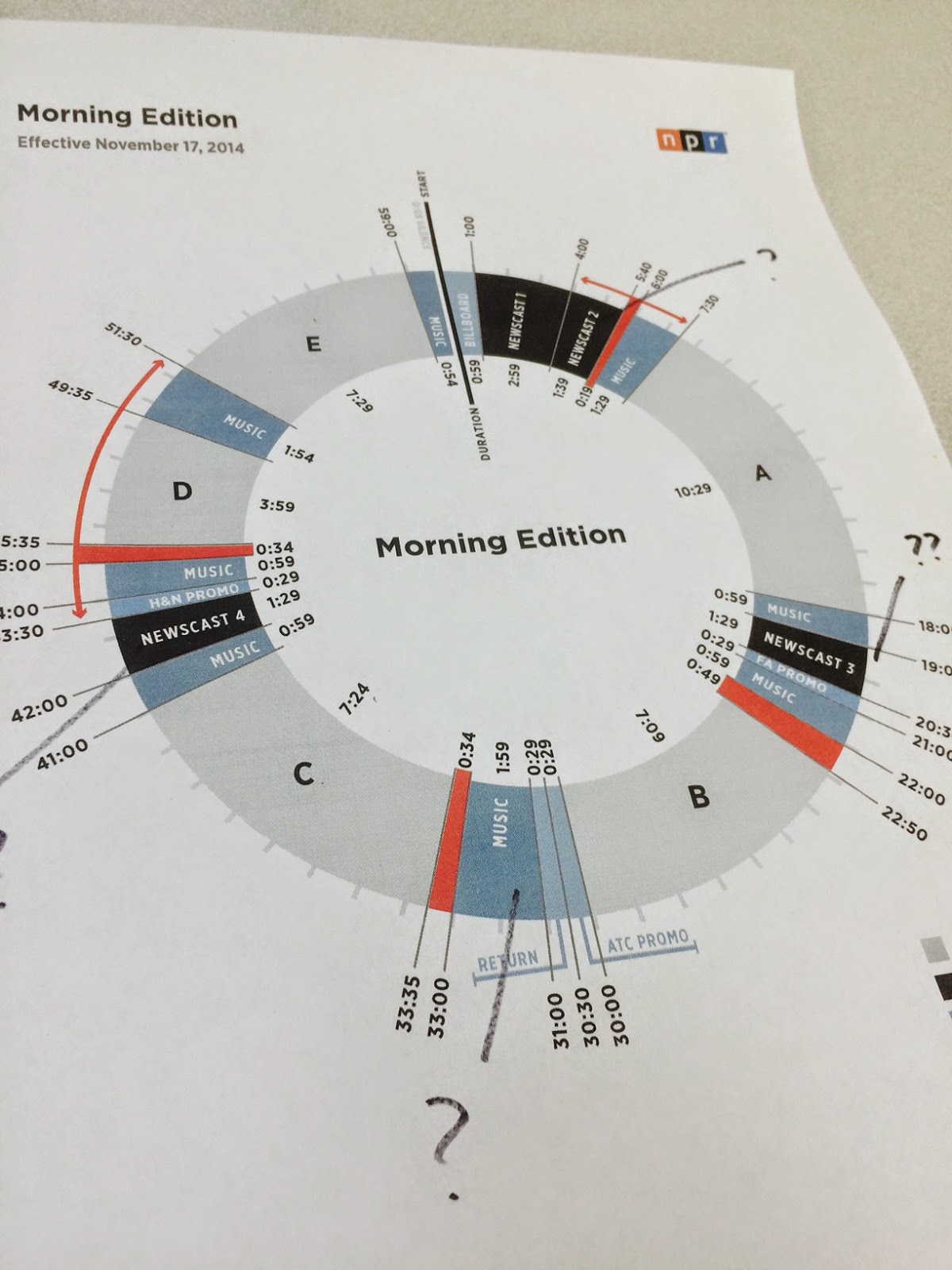
Since Morning Edition is the most changed of the clocks, Greater Public's Jay Clayton put together a few sample approaches for how you can pitch during Morning Edition after the clock change.   Both of these examples try to get 20 minutes of pitching an hour spread out into four breaks.  You can use these as you create your own fundraising clocks for Morning Edition. 

Here are the two examples:

FOR STATIONS THAT DON'T TIME-SHIFT

NPR news             01-04
Station news           04-7:30
NPR A seg            07:30-12
Pitch 1                   12-19
Newscast               19-20:30
Station news          20:30-22:50
NPR B seg             22:50-27
Pitch 2                    27-33:35
NPR C seg              33:35-41
Pitch 3                    41-45:35
NPR D seg             45:35-49:35
Funders                   49:35-51
NPR E seg              51-55
Pitch 4                     55-01
       
FOR STATIONS THAT DO TIME SHIFT

NPR news            01-04
Station news         04-06
Pitch 1                   06-12
NPR A Seg            12-23:30
Pitch 2                   23:30-30
NPR B Seg            30-37:10
Pitch 3                    37:10-43
NPR C/D segs        43-54:30
Pitch 4                    54:30-01    


AIR to Expand Localore Projects

The Association of Independents in Radio (AIR) has received funding to expand three of its Localore projects - Curious City, iSeeChange and Sonic Trace.  The funding will allow producers of those projects (located at Chicago Public Media, KVNF, Paonia and KCRW, LA.)

With the grant from the Wyncote Foundation, AIR has established a "...New Enterprise Fund, a grant distribution that will spread new models and best practices from three Localore productions to stations and producers across the public media system."

Joyce Mac to CPB

Continuing the changes at NPR, Joyce MacDonald has accepted the position of VP of Journalism at the Corporation for Public Broadcasting.  According to a note to the NPR Areps from Jarl Mohn:
"In this role, Joyce will be able to amplify what she has done so exceptionally for so many years, advocate for the critically important work of local journalism throughout the system and across all platforms."
MacDonald is also quoted:
“I am very grateful for the unique opportunity NPR has given me to be on the front lines of delivering on our mission to provide high quality national and local public service journalism. I look forward to continuing this important work on behalf of the American public at CPB.”
Joyce worked for many years in NPR station relations and recently spent 2 years as Chief of Staff under Gary Knell.  In the past year has been Interim President and CEO for NPM.

According to a CPB release, MacDonald will start at CPB next Monday, Novembber 10.

Jody Evans Named Next PRPD Prez


The Public Radio Program Directors Association (PRPD) has named Jody Evans its next President and Chief Executive Officer.  Evans is currently President and CEO of Western North Carolina Public Radio, Inc., which operates WCQS-FM in Asheville, NC. Evans joined WCQS in 2010 and led a highly successful turnaround effort. In 4 years, Evans eliminated the community licensee’s debt through a successful partnership with the organizations’ Board of Directors and significant community leaders. 

Prior to WCQS, Evans has been a national thought leader and successful programmer at Vermont Public Radio and KUT, Austin. Evans was a PRPD Board member from 2005-2009 and has long been a national thought leader in the areas of programming, development and effective public media organizations. She will step into the President and CEO position on January 1, 2015, succeeding Arthur Cohen who is retiring after eight years at the PRPD helm and a decades- long career in public broadcasting.

“We are excited that Jody will bring her passion for mission driven content, forward thinking ideas about our industry, and her inspirational leadership abilities to PRPD,” said Tamar Charney, chair of the PRPD board and Program Director at Michigan Radio. “She is driven by her love of our industry and her excitement about the strong future that is possible for public media. We were impressed by her track record in content creation, fundraising, fiscal management, and working with stakeholders. We look forward to working with her to ensure that PRPD remains a vital force in support of great content across all our platforms.”

PRPD is known for its annual Public Radio Programming Conference, and has evolved into a leadership organization that elevates the role of the program director in each station and throughout the system. Under Evans leadership, PRPD will lead the discussion about the future of content and develop the research needed to move forward in a strategic manner. Evans has expressed great enthusiasm about “the ability to be part of and possibly ignite a national dialogue about what we do and how we are going to move forward.”

Evans has a Bachelor of Arts degree in Mass Communications from Wright State University in Dayton, Ohio.

Cara Erickson, president of NewCoordinates, LLC partnered with PRPD's Board search committee to conduct this search.  NewCoordinates is a boutique retained executive search consultancy specialized in the media, digital media, and information industries. 


Twenty Years on the Front Lines of Journalism Innovation

Posted To: Ideas & Innovation > Blogically Thinking

J-Lab director Jan Schaffer is wrapping up 20 years of raising money to give it away to fund news startups, innovations and pilot projects. She is pivoting J-Lab to do more writing, custom training and discrete projects.

After two decades of work at the forefront of journalism innovations, interactive journalism and news startups, she weighs in with some observations and lessons learned. This post addresses journalism innovations.


Little did I expect when I left The Philadelphia Inquirer to come to Washington, D.C., 20 years ago, that I would end up on the frontlines of journalism innovation, participatory journalism and news startups ­– just as the journalism industry was on the precipice of profound disruption.

I quickly took on a leadership role in what was to become one of the nation's most controversial attempts to reform journalism: the civic journalism movement. Castigated by the cardinals of the profession for its outreach to readers and viewers (there weren't many "users" then), civic journalism was an effort to experiment with new ways to engage audiences and stimulate citizen involvement in elections, local issues and problem solving. Its critics found abhorrent any idea that citizens might have input into how journalists did their jobs.

I can look back now with some amusement. But I gotta say: Civic journalism really worked. (More on this in another blog post.) It makes most of today's audience engagement initiatives look a mile wide and an inch deep.

I now see the degree to which civic journalism was a precursor to today's participatory and interactive journalism and the rise of citizen journalists. And I am heartened when I see so many entrepreneurial news startups openly embrace civic aspirations. Consider Jim Brady's BillyPenn.com, for one.

When a decade of the Pew Charitable Trusts' generous support for civic journalism ended, I spun our efforts into J-Lab: The Institute for Interactive Journalism. Informed by early clickable maps that served as surrogate public hearings (kudos to the Everett Herald's Waterfront Renaissance project) and by the gaming instincts of the first state tax calculators and budget balancers (hat tips to New Hampshire and Minnesota Public Radio), I wanted to move in a more digital direction. It was 2002, and we soon found ourselves in the vanguard of an onslaught of activities. We rewarded innovations with theKnight-Batten Awards, seeded startups with theNew Voices projects and Women Entrepreneur awards, built digital capacity and created new kinds of knowledge.

J-Lab became a catalyst for news ideas that work. The center and its advisory boards funded 100 news startups and pilot projects. They included community news startups, women media entrepreneur initiatives, networked journalism initiatives and enterprise reporting awards.

In the process of monitoring these projects, J-Lab learned a lot. And we shared it in 11 publications and five websites that have been used as resources in newsrooms and classrooms. J-Lab was the first to chronicle the emergence of citizen-ledcommunity news sites. It was the first to capture the extent of nonprofit funding for news projects with a 2009 database of grant-funded news projects accompanied by video case studies. We tapped Mark Briggs to write "Journalism 2.0," and it was such a popular early guide to digital literacy, it was downloaded some 200,000 times.

As I pivot to embrace some new projects, I offer this roundup of some lessons learned:

  • Innovations awards work - if they recognize more than multimedia bells and whistles. Audience engagement and impact are the most useful barometers of excellence.
  • Micro-grants for startups work - when the founders are genuinely committed to leveraging a proof of concept into an ongoing project.
  • News entrepreneurs see new jobs to be done in today's media space ­– but far too many are leaving traditional newsrooms to do them.
  • You can change behaviors by incentivizing change - if you set out short-term and long-term expectations.

Entrepreneurship

Our funding for news startups ranged from $10,000 to $25,000 per project, and our pilot-projects ventures received $5,000 to $50,000. The demand for micro start-up awards is enormous and the success rate is notable, especially when applicants must lay out plans for sustainability.

We received 2,011 applications for 22 awards in our McCormick New Media Women Entrepreneur initiative, launched in 2008; 73 percent of those projects are still active. Across the board, the applicants were deeply accomplished, with many Pulitzer, Peabody and Fulbright winners in the mix. The vast majority of the proposals expressed a passion for purpose-driven news and information projects addressing such things as sustainability, social justice or equity. These themes have started to become more pronounced in recent years. Look at The Marshall Project as a case in point.

The vast majority of our women entrepreneurs were also refugees from traditional newsrooms. What a shame their ideas could not find the oxygen to be developed in-house.

Our New Voices grants for community news startups attracted 1,433 proposals for 55 projects that turned into 57 websites. However, 44 percent of the projects were launched by journalism schools and half of these could not figure out how to continue after the initial funding was spent. Kudos, though, to some notable exceptions: Chicago Talks, Great Lakes Echo,Philadelphia Neighborhoods, Madison Commons and Intersections South LA.

I am particularly proud that our award winners represented a broad cross-section of applicants who won on the merits of their ideas and not because they had past relationships or grant-writing abilities.

Training

J-Lab's shared its learning in dozens of high-touch training programs for both journalism practitioners and educators at national journalism gatherings and at our own interactive summits and workshops. For more than 10 years J-Lab programmed lunches for journalism educators at AEJMC. For eight years, we produced sold-out pre-convention workshops for the Online News Association. We convened the first summit of university-based news sites and two women media entrepreneur summits. When you give people practical, accessible tools and information, they will use them.

Our Knight Community News Network suite of consultants engaged partners to provide learning modules on how to become a nonprofit 501(c)3, avoid legal risks, use social media and engage audiences. Our J-Learning site offers tutorials in using publishing software and hardware.
Innovations Awards

For nine years, J-Lab and its advisory board rewarded first-mover innovations via the Knight-Batten Awards for Innovations in Journalism. We honored 56 winners and showcased 196 notable entries, good ideas even if they didn't win. Again and again, our awards were an early scout for innovations that later turned into Knight News Challenge winners or Knight grantees. Many of the ideas also were replicated by other news organizations.

While we may not know exactly where we are going in the future, sometimes, it's helpful to look back. I am struck by how, if you track past Knight-Batten winners, you really capture the arc of journalism's reinvention over the last decade. The awards were among the first to validate and honor:

  • News games with Minnesota Public Radio's state Budget Balancer (2003).
  • Participatory journalism with KQED's "You Decide" exercise tool and early crowdsourcing with USAToday giving readers the chance to pick their winners in West Virginia's NewSong Festival for songwriters (2004).
  • Database journalism with the Grand Prize going to ChicagoCrime.com, a searchable database of local crime that later became EveryBlock. Minnesota Public Radio was honored for Public Insight Journalism participatory journalism efforts that have since been adopted around the country (2005).
  • Blogs , with the still-robust Global Voices winning for curating and translating international blogs. Our first social media award went to the Bakersfield Californian. The theme of journalistic transparency emerged with webcast news meetings of the Spokane's Spokesman-Review (2006).
  • Non-traditional journalism winners: the Personal Democracy Forum for its techpresident.com initiative and the Council on Foreign Relations for its Crisis Guides. It was time to acknowledge how new players were entering the news and information space. Our first citizen media award went to The Forum, the nine-year-old citizen-run hyperlocal site for Deerfield, N.H. (2007)
  • Fact-checking was the theme with Wired.com's Wikiscanner winning for developing a way to truth-squad entries on Wikipedia. PolitiFact won for fact-checking public officials and candidates. Ushahidi showed us how mobile phone crowdsourcing could help with crisis information (2008).
  • Innovations in mainstream media had the New York Times sweeping the awards with aportfolio of innovative entries. The rise of nonprofit journalism channeled honors to the Center for Public Integrity (2009).
  • Transparency was the theme of Grand Prize winner The Sunlight Foundation's Sunlight Live coverage of the health care summit with an innovative blending of data, liveblogging, streaming video and social media. An award to ProPublica's distributed reporting corps paid tribute to the theme of collaboration (2010).
  • Social media was the hallmark of the final year of the awards, 2011, which honored Storify's social media story builder and NPR's Andy Carvin for his Twitter coverage of the Arab Spring.

The Knight-Batten Awards were unique in their focus on innovations that "spurred non-traditional interactions," demonstrably engaged audiences, "employed new definitions of news" and "created news ways of imparting useful information." Again and again, they proved to be remarkably prescient about innovations that would have real staying power.

My thanks to our supporters, who had the courage and creativity to fund these activities, including The Pew Charitable Trusts and the Knight, McCormick, Ethics and Excellence, Ford, Wyncote, William Penn, Gannett and Ottaway Foundations and to American University, our home.


Journalism Education: It&#8217;s Time to Craft the Gateway Degree

Posted To: Ideas & Innovation > Blogically Thinking

J-Lab director Jan Schaffer is wrapping up 20 years of raising money to give it away to fund news startups, innovations and pilot projects. She is pivoting J-Lab to do more consulting, custom training and discrete projects.

After two decades of work at the forefront of journalism innovations, interactive journalism and news startups, she weighs in with some observations and lessons learned.  This post addresses journalism education.


If I were to lead a journalism school today, I'd want its mission to be: We make the media we need for the world we want. 

Not: We are an assembly line for journalism wannabes.

The media we need could encompass investigative journalism, restorative narratives , soft-advocacy journalism , knowledge-based journalism,artisanal journalism, solutions journalism, civic journalism, entrepreneurial journalism, explanatory journalism, and maybe a little activist journalism to boot. That's in addition to the what-happened-today and accountability journalism.

Journalism is changing all around us. It's no longer the one-size-fits-all conventions and rules I grew up with.  Not what I was taught at Northwestern's Medill School of Journalism. Not what I practiced for 20 years at The Philadelphia Inquirer.

Yet, as someone who consumes a lot of media, I find I like journalism that has some transparent civic impulses, some sensibilities about possible solutions, and some acknowledged aspirations toward the public good. Even though I realize that might make some traditional journalists squirm.

And I'd assert that – if the journalism industry really wants to engage its audiences and woo new ones, and if the academy wants its journalism schools to flourish – it's time for journalism schools to embrace a larger mission and to construct a different narrative about the merits of a journalism education.

It's time for journalism schools to embrace a larger mission and to construct a different narrative about the merits of a journalism education.

There is some urgency here. Colleges and universities are cascading toward the disruptive chaos that has upended legacy news outlets.  Many, like newspapers, will likely shut their doors in the next decade or two, victims of skyrocketing tuitions, unmanageable debt, unimaginative responses and questionable usefulness.

Adding to the urgency are indications that some J-school enrollments have declined in the last few years, according to the University of Georgia's latest enrollment survey, released in July. Industry retrenchment is partly blamed for making prospective students and their parents nervous about future jobs.

How do you quell that nervousness?  One way is to articulate a new value proposition for journalism education; next, of course, is to implement it. 

It's time to think about trumpeting a journalism degree as the ultimate Gateway Degree, one that can get you a job just about anywhere, except perhaps the International Space Station.

It's time to think about trumpeting a journalism degree as the ultimate Gateway Degree, one that can get you a job just about anywhere, except perhaps the International Space Station.

Sure, you might land at your local news outlet. But, armed with a journalism degree, infused with liberal arts courses and overlaid with digital media skills, you are also attractive to information startups, nonprofits, the diplomatic corps, commercial enterprises, the political arena and tech giants seeking to build out journalism portfolios, among others.

We already know that a journalism education – leavened with liberal arts courses and sharpened with interviewing, research, writing, and digital production/social media competencies– is an excellent gateway to law school or an MBA.  And we already know that journalism education has moved away from primarily teaching students how to be journalists; indeed, seven out of 10 journalism and mass communications students are studying advertising and public relations, according to the UGA study.

In particular, schools that offer students hands-on experience running real newsrooms, a piece of the "teaching hospital" model of journalism education, pave the road to richer, more varied futures.

Refining the Gateway Degree, however, means embracing different types of journalism and showcasing different definitions of success achieved by alums, not just highlighting those who work in news organizations.

Journalism education as a Gateway Degree is a good business proposition – both for the journalism schools and for the industry. We need journalism schools to teach more than inverted-pyramid stories and video and digital production, in part because the industry is awash in entrepreneurial startups that are practicing excellent journalism but are increasingly mission-driven. They are driving strong coverage of public schools, public health, diverse communities and sustainable cities. Moreover, the news startup space is increasingly populated by nonprofit, regional investigative news sites.

For many startup founders, it's not enough to afflict the comfortable or speak truth to power.  They want their journalism to solve problems, improve lives and help make things better. These startups want measureable impact...

For many of these startup founders, it's not enough to afflict the comfortable or speak truth to power.  They want their journalism to solve problems, improve lives and help make things better. These startups want measureable impact beyond winning a journalism prize or changing legislation. This is a mindset, however, not a skill set, and one not often addressed in a standard journalism curriculum.

Instead, journalism schools in recent years have been hyper-focused on skill sets – convergence in the last decade, and coding and data skills in this one.

Media entrepreneurship courses especially can help pave the way for embracing a broader mission and cultivating different mindsets. Courses in entrepreneurial journalism train students to spot what disruption guru Clay Christensen calls "jobs [that need] to be done" and rethink how to engage audiences in those challenges. Students do competitive scans  (a good exercise for solutions reporting); they construct business plans (a useful reality exercise); and they build wireframes, proof-of-concept sites or apps (an introduction to the maker culture).

These activities also help channel those students who come to journalism school thinking they are going to produce works of art – the "I like to write" students – into more grounded activities.

Equally important, though, is the role that journalism education can play in the aspirations and social mindsets of Millennials, who are now wearing two hats: as news consumers and news creators. "One of the characteristics of Millennials, besides the fact that they are masters of digital communication, is that they are primed to do well by doing good. Almost 70 percent say that giving back and being civically engaged are their highest priorities," Leigh Buchanon writes in Meet the Millennials.

There is more work to be done in rendering how responsible journalism meshes with responsible aspirations to advance the public good.  But the ripple effect of engaging audiences in issues people care about can be enormous if news organizations master the onramps.

So I'd say it's time to be creative in leveraging current abilities and new mindsets to design a robust Gateway Degree that can imagine and deliver upon the media we need for the future.


Clock Tips From NPR

In advance of the introduction of new broadcast clocks for NPR, here are some tips from NPR:

1. Download and review the new clocks- Clocks are available for all NPR shows at NPRstations.org.
    You'll also find more resources there, including FAQs and sample audio of how ME and ATC
     will sound with the new clocks.  Information on that page is valuable to local hosts, engineers,
     traffic coordinators, etc.

2. Subscribe to the new newsmagazine evergreens- New evergreens are coming for all NPR shows.
    For the newsmagazines, there are new Content Depot program subscriptions and you'll need to
    subscribe in order for them to download automatically. For the other NPR programs, you will
    find the new evergreens at their respective general program pages.  All evergreens will be in
    place by November 17.

3. Subscribe to the new funding credit feeds- If your station makes use of the NPR-voiced
    funding credits available from Content Depot, you will need to subscribe to the new feeds.
    There are also changes coming to the break names for the newscast credits. 

Encore Media Entrepreneurs Invited to Apply for Four $12,000 Startup Grants

Posted To: Press Releases

Washington, D.C.  -  Encore media entrepreneurs, age 50+, are invited to apply for seed funding to help them launch news projects in 2015 as part of a new initiative launched today by J-Lab: The Institute for Interactive Journalism.

Four $12,000 awards are available to those Baby Boomers who have a vision for a news venture and a plan to continue it after initial funding is spent. The awards are supported with funding from the Ethics and Excellence in Journalism Foundation and the Nicholas B. Ottaway Foundation.

Funding is available for web sites, mobile apps or other news ideas. The deadline for proposals is Dec. 15, 2014. See guidelines here. Apply online here: https://www.surveymonkey.com/s/EncoreEntrepreneurs.

"We are seeking to create replicable models for engaging older adults in digital leadership roles in democratic society – roles that can help watchdog local officials, foster doable solutions to community problems, and build models for civic participation through the media, not just the voting booth," said J-Lab Director Jan Schaffer.

"This cohort group, raised in the journalism of the Watergate-era, seem eager to participate in their communities in new digital ways," she said.

J-Lab has provided seed funding to 100 start-ups and collaborative pilot projects since 2005. "At least 17 of the 100 start-ups we have funded so far were the vision of adults aged 53 to 70. They have been among our most enduring projects," Schaffer said.  See some of those projects here: http://www.j-lab.org/projects/masters-mediapreneurs-initiative/

These site founders were familiar with new digital tools, Schaffer said. Often, they were empty nesters who had been involved in their community. Some were journalists who took left newsrooms in the downsizings that have swept the news industry since 2007. Others are embracing an encore career – or just an encore hobby.

Here's an observation from Maureen Mann, a retired school teacher who founded The Forum in Deerfield, N.H. in 2005 at age 59: "One thing to point out is that people over 50 are used to having access to good media, want good media and have the time to make it happen – often for a lot less money (or in some cases no money but a desire for a good source of news)."

Encore media entrepreneurs align with research from the MetLife Foundation that finds adults in the 55-64 age group have the highest rate of entrepreneurial activity in the U.S. Two out of three:

  • Want to have local or regional, not national, impact.
  • Say they'd find their business worthwhile if they made less than $60,000 a year, which is in line with sustainable models for media start-ups.
  • Say they need less that $50,000 to get started.  Nearly one-half expect to tap personal savings to launch ventures.

J-Lab, founded in 2002, is a journalism catalyst. It funds new approaches to news and information, researches what works and shares practical insights with traditional and entrepreneurial news organizations. Jan Schaffer is Entrepreneur in Residence at American University.


Bannon Named PRPD Secretary

Chris Bannon of WNYC, New York, has been elected Secretary of the PRPD Board of Directors replacing Gabe DiMaio, who has accepted a position outside of public media.  As Secretary, Bannon will now be part of the Executive Committee of the organization. The PRPD Board Development Committee is currently in process toward filling DiMaio’s board position.

 Bannon is Vice President of Content Development and Production at WNYC.  From 2006 through 2012, he served as Program Director for WNYC AM and FM. During that time, he also led the teams that launched WQXR and New Jersey Public Radio. In addition to leading the development of new content for WNYC's platforms, he oversees The Leonard Lopate Show, Soundcheck, Studio 360, Freakonomics Radio, Here's The Thing, and collaborations with other broadcast partners. Prior to joining WNYC he worked on a variety of national radio shows, including Here and Now, Michael Feldman's Whad'Ya Know? and A Prairie Home Companion with Garrison Keillor.

Gomeshi and CBC Split

The CBC has fired Jian Gomeshi, host of Q.  In an announcement today, the CBC said in an online statement
"The CBC is saddened to announce its relationship with Jian Ghomeshi has come to an end, This decision was not made without serious deliberation and careful consideration. Jian has made an immense contribution to the CBC and we wish him well"
According to the Globe and Mail, Gomeshi will file a $50 million suit when courts open on Monday.

UPDATE:  KPCC reports on underlying issues.

1-0/28/14: Jian Gomeshi Facebook post

Apply NOW for a spring internship with NPR Visuals

Hey!

Are you a student?

Do you design? Develop? Love the web?

…or…

Do you make pictures? Want to learn to be a great photo editor?

If so, we’d very much like to hear from you. You’ll spend the spring working on the visuals team here at NPR’s headquarters in Washington, DC. We’re a small group of photographers, videographers, photo editors, developers, designers and reporters in the NPR newsroom who work on visual stuff for npr.org. Our work varies widely, check it out here.

Photo editing

Our photo editing intern will work with our digital news team to edit photos for npr.org. It’ll be awesome. There will also be opportunities to research and pitch original work.

Please…

  • Love to write, edit and research
  • Be awesome at making pictures

Are you awesome? Apply now!

News applications

Our news apps intern will be working as a designer or developer on projects and daily graphics for npr.org. It’ll be awesome.

Please…

  • Show your work. If you don’t have an online portfolio, github account, or other evidence of your work, we won’t call you.
  • Code or design. We’re not the radio people. We don’t do social media. We make stuff.

Are you awesome? Apply now!

What will I be paid? What are the dates?

The deadline for applications is November 21, 2014.

Check out our careers site for much more info.

Thx!

Adobe & Nielsen to Launch Digital Content Ratings

In a new partnership, Adobe and Nielsen have announced plans for a Digital Content Ratings system.  While initially focused on TV and online video, the announcement states that it will include all kinds of digital content, including audio.

In an article today, Inside Radio reports:
The company’s long-awaited Digital Audio Measurement product will be rolled into the new more comprehensive digital service. “To be clear, Digital Content Ratings is not replacing or changing our Digital Audio Measurement plans,” a Nielsen rep tells Inside Radio. “The new audio service will be a component of the larger, comprehensive product that is Digital Content Ratings.” Incorporating streaming audio, from both broadcasters and pureplay streamers, into an all-encompassing digital ratings service may help elevate the medium in the eyes of the large ad agency holding groups that have already expressed support for Digital Content Ratings, including IPG Mediabrands and Starcom MediaVest Group

Working on fundraising breaks and the new clocks? Greater Public’s Jay Clayton has some tips.


Today's blog post deals with on-air fundraising with the new clocks.  Thanks to Greater Public for making this post available to PRPD. 

by Jay Clayton

On November 17th NPR will begin using new clocks for Morning Edition, Weekend Edition and All Things Considered, including Weekend All Things Considered. The new clocks will not affect the fundamental strategy behind your on-air fundraising approach. They will require you to rethink where your station decides to run pitch breaks during your drives.

Before I offer specific recommendations about how to get your fundraising breaks into the new clocks, let’s revisit some fundamentals of on-air fundraising that are important considerations when mapping out your breaks.
Converting listeners to donors (and therefore to revenue) through on-air fundraising requires that your listeners hear your message, have time to absorb it and respond to it in large enough numbers to allow your station to achieve its full fundraising potential. In other words, the number and length of your fundraising breaks in any given hour are critical to your station’s fundraising success.
The optimal amount of pitch time is 20 – 22 minutes per hour, broken into four breaks distributed as evenly as possible throughout the hour.This recommendation is based on findings from the Morning Edition Air Check Project conducted by NPR and Greater Public.

Why this amount? 
Consider the average weekly time spent listening to Morning Edition and All Things Considered.
Morning Edition:
2 hours 11 minutes*
All Things Considered:
1 hour 25 minutes*
Weekend All Things Considered:
37 minutes*

The typical listener simply doesn’t hear many pitch breaks. And time spent listening doesn’t take into account how much, or how little, a listener pays attention to the breaks. Therefore, it takes many breaks, implemented consistently over time, to reach enough listeners and generate enough response to achieve an optimal outcome.
So, how can you get 20 - 22 minutes per hour of pitching into NPR’s new clocks? When your station is fundraising on-air, NPR relaxes its requirements around content you are required to broadcast. During an on-air fundraiser your station may cover anything except funding credits, which must run within the hour in which they are fed. If your station opts to run any newscast, it must run live.
Here are the new clocks:
·         Morning Edition
·         All Things Considered
·         Weekend Edition Saturday
·         Weekend Edition Sunday

Your strategy around pitch breaks will not change substantially. Your breaks should preempt part or all of the A, B, D and E segments depending on each day’s news content and whether or not NPR includes one or multiple stories in each segment.
Preempt as much of each segment as you need to, and as frequently as you need to, in order to get 20 - 22 minutes of pitching into each hour. Keep in mind that you may not be able to pitch as much time as you’d like during each hour, depending on each program’s rundown. Remember to distribute your pitching as evenly as possible throughout the hour. Ideally you’d have about 10 minutes of news content followed by about five minutes of pitching in each quarter hour.
The exception to this approach is Weekend All Things Considered. Here you’d run breaks in the A and B segments and then run two breaks in the D segment, one at the start of the segment and one at the end. Between these two breaks you’d run a story from the D segment or one from earlier in the hour.
While the new clocks may take a bit of getting used to, the fundamentals of on-air fundraising remain the same. Join me for my upcoming webinar on this topic, and if you have specific questions please contact me directly. I’ll be happy to help.

JAY CLAYTON is an Individual Giving Advisor for Greater Public.  

NPR offers details on November 17th clock changes


Throughout October, PRPD's blog will be offering posts about the upcoming clock changes to the NPR newsmagazines.  Today's piece is a summary of a recent clock webinar by NPR.   This was initially published on NPR's ENGAGE blog.

By Brendan Banaszak

The NPR clock changes are now just weeks away. On November 17th, the NPR Newsmagazines and other NPR produced and acquired shows will implement their respective new clocks. However, there are four exemptions to this: Here & Now, Fresh Air, Fresh Air Weekend, and Only a Game will NOT implement new clocks on November 17th. The new clocks for those programs will undergo a collaborative review with stations before the new clocks are implemented. That process will begin after November 17th, with an expectation that the clocks to go into effect in the New Year.

Since the PRPD conference some changes have been made to the Newsmagazine clocks and to the business rules around using the clocks. 

In Weekend Edition Saturday, Weekend Edition Sunday, and Weekend All Things Considered the produced promos have been added back to the show.

Changes have also been made to the rules around how much national content a station may cover over and which Newscasts are must carry. Previously NPR proposed rules stated that a station can cover 11:30 worth of segment time in ME, and 12:25 in ATC. Also proposed, stations must carry Newscast 1,3, and 4 in ME, and 1 and 3 in ATC. Initially NPR required a waiver if a station was going to program outside of these parameters. Now, if you plan to regularly cover more time in either ME or ATC or cover those newscasts on a regular basis NPR asks that you contact your station representative and have a ‘good faith conversation’ about your programming decisions. NPR wants to produce a show that is the best it can be and knowing how stations are programming the shows helps achieve that. Please remember that for breaking news and fund drive stations may cover over whatever content is necessary. The only items that are required to be carried are the national funding credits. 

While the clocks are changing on November 17th, there are NO changes coming to the ContentDepot subscriptions for the programs. For the newsmagazines and other NPR produced and distributed shows the subscription information all stays the same. However, there will be changes to the underwriting feeds and the newsmagazine evergreen subscriptions. 

The naming conventions for some of the NPR funding credits and their respective cut IDs are changing. There will also be changes coming for stations who automate the ingestion of the Newscast funding credit text. More information about the changes can be found here.

There are also new Evergreens on the way for the newsmagazines and the other NPR produced shows. All the Evergreens will be in place before the November 17th implementation. For the newsmagazines, this will require new subscriptions for the programs. For the other shows the evergreens will continue to be available through the general show page.

BRENDAN BANASZAK is a producer at NPR. 

Handling newscasts and breaks with the new clocks. MEGS trainer Tanya Ott offers some ideas.


By Tanya Ott

Now that we know what NPR is doing with its newscasts in the New World Order, we have to figure out how we handle ours.     

Each station is different – different size, different resources, different news philosophy.  So every station will have its own way of handling news in the new clocks.  In our “Clocks… Clocks… Clocks” presentation at the PRPD conference, Michigan Radio PD Tamar Charney,  MEGS  founder Scott Williams and I suggested the following structure for Morning Edition, which has much more dramatic changes than All Things Considered.
  
Morning Edition

1:00 – 4:00 NPR Newscast
4:00 – 7:30 Station Newscast

18:00 – 19:00 Forward promote, followed by other station “business” including program vertical or horizontal promotion and underwriting (see tips on stacking here)

19:00 – 20:30 NPR Headlines
20:30 – 22:00 Station Headlines and weather

41:00 – 42:00 Forward promote, station business
42:00 – 43:30 NPR Headlines
43:30 – 45:00 Station Headlines with weather
45:35 – 49:35 Feature

59:00 - :00 Forward promote, station business, and legal ID

The top of the hour newscast is very straightforward.  Stations with more journalists can easily fill the 3+ minute station newscast.  Stations with fewer journalists, or those stepping back from spot news for strategic reasons, can scale commit to fill 6:00 – 7:30 with local news.  (But remember, MEGSsuggests not calling it “local” on the air.  Many listeners equate that with local commercial TV news.) 

The 20:30 and 43:30 breaks are also fairly straightforward.   Stations can take the full 1:30 for newscast (we suggest following NPR’s lead).   For stations who can’t or don’t want to fill a full 1:30, the most recent clock revision provides for an imbedded promo for the first 30-seconds of that break.  Keep in mind, though, that it could sound odd to go from an NPR newscast, to a promo, and then back to station headlines.   You might consider doing your newscast for the first minute, then playing the program promo yourself for the last 30-seconds for a smoother flow.  

By far, the trickiest break in the new Morning Edition clock is the bottom of the hour.  There’s a 3:30 hole.  

Do you keep the return or dump it?

Do you do a station newscast or headlines?

Do you put a SuperSpot in that space? 

How do you fit “station business” around any news content you might choose to include?

Even stations that started planning their clocks months ago are struggling with that break and continue to make tweaks.   If you haven’t heard them yet, check out the early audio samples prepared by Michigan Radio.  And props to NPR for a visually cool player!

One final thought:  When we presented our PRPD session, I was asked how to do an effective newscast in less than 2 minutes.  My response?  “There’s a lot of fat on the bones of current newscasts.  Use these clocks as a training tool to tighten up your writing of your staff.”   

My comment elicited some gasps, some nods, and several tweets.  But I stand by it.  Next week I’ll share some tips for embracing (and employing!) the mantra I learned from WBHM Program Director Michael Krall:  “Fewest, Most Powerful Words.”

TANYA OTT is the Vice President of Radio for Georgia Public Broadcasting and a consultant and trainer with the Morning Edition Grad School (MEGS).

Newscasts and the NPR clocks: MEGS trainer Tanya Ott gets the scoop


PRPD continues its series of blog posts about the new clocks for Morning Edition and All Things Considered.  In this edition, Tanya Ott talks offers the first of two posts about newscasts.  


by Tanya Ott

NPR’s new newsmagazine clocks will go into effect in just four weeks and programmers across the country are scrambling to wrap their heads around how to best serve listeners in the new world order.   You can bet your news departments – from News Director down to morning host – are equally, um, nervous.   

Where should we put our newscasts? Should they be traditional newscasts or super spots?   How often should we repeat stories? How will we fill the time (for newsrooms who’ve back away from spot news) or find the time (for newsrooms with a robust commitment to day-of reporting)? 

One guide is how NPR plans to approach its part of the equation.  I chatted with NPR’s Newscast Unit Executive Producer Robert Garcia  about how his team is handling the move to three newscasts an hour in Morning Edition and he offered these insights:
  • The top of the hour newscast will be a traditional mix of readers, cut & copy, voicers and wraps; but the :19 and :42 newscasts will not be using traditional reporter “spots.”  Instead, NPR will be using newsmaker soundbites and excerpts from debriefs with staff reporters and, hopefully, member station reporters.   (Note: when station and freelance reporters file an NPR spot they’ll be asked to do a brief Q&A too.  I asked Robert if they’d be paid extra for that Q&A – which could, conceivably, result in multiple stories for NPR – and he said that wasn’t his department.   Disclaimer:  I haven’t followed up with NPR, but would still love to know the answer.  AIR?
  • NPR expects to be able to fit four or five stories into each 90-second newscast, with two to three pieces of sound on average.
  • NPR recognizes that listeners may well be hearing both newscasts since they’re roughly 20 minutes apart.  To cut down on repetition they’re going to vary the stories as much as possible.  But some days the “lead” story is THE “lead” story and will have to appear in several newscasts in a row.  In those instances, NPR will work to vary the writing and angle on each version, then follow it up with different “B” and “C” stories.
The most obvious place to insert your local newscasts is adjacent to the NPR newscasts (4:00, 20:30, and 43:30 in Morning Edition and the usual 4:00 and 34:00 in All Things Considered.)   What should you place in those spots?  We’ll tackle that in the next blog post. Stay tuned.  (How’s that for a forward promote?)  

TANYA OTT is the Vice President of Radio at Georgia Public Broadcasting and a trainer and consultant for the Morning Edition Grad School (MEGS).

MEGS Trainer Scott Williams Offers Tips on the New Clocks

                                     Consider These Tips as you Prepare for November 17th

Programmers at stations across the country are working through new plans for Morning Edition and All Things Considered breaks as the deadline approaches for the clock change in November.
As you consider the new clocks, MEGS trainer and veteran programmer Scott Williams has some tips to consider about promotion and underwriting. 

Promotion During Morning Edition-

When planning your breaks for Morning Edition, give the highest priority to forward, vertical and horizontal promos.   If you have more than one promo in a break, be sure they are in chronological order to make it easier for the listener.  If you have limited vertical promotion opportunities, give highest priority to what is on after Morning Edition and prioritize promotion of today’s All Things Considered.

Local Underwriting during Morning Edition-

When planning where to place local underwriting in Morning Edition,  avoid stacking the credits.  Listeners have clearly said that they can tolerate two underwriting announcements in a row but after that you are in danger of losing them.    Also, try not to begin a break with local underwriting as I have yet to meet a listener who specifically tunes in for this content.  Whenever possible, begin breaks with your positioning and local content that is important to the listener.  Note that the hour no longer ends with national underwriting credits.

PRPD will offer more clock tips through the PRPD blog in the coming weeks. 

Knight Names VP Journalism

Award winning NY Times journalist Jennifer Preston will be joining the Knight Foundation at VP of Journalism.  Preston has 30 years of experience in newsrooms and senior management and in 2009 was named the Times' first social media editor.  The announcement on Knight's site states:
The move completes a reorganization designed to boost Knight Foundation’s ability to help accelerate digital innovation at news organizations and journalism schools, while accelerating the pace of experimentation that drives that innovation.
Preston will begin in her new position on October 20.

Leadership Reorg at NPR

Mayer new NPR COO
Wilson out at NPR
In a message to their areps NPR announced a major reorganization of its top leadership.  Loren Mayer
will now be NPR's Chief Operating Officer.  She was formerly Senior Vice President of Strategy.

Leaving NPR will be Kinsey Wilson, Executive VP and Chief Content Officer.  His last day will be Friday.
With these two major changes come reshuffling of reporting lines that are detailed in the memo: 
"...areas that will report up to Loren are: Corporate Strategy, Digital Media, Digital Services, Diversity, Engineering/IT, Human Resources, Member Partnership, and Policy and Representation. " 
When appointed, the new SVP of News will report to the CEO (Jarl Mohn).  Chris Turpin will remain in that role until the hiring is complete.  Other changes:
"Anya Grundmann, Director and Executive Producer of NPR Music, will report to the SVP of News, and Sarah Lumbard, VP of Content Strategy and Operations, Zach Brand, VP of Digital Media, and Bob Kempf, VP of Digital Services, will report to Loren. Eric Nuzum, VP of Programming, will report to Chief Marketing Officer Emma Carrasco, whose portfolio will expand to include audience development and the alignment of promotion and marketing across all platforms.  All news-focused programming will eventually shift to the SVP of News, while non-news programs will continue to be led by Eric."

Webinars Scheduled Re: NPR Clock Changes

With changes to the NPR news magazine clocks set to begin on November 17, PRPD and other organizations will be holding webinars to aid stations in planning the transition.  Tomorrow (9/30) PRNDI is offering the  webinar outlined below
Next week, Tuesday 10/7, PRPD will offer the first of three webinars, this one with Scott Williams and friends reviewing material form the recent PRPD conference session.  More details on that soon - watch your email for an invitation.

Are you scratching your head over the new NPR clocks, trying to figure out how to fit your local programming into the new segments? Well, we all are. That’s why PRNDI is bringing you a webinar that looks at what other stations are doing, Tuesday Sept. 30 at 3:00 p.m. EST.We’ll hear from programmers and news directors at large, medium and small stations on how they will use the new clocks to meet their local programming needs.
Join WBUR’s Sam Fleming, WJCT’s Karen Feagins, and WRKF’s Amy Jeffries as they go over what they’re adding, subtracting or re-jiggering to fit local into Morning Edition and All Things Considered.

Sign up for the webinar here: https://www3.gotomeeting.com/register/157528062


Observations on NPR One

The slogan for the NPR One app is “Public Radio Made Personal. The purpose of the app is to help the user create a more customized listening experience.  Stories can be skipped. A recommendation engine personalizes the line-up of offerings. The app draws on NPR’s most current news content, archival pieces, and content from local NPR stations.

NPR One is a good start for what it is trying to do and it will get better. Here are a few early observations about its potential impact on NPR and NPR News stations.

Sonic Station Branding Needs to Improve – a Lot

When it comes to cobranding, NPR News stations fare better in NPR One than in any of NPR’s previous digital audio efforts. An NPR One listening session begins with an NPR/Station cobranded audio ID. Local station newscasts and stories appear throughout listening sessions. Occasionally, there is a second NPR/Station cobranded audio ID, but there is nowhere close to the amount of NPR/Station cobranding listeners hear when using the radio.

That sonic cobranding over the past three decades was an integral part of building the NPR brand and strong station brands. That sonic cobranding is still needed today to maintain strong station brands. It is probably the single most important element of helping stations of all sizes solidify their place in the digital media space.

This is extremely important given that NPR is prohibited by policy from raising money directly from listeners. In order to protect the existing listener-support model, every listening session in the NPR One space has to have NPR/Station cobranding that is as good, or better, than what listeners have experienced over the past three decades. Stations have to get equal credit with NPR for creating quality listening experiences in the digital space or fundraising revenues will eventually drop.

No Sense of Place, No Sense of Time, Inconsistent Pacing

Sense of Place, Sense of Time, and Pacing are three vital aspects of the radio listening experience for many people, especially in the morning. The radio programming elements that create Sense of Place, Sense of Time, and Pacing – time, segment time posts, weather, local information, forward promotion, etc. – are absent from NPR One.

This will be perfectly fine for many NPR One listeners. Some will even embrace it and use NPR One exclusively. It could even be a substantial audience. But the absence of these elements will prevent NPR One from being a “radio killing” app.

The more likely scenario is that NPR One will share substantial audiences with NPR News stations. These shared audiences will want varied listening experiences. It’s not difficult to imagine someone listening to an NPR station live via stream or over the air in morning and afternoon drive and then using NPR One to customize their listening experience during other dayparts. This is something worth testing within the NPR One app, including testing “live now” promotion of key interviews on national and local talk shows.

Weaker Branding of NPR Programs and NPR Hosts

NPR One is creating a bit of a branding mess for NPR's hosts and programs. I’ve heard NPR’s Steve Inskeep, David Greene, Melissa Block, and Scott Simon all introducing stories within the same listening session. It is sometimes difficult to sense who the host is supposed to be. Likewise, the names of multiple NPR programs can appear within the same listening session.

In its current state, the NPR One App transcends the NPR’s major sub-brands such as Morning Edition and All Things Considered. That might just be one of the inevitable side effects of personalizing the listening experience. The source programs of content could end up being irrelevant in NPR One and the role of the programs hosts could be more correspondent-like than host-like.

Pre-Atomization of Content

Atomizing content is curating it in a way that extends its shelf life and makes it easier to discover and consume in the digital space. It is my understanding that a lot of NPR News content is currently atomized after it is presented on the newsmagazines. That’s why, when listening to NPR content on demand, you can still hear a program outcue at the end of an interview or a reference to “this morning” when a host introduces a story. Those are elements of good radio programming that are unnecessary, and even problematic, in the NPR One space.

Expect this to change. Expect more of what you hear in Morning Edition and All Things Considered to be pre-atomized; to be produced to be NPR One-ready without as much editing work on the back end.  Will it change the way NPR’s newsmagazines sound on the radio?  Probably. Will pre-atomization of content hurt the audience performance of Morning Edition and All Things Considered? We don’t know. Maybe it could help.

Maybe the pre-atomization of NPR content will create new branding opportunities for stations around NPR’s flagship programs. Presently, stations face challenges establishing their own brand in the NPR News programs without excising elements of the NPR brand. A more atomized Morning Edition or All Things Considered just might be the best approach to helping stations create stronger local brands without running away from their NPR identity. More on that in a future posting. 

The Increasing Importance of Station Branding in the Digital Space

Well, the blog unintentionally ended up on hiatus for almost 10 months as I launched Emodus Research to study the emotional connections public radio listeners have with NPR and with their stations.

That research is yielding some fascinating insights. Even the process of planning and evaluating that research has uncovered, for me at least, the increasing importance of branding in public radio, particularly when it comes to digital listening and listener support.

I covered some of this in an article published at Current.org about NPR stations staying relevant in the digital age.

We know that station audiences will fragment as more listening options become available. In our research, we're trying to figure how much audience stations might gain, keep, or lose along the way and how valuable those listeners are to a station's membership fundraising.

Here are some of the issues that have surfaced as we consider the implications of this fragmentation.

1. It is well-established that listening to public radio leads to giving to public radio. In that past, all of that listening was station-branded to some degree. Today, an increasing amount of public radio listening is going to digital brands, particularly NPR, that cannot monetize that listening through individual giving. 

2. Based on industry benchmarks, every 1,000,000 hours of listening that shifts from stations to NPR has the potential of costing public radio 250 givers and $30,000 in gross membership contributions. 

For perspective, it takes 200,000 people listening 5 hours per week to generate 1,000,000 hours of listening.

So 200,000 people switching from station-branded listening to NPR-only listening for an entire year (a loss of 52,000,000 hours) could cost public radio 13,000 current or future givers and just over $1.5 million.

Downloads of NPR apps are in the millions. There is a huge financial downside to shifting existing and generating new listening to NPR platforms that are not strongly co-branded with stations. 

3. Failure to convert NPR-direct listening into listener contributions -- at the station or national level -- risks making NPR more dependent on corporate support as stations' ability to pay for NPR declines. Corporate support will likely have to be NPR's fastest growing income segment to keep up with expenses.

Neither the public nor NPR stations will benefit from an NPR that must put corporate support first to survive, but we see that already beginning to happen. The pressure to create new corporate sponsorship opportunities is great. It has strongly influenced the discussion around how NPR News programs are structured (program clocks), the development of digital offerings, and the drive to promise sponsors prime adjacencies to content that puts their sponsorship in a favorable context. 

Let's bring this back to branding. By policy, NPR cannot raise money directly from listeners.  It has no meaningful way to generate listener revenue from NPR-only digital listening.  It stands to reason then that NPR would want to cobrand every single NPR digital listening occasion with an NPR station. 

That branding has to be as good or better than it is today so listeners understand that the station is a key provider of their listening experiences. Anything short of that will cost public radio givers and membership revenue. Yet today, even with NPR One, digital cobranding isn't even close to what is heard on the radio.

More on that, and other NPR One thoughts, in the next post.  

-------------------------------------------

Footnote:  Here's one additional thought about audience fragmentation.  It might hurt station underwriting income before it hurts membership income.

Our research is beginning to show that givers who put high value on Sense of Place and the station's local efforts are more financially valuable than listeners who perceive the station as a middle-man between them and NPR.

There's more research to be done, but an audience drop of 25% might not result in an equal drop in station membership revenue. However, a 25% drop in audience, particularly during the NPR News programs, might have an even larger impact on a station's ability to sell underwriting.